A buyer plugs the watch in at night and wakes up to a dead watch. That is one of the most common smartwatch complaints in reviews and support forums, and it has little to do with battery size. The battery can be fine. The charging is what fails.
Most cheap smartwatches charge through two small gold contacts and a magnetic cable with spring-loaded pogo pins. Sweat, dust, a weak magnet or a worn pin breaks the contact, and the watch simply does not charge. Your buyer blames the watch and asks for a refund — over a cable that costs a fraction of the watch.
Why magnetic charging stops working
Magnetic charging is sensitive to alignment in a way a USB plug is not: the contacts need the cable to sit in exactly the right spot. A repair guide from GoPhoneHut lists the usual causes when a watch stops charging even though the charger looks fine: dirty contacts, weak magnets, worn-out cables that fail inside while looking fine, and mismatched chargers.
Dirty contacts are the first thing to check. Sweat, skin oil and dust build up on the gold contacts and on the cable pins, and even a thin layer can block power transfer completely. One guide on loose magnetic pins describes carbon deposits that jam the tiny springs inside the pogo pins, so the pins stop pressing against the contacts. A wipe with a dry cloth or a little isopropyl alcohol fixes it — but a buyer who paid for a watch does not want to service it.
Weak magnets cause the same result from the other side. If the magnet is weak, the cable sits slightly off, and charging slows or stops. Huawei’s support pages warn that third-party charging bases can bring exactly this problem — misaligned coils, magnetic strength that does not match, and power that does not match — leading to charging failure, slow charging and overheating. Their advice is blunt: use the base that came with the product. Cables also wear out out of sight: a wire can break inside while the outside looks new. Cheap replacement chargers add another failure: GoPhoneHut notes aftermarket chargers often supply unstable power, which makes charging stop and start, generates heat, and can show false battery readings.
The cable is proprietary, and that is the real cost
Almost every budget smartwatch uses its own charging cable: pin spacing, magnet shape and connector are specific to that model. A buyer who loses the cable cannot buy a replacement in a shop. They come back to you, or they throw the watch away.
That makes the cable part of the product, not an accessory. Before you order, find out whether the cable ships in the box, what a spare costs, and whether you can buy 5% spares with the order — spares are cheap at order time and hard to source later. Ask whether the pin layout is shared with any other model you sell — one cable fitting three models makes after-sales far easier. And check the plug at the other end: a buyer with only USB-A ports will complain about a USB-C cable.
The number missing from most spec sheets: charge time
Spec sheets love battery size and battery life, but rarely state how long a full charge takes. The HT38 we carry lists a 1100mAh battery and 20 days of battery life — and gives no charge time at all. That gap is normal, and it is the number your buyers will ask about when the watch takes all night to fill up.
A charge time is only useful if you know how it was measured. Ask the supplier, in writing: from 0% to 100%, with which charger, at what input voltage and current. A “2-hour charge” on a 5V/2A adapter is a different claim from the same words on a 5V/1A adapter or a laptop USB port. Huawei’s support pages recommend a standard 5V/1A charger or better, and warn that a non-standard cable between charger and base is enough to trigger an abnormal-charging error. Test with a phone charger, not a lab supply. Also ask what the watch does while it charges: some pause past 80% when hot — a protection feature, not a defect, but a buyer who sees the percentage freeze will think the watch is broken.
What to ask the supplier before you order
Get these answers in writing:
- What is the charging interface — 2-pin magnetic, 4-pin magnetic, or wireless? Get the pin count and spacing.
- What is the full charge time from 0% to 100%, and with which adapter? Ask for the test conditions.
- What input does the cable need — 5V/1A or 5V/2A? Check that a normal phone charger covers it.
- Is the cable in the box, and what does a spare cost? Order spares with the bulk order.
- Does the watch show an error when contact is poor? A watch that flags a misaligned cable gets fewer returns than one that silently stays dead.
- Is there a protective film on the charging contacts? One left on the base blocks charging entirely.
How to test charging on samples
Run this on three samples before the bulk order:
- Charge each sample from dead to full three times on a phone charger. If the runs differ by more than half an hour, the charging is unstable.
- Charge one sample on a laptop USB port and one on a wall charger, and note any difference in time or heat.
- Wipe the contacts with a dry cloth, then charge again. If a wipe changes the charge time, the contacts foul easily.
- Pull the cable sideways while it charges: a good magnet holds, a weak one lets the cable slide off with a light tug.
- Leave one sample charging overnight: it should read 100% and feel cool in the morning, while a warm watch at 80% is a complaint waiting to happen.
We covered the other half of this problem in our battery life guide: a big battery number means little if the watch cannot be charged reliably. Test charging the way a buyer uses it — at night, on a phone charger, with sweaty contacts.
A watch from our range
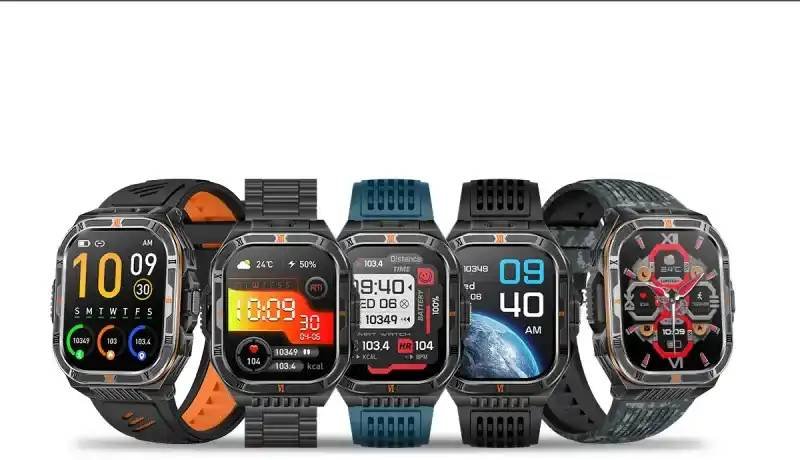
The HT38 outdoor smartwatch is built around the battery-and-charging question: a 1100mAh battery with 20 days of battery life on its spec sheet, charged through a 2-pin magnetic cable that ships in the box. It has a 2.01-inch IPS display (240 x 296) with full touch, an AB5691 chip with BLE 5.3, and an IP68 rating, in a zinc alloy and plastic case (49.5 x 42.3 x 14mm, 70g) on a 22mm silicone strap. It also carries a compass, an LED flashlight, 100+ sport modes, 7 built-in dials, and the FitCloudPro app.
A watch that charges once every three weeks forgives a lot — if the one charge it needs works. Check the cable, the magnet and the charge time on samples, and get the charge time in writing.
Related reading: Smartwatch Sourcing Guide — How to Choose a Smartwatch Supplier in China
Why does my smartwatch not charge on its magnetic charger?
Most budget smartwatches charge through two gold contacts and a magnetic cable with spring-loaded pogo pins, and the contact is easy to break. Dirty contacts are the first check: sweat, skin oil and dust build up on the contacts and pins, and even a thin layer can block power transfer completely. Weak magnets let the cable sit slightly off, so charging slows or stops, and a cable can fail inside while looking fine from the outside. Cheap replacement chargers add another failure, supplying unstable power that makes charging stop and start. A wipe with a dry cloth or a little isopropyl alcohol fixes dirty contacts, but a buyer who paid for a watch does not want to service it.
Can I use any USB charger with a magnetic smartwatch cable?
No — the charger and the cable both matter. Huawei’s support pages recommend a standard 5V/1A charger or better, and warn that a non-standard cable between charger and base is enough to trigger an abnormal-charging error. A ‘2-hour charge’ on a 5V/2A adapter is a different claim from the same words on a 5V/1A adapter or a laptop USB port, so ask the supplier for the charge time with the test conditions: from 0% to 100%, with which charger, at what input voltage and current. Test charging on a phone charger, not a lab supply, and check the plug at the other end — a buyer with only USB-A ports will complain about a USB-C cable.
What charging details should I confirm with the supplier before ordering?
Get the charging interface in writing — 2-pin magnetic, 4-pin magnetic or wireless — with the pin count and spacing, and the full charge time from 0% to 100% with the adapter it was tested on. Ask what input the cable needs, 5V/1A or 5V/2A, and check that a normal phone charger covers it. Confirm the cable ships in the box and what a spare costs, and consider ordering 5% spares with the bulk order, since spares are cheap at order time and hard to source later. Ask whether the watch shows an error when contact is poor, and whether a protective film is left on the charging contacts — one left on the base blocks charging entirely.
If you want samples tested for charging reliability, or help comparing charging systems, talk to us at HnThai.