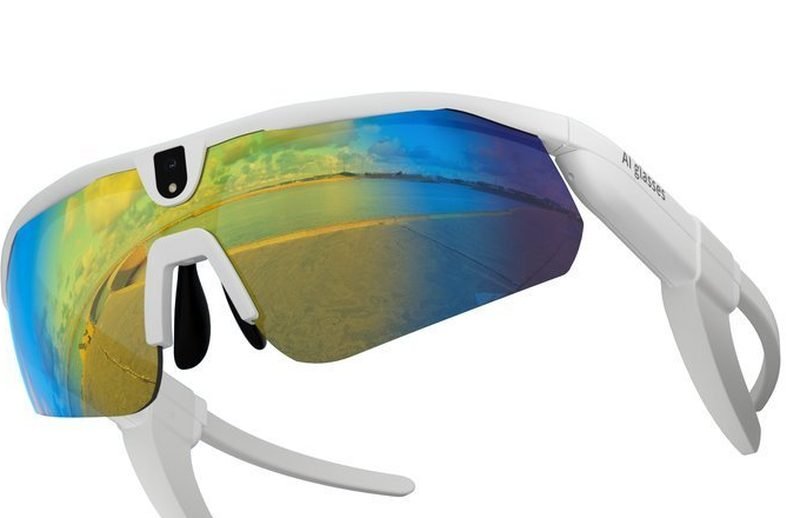
Most wholesale smart glasses have no display. The CY06 is a camera and audio frame: an 8MP camera, open-ear speakers and AI translation, with no image in front of your eye. With a display, waveguide and birdbath are the two optical paths that put the image there, and micro-OLED is the panel that makes the image, not a third rival.
The mix-up to clear up first
Waveguide and birdbath describe how light travels from a tiny screen to your eye. Micro-OLED describes the tiny screen itself — the panel that makes the picture. A listing that says "micro-OLED display" has told you the panel, not the optics: the same micro-OLED panel can sit inside a birdbath frame or feed a waveguide. If the supplier cannot name the optics, you cannot compare that quote against anything.
This mix-up decides the price tier. Across the 98 devices in AR Compare's database, birdbath models average a 48.3-degree field of view at a $374 median in-stock price, while waveguide models average 34.1 degrees at $599. Micro-LED is the brighter, costlier panel waveguide designs lean on; micro-OLED is the mature one birdbath frames use — and a supplier who charges micro-LED prices for a micro-OLED panel is pocketing the difference.
Waveguide: the one that looks like normal glasses
A waveguide pipes light from a tiny projector through a thin, clear lens and out again in front of your eye. The lens stays transparent, so the glasses look like ordinary spectacles and the digital image floats over the real world.
That transparency costs light. Only about 1% to 5% of the projector's light reaches your eye, according to Visible Compute, so the engine has to be very bright — spec sheets quote 1,000-plus nits. The field of view stays narrow too: most consumer waveguide displays land between 20 and 35 degrees. Diffractive waveguides can also show rainbow artifacts at the edges.
The RayNeo X3 Pro shows the trade: a diffractive waveguide with a micro-LED source, lens transparency above 85%, and still only about a 30-degree field of view at $1,299.
Birdbath: the bigger, brighter picture
Birdbath optics mount a micro-OLED display above the lens, pointing down. A curved, half-silvered mirror — the "birdbath" — reflects that light toward your eye and magnifies it into a large virtual image that seems to float metres away.
The picture is the payoff: a bright, high-contrast image, typically 45 to 57 degrees in consumer models, with the perfect blacks micro-OLED is known for.
The cost is the view of the real world. The half-mirror has to block light to work, and AR Compare notes it blocks roughly 70% to 75% of ambient light — so birdbath lenses look dark, like sunglasses. The optics stack is also deeper: the module Hanihani references pushes total frame weight toward 150–200 grams, against 35–50 grams for everyday spectacles. Birdbath fits video and gaming, not street use.
Waveguide vs birdbath vs micro-OLED, side by side
| Waveguide | Birdbath | Micro-OLED (the panel) | |
|---|---|---|---|
| What it is | Light piped through a clear lens | Display reflected off a curved half-mirror | The panel that makes the image |
| Field of view | 20–35° (consumer) | 45–57°; 48.3° average across 32 models | Depends on the optics |
| See-through | Yes — lens stays clear, 85%+ transparency | No — blocks 70–75% of ambient light | Not applicable |
| Brightness | Needs 1,000+ nit engines; 1–5% efficiency | Brighter image from the same panel | High contrast, perfect blacks |
| Price tier | Higher — $599 median | Lower — $374 median | Cheaper than micro-LED |
| Best for | Navigation, captions, work | Video, gaming, a large virtual screen | Birdbath frames |
| Watch out for | Small image, dim in sunlight | Heavy frames, dark lenses | Quoted as if it were the whole system |
The wholesale trap: most cheap frames have no display at all
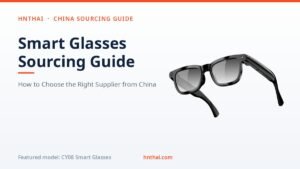
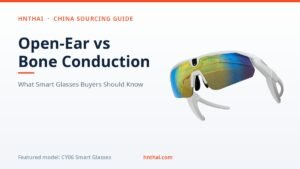
Frames in the $23 to $31 wholesale range are camera and audio glasses. The CY06 is a typical example: an 8MP Sony IMX219 camera, a 1012 large-magnet speaker, a 290mAh battery good for about 9 hours of music at 80% volume, and AI translation in 19 languages. It has no display, and its price — $23.80 to $30.50 on our product page — reflects that.
At audio-glasses prices, a "display" offer is usually a status indicator, a render, or an audio frame relabelled. Real display glasses sit in a different price tier — the birdbath median alone is $374 at retail.
We do carry a display-screen model, the W660, but its display type is not yet confirmed on a spec sheet — get it in writing before you quote it to your own buyer.
Five checks before you order display glasses
- Optics type in writing — waveguide, birdbath or prism. "Display" alone is not a specification.
- Panel type and resolution per eye — micro-OLED or micro-LED, and the pixel count.
- Field of view and brightness as numbers — degrees and nits, tested outdoors, not on a render.
- Weight on the spec sheet — a 150-gram frame returns differently from a 35-gram one; see our battery life guide.
- A video of the display running in daylight — renders alone mean it is not ready to sell.
Featured model: the CY06
The CY06 cycling AI smart glasses show what most wholesale smart glasses actually are today: a sport-shield frame with an 8MP Sony IMX219 camera, a 1012 large-magnet speaker, and a 290mAh battery that plays music for about 9 hours at 80% volume. It translates in 19 languages and charges in 2 hours or less. It has no display — and knowing that is the point. Buy a display frame only after the five checks above are answered in writing.
For the camera side of the category, read our camera glasses guide, which covers the CY08 in detail.
Frequently asked questions
Do cheap wholesale smart glasses have displays?
Most do not. Frames in the $23 to $31 wholesale range, such as the CY06, are camera and audio glasses: they record, translate and play sound, but project no image. Real display glasses use waveguide or birdbath optics and sit in a much higher price tier — birdbath models median $374 at retail in AR Compare's database. If a quote offers a display at audio-glasses prices, ask for the optics type and a video of it running before you pay a deposit.
Which display type works best outdoors?
Birdbath gives the brighter, larger image, so it reads better in shade and overcast light, but its dark lenses block 70% to 75% of ambient light and the frame runs heavy. Waveguide keeps the lens clear and looks like normal glasses, yet its small, dim overlay can wash out in direct sunlight because only 1% to 5% of the projector's light reaches your eye. For cycling, most buyers still choose audio and camera frames like the CY06 and skip the display.
What should I ask a supplier who offers "display smart glasses"?
Ask for five things in writing: the optics type (waveguide, birdbath or prism), the panel type (micro-OLED or micro-LED) with resolution per eye, the field of view in degrees, the brightness in nits, and the frame weight — plus a video of the display running in daylight, not a render. A supplier who answers with "micro-OLED display" and stops there has only named the panel, and the quote cannot be compared with any other.
Talk to HnThai about your smart glasses order
HnThai is a sourcing partner based in Huaqiangbei, Shenzhen. We check optics type, panel, field of view and weight before we quote, and we tell you plainly when a frame has no display. See the full range on our smart glasses page or contact us.