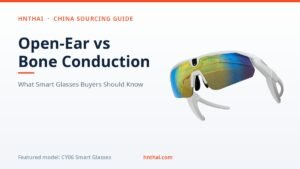
The CY06 plays sound through a 1012 large-magnet open-ear speaker: a small driver in the temple fires sound through the air toward your ear, leaving the ear canal open. Bone conduction works differently — a transducer presses against the skull and vibrates, so sound reaches the inner ear through bone. Open-ear sounds fuller; bone conduction keeps the ear fully clear.
How open-ear speakers work
Open-ear audio is the standard setup on wholesale smart glasses, and the CY06 is a typical example. A small driver sits in each temple and fires sound down and back toward the ear canal. Nothing touches or seals the ear, so the music mixes with the room around you instead of replacing it. The CY06's driver is a 1012 large-magnet speaker, 6 ohms, rated 0.05W, driven by a JL7018F chip with ENC noise reduction and dual-microphone noise cancellation. Its 290mAh battery plays music for about 9 hours at 80% volume.
That open design is the point for cyclists, runners and drivers: the wearer hears traffic while the call keeps playing. It is also the limit: low notes need a sealed ear to sound full, and no open-ear speaker gets that seal, so bass stays light. On a loud train the wearer turns the volume up — and that is when the sound reaches the people nearby. One field test on the London Underground, where ambient noise spikes hit 92 dB, found most smart glasses functionally silent: the roar erased the mid-range of the audio. Open-ear audio suits speech, calls and directions — not sealed earbuds, when bass or silence matters.
How bone conduction works
Bone conduction skips the air entirely. A flat transducer pad rests against the bone near the temple and vibrates; those vibrations travel through the skull to the inner ear, so the wearer hears sound with the ear opening completely clear.
The trade is in the sound itself. Vibration through bone carries mid and high tones better than low ones, so bass is thinner, and pushing the volume makes the vibration more noticeable — a tickle or buzz on the skin. Bone conduction can be a little easier to hear in wind, since its signal does not travel through the air — but the wearer still hears the roar.
Fit matters more here: the transducer must stay pressed against the head, so the frame needs a firm grip. Some wearers never notice it; others find the pressure annoying. Test it on a sample, not from a spec sheet.
The trap: "bone conduction" that is not bone conduction at all
This is the part that costs importers money. "Bone conduction" has become a selling phrase, and many low-cost frames that advertise it use a small directional air speaker hidden in the temple instead. It can sound convincing indoors, but outside the clarity drops and the audio leaks. No vibration passes through bone, so it is open-air playback under a different name.
Sonovo's test: cover your ears while the glasses play. If the sound stays about the same, vibration is carrying it — real bone conduction. If it almost vanishes, it is an air speaker. Second check: real bone conduction vibrates. If a pair sounds as rich as in-ear headphones and you feel no vibration, it is not bone conduction.
The wording trap runs the other way too: on the OXIVUE M14, the bone-conduction part is a microphone, not a speaker — check which part the listing means.
Open-ear vs bone conduction, side by side
| Open-ear speakers (CY06) | Bone conduction | |
|---|---|---|
| How sound reaches you | Air into the ear canal | Vibration through the skull |
| Ear canal | Open, speaker above it | Fully clear |
| Bass and music | Fuller than bone conduction | Thinner; buzzes at higher volume |
| Sound leak | Some at high volume | Some at high volume |
| Wind | Wind masks quiet audio | Signal survives wind better |
| Fit | No grip needed | Transducer must press on the head |
| Price tier | Standard wholesale — CY06 $23.80–$30.50 | Usually higher; verify the transducer |
| Best for | Calls, podcasts, cycling | Buyers who want the ear clear |
Neither type is private at high volume, and bass is the weak point of both — podcasts and navigation suit open-ear audio best.
What to test on the sample
- The ear-cover test. Block your ears while the glasses play: sound that stays is bone conduction; sound that vanishes is an air speaker.
- Leak at arm's length. Play a call at normal volume in a quiet room, stand a metre away, then turn it up to beat street noise — leakage grows with volume.
- Wind. Take the sample outside on a bike. The CY06 is a cycling shield frame — test it at speed, with the wind across the temples.
- Controls on the frame. Volume, pause and a slide or physical control beat touch-only. Test the CY06's slide touch while wearing the glasses, not on the desk.
- Calls with background noise. Make a call from a busy street and ask the other end what they hear — the CY06 answers with ENC dual-microphone noise reduction.
- Battery as the buyer will use it. Music hours are not talk hours: the CY06 states about 9 hours of music at 80% volume — ask for talk time too. See our battery life guide.
Featured model: the CY06
The CY06 cycling AI smart glasses show the setup most wholesale buyers actually stock: a 1012 large-magnet speaker with ENC noise reduction, dual-microphone noise cancellation, an 8MP Sony IMX219 camera, and a 290mAh battery that plays music for about 9 hours at 80% volume. The sport-shield frame is matte PC+ABS, the controls are slide touch, and the app translates in 19 languages. It charges in 2 hours or less. If your buyer asks for bone conduction, test the sample with the ear-cover test — and get the transducer type in writing first.

For the display side of the category, read our display guide, which explains waveguide, birdbath and micro-OLED. For the camera side, see our camera glasses guide.
Frequently asked questions
Which is better for cycling, open-ear or bone conduction?
Open-ear is the usual pick for cycling, and the CY06 is built for it: a sport-shield frame and an open-ear speaker that leaves traffic audible. Bone conduction can be a little easier to hear in wind because its signal does not travel through the air, but it needs the transducer pressed against your head. Test the sample at cycling speed, not on a desk — wind roar masks quiet audio on both types, and neither one replaces sealed earbuds for bass-heavy music.
Can people nearby hear smart glasses audio?
Yes, at high volume. Neither open-ear speakers nor bone conduction seal the ear, so both leak some sound when turned up — the person next to you may hear it. At a normal volume in an ordinary space, they hear little. Keep calls and podcasts at a modest volume in shared spaces, and treat audio glasses as a headset that keeps you present rather than a private one. Zero leakage is not something the physics allows.
How do I check a supplier's "bone conduction" claim?
Run the ear-cover test: block your ears while the glasses play. If the sound stays about the same, vibration is carrying it and the claim holds; if it almost vanishes, the frame uses an air speaker. Then ask for a photo of the transducer pad — real bone conduction has a flat pad that rests against the bone, not a speaker grille near the ear. Also check whether "bone conduction" means the speaker or the microphone: the OXIVUE M14 uses it only for the microphone. Get the answer in writing before you order.
Talk to HnThai about your smart glasses order
HnThai is a sourcing partner based in Huaqiangbei, Shenzhen. We test leakage, wind performance, controls and call quality on the sample, and we put the speaker type in writing in your quotation — open-ear or bone conduction, with the test to prove it. See the full range on our smart glasses page or contact us.