Sourcing smart glasses from China means matching the frame type to your buyer. Camera-and-audio frames like the CY08 — 8MP camera, 290mAh battery, about 9 hours of music — cover most orders; display frames cost far more and weigh far more, and battery life is measured in hours, not days. Use the checks below before you order.
Before You Read: This guide is written for importers, distributors, and e-commerce sellers who buy smart glasses in bulk from China. It covers how to read a spec sheet, which claims to test on samples, and how to match models to your buyers. If you already know which models you want, skip to the model list near the end. For the watch side of the category, see our Smartwatch Sourcing Guide.
What Smart Glasses Sourcing from China Involves
Smart glasses are having their biggest year yet. Grand View Research values the global market at USD 2.5 billion in 2025 and USD 3.2 billion in 2026, heading for USD 14.4 billion by 2033 at a 24.2% compound annual growth rate. Shipments are set to roughly triple in 2026, from around 6 million units in 2025 to around 20 million, according to forecasts cited by Counterpoint Research. The product driving that growth is not the one in the headlines: display-less glasses — a camera, microphones and a voice assistant, with no screen in the lens — took 96% of first-half 2026 volume, up 260% year over year.
That split is the first thing a buyer should understand. Most wholesale smart glasses are camera-and-audio frames. They record photos and video, play music through open-ear speakers, take calls, and run AI translation through a phone app. A smaller group adds a display that projects an image in front of your eye. The two groups sit in different price tiers, weigh different amounts, and sell to different buyers — and a quote that mixes them up is the most common way an order goes wrong.
Sourcing from China means buying from the factories and trading suppliers in Shenzhen that build these frames, usually through a sourcing partner who checks the sample, reads the spec sheet line by line, and puts the numbers in writing in the quotation. The checks in this guide are the same ones we run before we quote a model: battery under real use, weight on a scale, audio leakage at arm’s length, camera clip length, app pairing, and lens behaviour. A supplier who answers those checks in writing is a supplier you can plan around.
Four Types of Smart Glasses, and Who Buys Each
| Type | What it does | Who buys it | Example model | Price tier |
|---|---|---|---|---|
| Audio-only | Music, calls, voice assistant, no camera | Gift buyers, promo orders, first-time sellers | Entry audio frames | Lowest |
| Camera + audio | 8MP photo and video, open-ear speakers, AI features | Distributors, e-commerce sellers, sports channels | CY08, CY06, MT9 | USD 23–31 wholesale |
| Display (waveguide / birdbath) | Projects an image in front of the eye | Enterprise, early adopters, premium retail | RayNeo X3 Pro class | USD 374–599 median retail |
| AI translation focus | Real-time translation, dialogue interpretation | Travel retail, language schools, tour operators | MT9 (130+ languages) | Mid, varies by camera spec |
The audio-only frame is the simplest product in the category and the hardest to sell at a margin, because there is little to tell apart from one listing to the next. The camera-and-audio frame is where most wholesale volume sits: the camera gives the listing a story, the speakers give it a use case, and the price stays in reach of an impulse buy. Display frames are a different business — heavier, dearer, and sold on the screen, not the frame. Translation-led models cut across the types: the same camera frame can be sold to a travel buyer on its language list and to a sports buyer on its camera.
Ask your supplier which type a quote is before you compare prices. A USD 25 camera frame and a USD 400 display frame are not two prices for the same product, and a listing that calls a camera frame “AR glasses” will bring returns from buyers who expected a screen.
Why Smart Glasses Get Returned: Five Pain Points Buyers Meet First
Battery life is measured in hours, not days. A slim frame cannot hold a big battery, and a camera, a wireless chip and a microphone array all draw power at once. White-label frames shown at IFA 2025 ran their cells down in just a few hours of multimedia use, according to BGR’s José Adorno. Snap’s 2026 Specs manage about four hours on a full charge. Simpler audio designs last longer: Meta’s Ray-Ban Meta Audio runs for up to 12 hours on assistant tasks. The trap for importers is that spec sheets quote music playback time — nine hours, ten hours — because audio sips power. Video recording is a different load, and the slim frame cannot shed the heat. Read the sheet the way a buyer will use the glasses, and ask for the recording minutes, not just the music hours. Our battery life guide works through the numbers model by model.
Weight decides whether the glasses get worn. Everyday spectacles weigh between 35 and 50 grams, and any added bulk presses on the nose bridge and behind the ears. A frame that weighs 42 grams gets worn all day; a frame that pushes past 75 grams gets taken off by lunch. The RayNeo X3 Pro measured about 76 grams in reviews, and birdbath display frames push toward 150 to 200 grams. Weight is the complaint that shows up in reviews after the battery complaint, and it is the easiest to check: put the sample on a scale before you order, and print the real weight on your listing.
Audio leaks, and the wearer cannot hear it over street noise. Smart glasses play sound through open-ear speakers, so the audio reaches people nearby as well as the wearer. Amazon reviews of the Razer Anzu are blunt on this: fine for a quiet office, useless for a podcast in ambient noise. The same review notes the glasses offer no volume control on the device at all, and the touch controls skipped through songs with the wrong touch. Check three things on the sample: volume and pause controls on the frame, sound leakage at arm’s length, and call quality with background noise.
The camera raises questions the buyer will ask you. A camera on a pair of glasses is not easily noticeable, and people nearby cannot tell when a photo or clip is being taken. One owner on Hacker News says they feel compelled to remove the glasses whenever they interact with people. Ask the supplier: is there a visible recording indicator? What is the longest single video clip? And where does the AI processing happen — on the device, or in the cloud? The MT9 answers the first question with an LED that flashes once for a photo and stays solid during video recording. The HD5 Ultra and the X01 both cap one recording at 12 minutes.
The app is half the product. Translation, photo transfer and AI features all run through the phone and the companion app, so the app’s language support and phone versions decide whether the glasses work for your market. The MT9 app speaks 40 languages and its AI assistant covers 145; the CY08 app speaks 19. Test pairing on the phones your buyers actually use — Android 5.0 or later and iOS 10.0 or later for the MT9 — and test it twice, because a pairing that works once and fails on the second try is a return waiting to happen.
Displays: Waveguide vs Birdbath vs Micro-OLED
Most wholesale smart glasses have no display at all, and the first display question is which kind you are being offered. Waveguide and birdbath describe how light travels from a tiny screen to your eye. Micro-OLED describes the tiny screen itself — the panel that makes the picture. A listing that says “micro-OLED display” has told you the panel, not the optics: the same micro-OLED panel can sit inside a birdbath frame or feed a waveguide. If the supplier cannot name the optics, you cannot compare that quote against anything.
| Waveguide | Birdbath | Micro-OLED (the panel) | |
|---|---|---|---|
| What it is | Light piped through a clear lens | Display reflected off a curved half-mirror | The panel that makes the image |
| Field of view | 20–35° (consumer) | 45–57°; 48.3° average | Depends on the optics |
| See-through | Yes — lens stays clear, 85%+ transparency | No — blocks 70–75% of ambient light | Not applicable |
| Brightness | Needs 1,000+ nit engines; 1–5% efficiency | Brighter image from the same panel | High contrast, perfect blacks |
| Price tier | Higher — $599 median | Lower — $374 median | Cheaper than micro-LED |
| Best for | Navigation, captions, work | Video, gaming, a large virtual screen | Birdbath frames |
Waveguide pipes light from a tiny projector through a thin, clear lens, so the glasses look like ordinary spectacles and the digital image floats over the real world. That transparency costs light: only about 1% to 5% of the projector’s light reaches your eye, according to Visible Compute, so the engine has to be very bright. The field of view stays narrow — most consumer waveguide displays land between 20 and 35 degrees — and diffractive waveguides can show rainbow artifacts at the edges. The RayNeo X3 Pro shows the trade: a diffractive waveguide with a micro-LED source, lens transparency above 85%, and still only about a 30-degree field of view at $1,299.
Birdbath mounts a micro-OLED display above the lens, pointing down, and a curved half-silvered mirror reflects that light toward your eye into a large virtual image. The picture is the payoff: a bright, high-contrast image, typically 45 to 57 degrees, with the perfect blacks micro-OLED is known for. The cost is the view of the real world — the half-mirror blocks roughly 70% to 75% of ambient light — and the optics stack is deeper, pushing total frame weight toward 150 to 200 grams.
The wholesale trap is the price gap. Frames in the USD 23 to 31 wholesale range are camera and audio glasses. At audio-glasses prices, a “display” offer is usually a status indicator, a render, or an audio frame relabelled. Real display glasses sit in a different price tier — the birdbath median alone is USD 374 at retail across the 98 devices in AR Compare’s database. We do carry a display-screen model, the W660, but its display type is not yet confirmed on a spec sheet — get it in writing before you quote it to your own buyer. Our display guide works through the five checks for display frames in full.
Audio: Open-Ear Speakers vs Bone Conduction
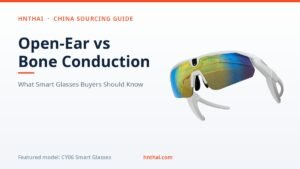
Smart glasses have to put sound in your ear without covering it, and there are two ways to do it. Open-ear speakers sit in the temple arms and play sound toward the ear canal — the CY06 uses a 1012 large-magnet speaker, the CY08 a 1509 speaker at 0.5W, and the MT9 dual 1210 high-magnetic speakers in stereo. Bone conduction vibrates sound through the cheekbone and leaves the ear canal fully open. Both keep the wearer aware of traffic and conversation, which is the point for cycling and walking — and both leak sound to people nearby, which is the complaint to test for.
The choice matters less than the controls. A frame with physical buttons or a slide-to-adjust volume beats touch-only, because a touch panel on a temple arm misreads every time the wearer adjusts the fit. The HD5 Ultra answers with metal physical buttons and ENC dual-microphone noise reduction; the X01 with slide-to-adjust volume, wear detection auto-pause, and dual silicon-mic noise cancellation. Test the sample the way a buyer will: volume up and down while walking, pause with one hand, and a call with street noise behind you. Our audio guide compares the two designs in detail.
Camera: What to Check Before You Order
The camera is the feature buyers test first and the one most likely to disappoint them, because a small sensor in a temple arm cannot match a phone. The CY08 and the CY06 both carry an 8MP Sony IMX219 sensor; the MT9 carries an 8MP camera at 4032×3016; the HD5 Ultra an 8MP camera at 3280×2464 with anti-shake photo and video. Those numbers describe the sensor, not the picture — ask for sample photos shot outdoors in daylight, and look at them full-size before you approve the listing images.
Four checks decide whether the camera sells or returns. First, the longest single video clip: the HD5 Ultra and the X01 both cap one recording at 12 minutes, and a cap that short needs to be on the listing, not discovered by the buyer. Second, the recording indicator: the MT9 LED flashes once for a photo and stays solid during video, which is the minimum a buyer in a privacy-sensitive market will accept. Third, how files leave the glasses: the CY08, CY06 and MT9 all move photos and video over 2.4G Wi-Fi to the phone app, so test the transfer speed on a full clip, not a single photo. Fourth, low light: a temple-arm sensor with no flash will smear in a dim room, so do not let the listing promise night shots it cannot deliver. Our camera glasses guide covers the CY08 in detail, including the tint test below.
Battery Life: Frame Battery vs Charging Case
The battery question has two numbers, not one: the frame battery and the charging case. The case is the battery that matters for a full day out, because the frame alone lasts hours.
| Model | Frame battery | Charging case | Music | Full charge | Weight |
|---|---|---|---|---|---|
| HD5 Ultra | 300mAh | 2000mAh | About 11 hours | 40 min via case | 35g |
| X01 | 220mAh | 3600mAh (~15 full charges) | 6–7 hours | 1.0 hour | — |
| CY08 | 290mAh | None stated | About 9 hours at 80% volume | 2 hours or less | — |
| CY06 | 290mAh | None stated | About 9 hours at 80% volume | 2 hours or less | — |
| MT9 | 265mAh | Case charging, 200g case | Not stated | 3 hours via case | 42g |
Two things to read off this table. First, the case is the battery: the X01’s 3600mAh case holds about 15 full charges for its 220mAh frame, and it reverse-charges phones. Second, the CY08 and CY06 state no continuous video recording time at all — that gap is normal, and it is the number to ask for in writing before you quote it. The MT9 states no music time either; its 265mAh frame battery and 3-hour case charge are the numbers the sheet gives, and the rest needs a sample test. Charging method matters as much as capacity: a case beats a cable per arm — the Razer Anzu review above reports a magnetic connection that drops the charge if it gets nudged — and the X01’s case charges in about 2 hours and doubles as a phone power bank.
Warranty is part of the battery story. RayNeo’s 12-month warranty covers free repair for quality issues but excludes physical damage, liquid exposure and normal wear — and for eyewear worn daily, a drop is the most common damage. Ask what your model’s warranty covers before you promise anything to your buyer.
Lenses: Electrochromic, Prescription and Photochromic
Lenses are where smart glasses meet the eyewear trade, and where a buyer who wears glasses every day will judge your product. Three options come up in quotes, and they are not the same thing. Electrochromic lenses change tint electronically — the CY08’s four-level lenses shift from clear to dark on demand, so one pair covers indoor use and bright sun. Photochromic lenses change tint with UV light and need no battery, but they change slowly and do not go fully clear indoors. Prescription inserts are clip-in or custom lenses that carry the wearer’s prescription behind the smart frame.
Test the CY08’s tint the way a buyer will: switch through all four levels, check each level is visibly different, check the tint changes without the app, and check the clearest state indoors — a “clear” lens that still looks grey will annoy anyone who wears the glasses all day. Ask what happens if the battery dies: a pair stuck dark indoors is a complaint. For prescription buyers, ask whether the frame takes standard inserts, what the insert size range is, and whether the insert changes the weight — the MT9 frame measures 133mm hinge to hinge with a 51mm lens width and a 22mm bridge, so an optician can judge fit from those numbers alone.
Weight and Comfort: Why Grams Decide Your Return Rate
| Frame | Weight | What it means for the buyer |
|---|---|---|
| Everyday spectacles | 35–50g | The comfort baseline buyers compare against |
| HD5 Ultra | 35g | Inside the everyday range |
| MT9 | 42g with lens | Inside the everyday range |
| RayNeo X3 Pro | About 76g | Noticeable after an hour, per reviews |
| Birdbath display frames | 150–200g | A different product — sold on the screen, not the fit |
Weight is the cheapest check in this guide and the one most often skipped: put the sample on a kitchen scale, write the number down, and compare it with the sheet. A frame that matches its sheet weight is a supplier who measures; a frame that weighs 20 grams more than the sheet claims is a supplier who guesses. Fit matters as much as weight: the MT9 temple length is 153mm, and a temple that is too short slides forward on a larger head. Ask for the frame dimensions — hinge to hinge, lens width, bridge width, temple length — and print them on the listing so buyers with wide faces can rule themselves in or out before they order.
AI and Translation: What the AI Actually Does
AI is the word most often stretched in smart glasses quotes, so pin it down to functions. The MT9 runs an AI voice assistant, AI question-and-answer, AI photo capture, AI image recognition, and AI audio recording with transcription and translation, through the Doubao engine, with real-time bidirectional dialogue translation across more than 130 languages and regional dialects. The CY08 covers voice commands, real-time translation, call translation and photo translation across 19 languages, with access to a ChatGPT-class model. The HD5 Ultra translates in 26 languages with voice wake-up through the AIbuds app.
Three questions cut through the AI wording. First, how many languages does the translation actually cover, and does it cover your buyer’s language pair — the MT9 lists 145 languages for its AI assistant and 40 app languages, while the CY08 lists 19 app languages, and those are different counts. Second, where does the processing happen: on the device, or in the cloud? A translation that needs a server needs a connection, and a buyer on a flight or in a dead zone will find out the hard way. Third, does the AI keep working when the app updates — the MT9 supports OTA upgrades, which is the answer you want, because an AI feature that breaks on the next app version is a return. Test translation live on the sample with your buyer’s language pair, not with the demo pair on the supplier’s video.
Choosing by Buyer Type: Importer, Distributor, E-Commerce Seller
| Buyer type | Best first order | What to prioritise | What to avoid |
|---|---|---|---|
| Importer | Camera + audio frame (CY08, CY06) | Spec sheet in writing, carton quantity (50 pcs/box for CY08), warranty terms | Display frames before you have a premium channel |
| Distributor | Two models: one camera frame, one translation frame (MT9) | Two price points, spare parts and case supply, app language coverage | A single model that has to serve every customer |
| E-commerce seller | One hero model with a clear story (MT9 for translation, CY08 for tint) | Real sample photos, clip-length and weight on the listing, fast sample turnaround | Copying supplier renders and spec claims into your listing |
Importers buy on paperwork: the spec sheet, the carton quantity, the warranty, and the price at volume. Get the camera clip length, the recording time and the lens behaviour in writing before the deposit, because those are the numbers your buyer will test. Distributors buy on range: two models at two price points sell better than one model that has to serve every customer, and a translation-led model next to a camera-led model covers two different buyers with one order. E-commerce sellers buy on the listing: real sample photos, the true weight, and the clip length printed honestly will outsell a supplier render with a bigger claim. See the full range on our smart glasses page.
Questions to Ask a Supplier Before You Order
- Which type is this frame — audio-only, camera and audio, or display? Get the optics type in writing for display frames: waveguide, birdbath or prism.
- What is the continuous video recording time, in minutes? Music hours are not recording minutes.
- How long is one video clip, and is there a recording indicator? The HD5 Ultra and X01 cap one clip at 12 minutes.
- What is the frame battery and the case capacity, as separate numbers? And how long does a full charge take?
- What does the frame weigh, in grams, and what are the frame dimensions? Check both on the sample.
- Which languages does the AI translation cover, and does it need a connection? Test your buyer’s language pair live.
- What happens to the lenses when the battery dies? For electrochromic frames, get the answer in writing.
- What does the warranty cover, and what does it exclude? Drops and liquid are the common damage for eyewear.
- What is the MOQ, the lead time, and what is in the carton? The CY08 ships 50 pieces per carton; MOQ and lead time vary by model and order size, so confirm them in the quotation.
A supplier who answers all nine in writing, with numbers that match the sample, is a supplier you can build a listing on. A supplier who answers with “micro-OLED display” and stops there has only named the panel, and the quote cannot be compared with any other.
Featured Model: The CY08
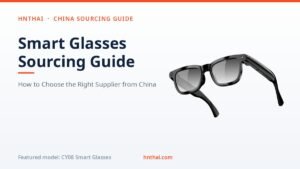
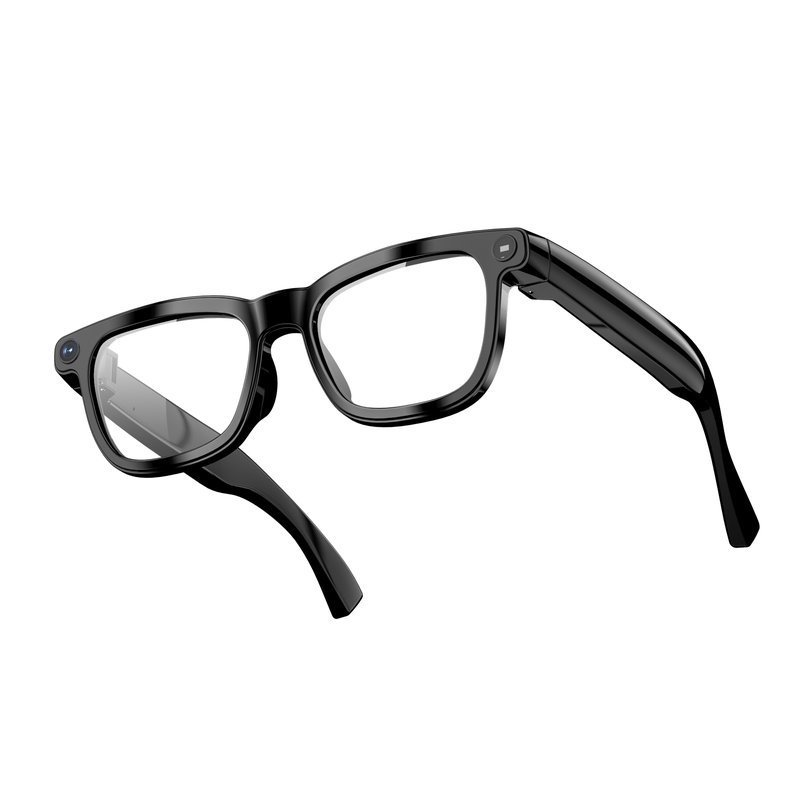
The CY08 electrochromic AI smart glasses show what the category offers when the pieces fit: an 8MP Sony IMX219 camera for photos, video and audio recording, four-level electrochromic lenses that shift from clear to dark, and a JL7018 main chip with stereo speakers and dual-microphone noise cancellation. Files move off the glasses over 2.4G Wi-Fi; the battery is 290mAh, charges in 2 hours or less on a 5V/0.22A input, and plays music for about 9 hours at 80% volume. The frame is PC+ABS, Bluetooth reaches 10 metres or more, the app speaks 19 languages, and the AI side covers voice commands, real-time translation, call translation and photo translation. It ships 50 pieces per carton.
For the camera side of the category, read our camera glasses guide. For the battery numbers behind the table above, read our battery life guide.
Frequently Asked Questions
What type of smart glasses sells best for wholesale?
Camera-and-audio frames sell best for wholesale right now. Display-less glasses took 96% of smart glasses volume in the first half of 2026, according to Counterpoint Research, and shipments are set to roughly triple in 2026. A camera frame like the CY08 gives a listing a clear story — photos, video, translation, music — at a wholesale price in the USD 23 to 31 range, while display frames sit at a USD 374 to 599 median retail price and sell through premium and enterprise channels. Start with the camera frame, and add a display model only when you have a buyer who asks for the screen.
How long do smart glasses last on a charge?
Hours, not days. The HD5 Ultra plays music for about 11 hours from its 300mAh frame battery and 2000mAh case; the CY08 and CY06 play about 9 hours of music at 80% volume from a 290mAh battery; the MT9 charges in 3 hours through its case. Recording drains the battery far faster than music: white-label frames shown at IFA 2025 ran down in a few hours of multimedia use, and Snap’s 2026 Specs manage about four hours. Ask the supplier for the continuous video recording time in writing, because the sheet usually quotes music hours only.
Do I need a display in my smart glasses?
Most buyers do not. A display adds a screen in front of the eye for navigation, captions or video, but it also adds weight and cost: waveguide frames average a 20 to 35-degree field of view with a USD 599 median retail price, and birdbath frames push toward 150 to 200 grams while blocking 70% to 75% of ambient light. If your buyers want photos, translation and music, a camera frame like the CY08 does the job at a fraction of the price. Buy a display frame only when your channel asks for the screen by name.
What should I check on a smart glasses sample?
Check six things: the weight on a scale, the music hours against the recording minutes, the longest single video clip, the recording indicator, the audio leakage at arm’s length, and the app pairing on your buyer’s phones. Switch the CY08’s tint through all four levels and check the clearest state indoors. Test translation live with your buyer’s language pair, not the demo pair on the supplier’s video. A sample that passes all six is a model you can put your name on; a sample that fails the weight or the pairing test will come back.
Can smart glasses translate languages in real time?
Yes, within limits. The MT9 translates across more than 130 languages with real-time bidirectional dialogue translation, and its AI assistant covers 145 languages; the CY08 translates in real time across 19 languages, including call translation and photo translation; the HD5 Ultra covers 26 languages. The limits matter: translation needs the phone app, and some functions need a connection, so test the pair your buyer actually speaks, and ask whether the processing happens on the device or in the cloud. A translation feature that only works in the demo language is not a feature.
What is the MOQ and lead time for smart glasses from China?
It varies by model and order size, so confirm it in the quotation. The CY08 ships 50 pieces per carton, which is a useful scale for a first order: one carton is a test batch, not a warehouse. Lead time depends on whether the model is in stock, whether you need a custom logo or lens, and how many cartons you order — a stock frame with your logo ships far faster than a new lens colour. Get the MOQ, the lead time and the warranty terms in writing before you pay a deposit, and do not accept a quote that leaves them open.
Talk to HnThai About Your Smart Glasses Order
HnThai is a sourcing partner based in Huaqiangbei, Shenzhen. We test battery life, weight, audio leakage, recording time and translation on the sample, and we put the numbers in writing in your quotation. See the full range on our smart glasses page, browse all products on our products page, or contact us with the models and quantities you have in mind — we reply within 24 hours with a quotation.