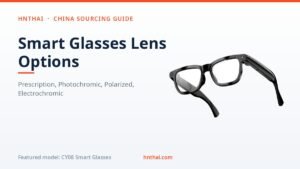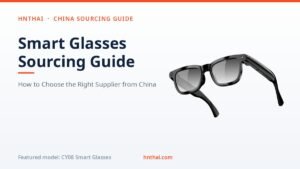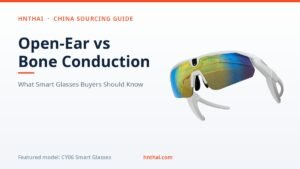
Smart glasses lenses come in four options, and the choice decides who can wear the frame: clear or blue-light lenses for indoor use, photochromic lenses that darken in sunlight, polarized lenses that cut glare, and electrochromic lenses that switch tint on demand. The CY08 switches through four tint levels electronically, and its 290mAh battery plays music for about 9 hours.
The Four Lens Options in One View
| Lens | How it works | Best for | Watch out for |
|---|---|---|---|
| Clear / blue-light | Fixed clear lens; blue-light coating filters about 20% | Indoor wear, screen-heavy work | No sun protection |
| Photochromic | Darkens with UV light, clears indoors; no battery | One pair for indoors and outdoors | About 30 seconds to fully darken |
| Polarized | Blocks reflected glare off water, snow and roads | Beach, boat, snow, bright days | Can blank phone and dashboard screens |
| Electrochromic | Four tint levels, switched on demand | Sunglasses and clear glasses in one frame | Needs battery; check the dead-battery state |
The lens decides whether a buyer who wears glasses can use the product at all. Ask which lens a quote includes before you compare prices. If you are still choosing the frame type, start with our Smart Glasses Sourcing Guide.
Prescription Lenses: Who Can Wear the Frame
Most buyers who wear glasses ask this first: a frame that cannot take a prescription rules out a large share of them. The process is simple — buy the smart frame, then an optical lab or optician cuts the lenses and fits them. Single vision, progressive, bifocal, blue-light and polarized lenses can all be cut for a prescription-compatible frame, according to Lucyd's prescription guide.
Check the frame dimensions first: the MT9 measures 133mm hinge to hinge, with a 51mm lens width, a 22mm bridge and 153mm temples. Progressive lenses need enough lens depth, so a shallow frame may take single vision only.
Budget for the lens on top of the frame: single vision runs USD 50–150 and progressives USD 150–350, on top of a frame from USD 99. One hands-on review found a −3.5 prescription added USD 180 to a pair of Ray-Ban Meta glasses. Camera glasses are restricted in some places, so confirm local rules before ordering a camera model for an optical channel.
Photochromic Lenses: Clear Indoors, Dark Outdoors
Photochromic lenses darken with UV light and clear again indoors, with no battery and no button — the simplest answer to the one-pair question. Lucyd sells its Shift lens on that point: clear indoors, dark outdoors, so prescription glasses double as sunglasses.
The trade is speed: a hands-on review of the GetD 2026 AI glasses found the lenses "take about 30 seconds to fully darken, which is standard for this technology." Thirty seconds is fine for walking out of a shop; it is not instant. The same review notes an optometrist fitted standard prescription lenses in 3 days. On the sample, time the darkening and check the tint is even across both lenses.
Polarized Lenses: Glare Control with a Trade-Off
Polarized lenses cut glare off water, snow and roads, so colours look deeper and eyes relax on bright days. Lucyd calls its polarized sunglasses its most protective lens, with UV400 protection plus the polarized layer, for beach, boat, snow and bright days. For outdoor and winter-sports channels, polarized is the lens that gives the listing its story.
The trade is screens: nonpolarized lenses keep phone, GPS and dashboard screens readable. A polarized lens can darken an LCD screen at some angles, and a driver who cannot read the dashboard will blame the glasses. Stock the nonpolarized version for drivers, or offer both.
Electrochromic Lenses: Tint on Demand
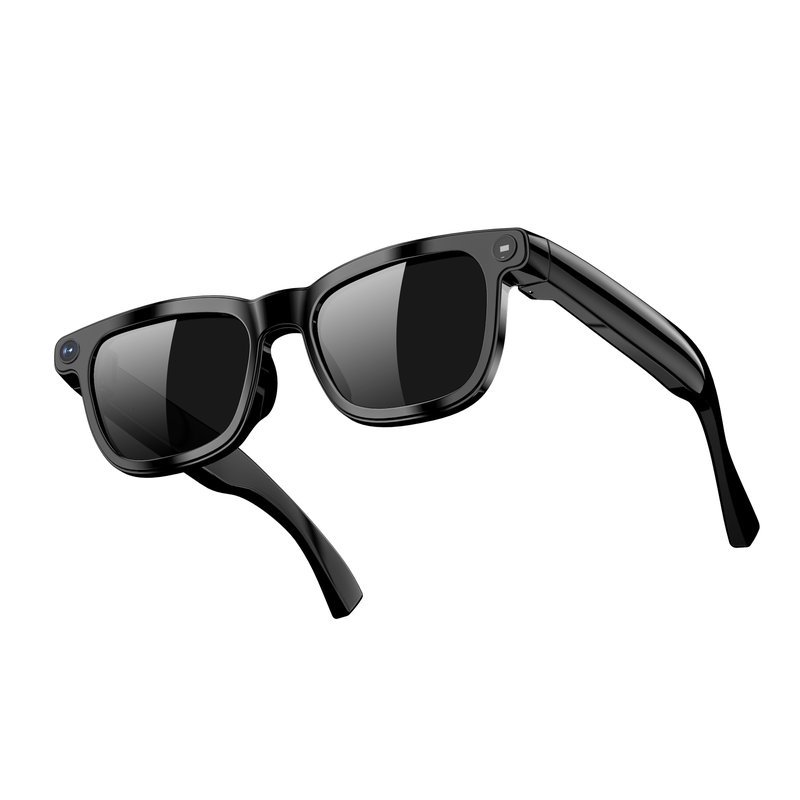
Electrochromic lenses change tint electronically, on demand, instead of waiting for sunlight. The CY08 electrochromic AI smart glasses switch through four tint levels, from clear to dark, and its 290mAh battery plays music for about 9 hours.
Four levels should mean four visibly different states. Test the sample: switch through all four levels, check the tint changes without the app, and check the clearest state indoors — a "clear" lens that still looks grey will annoy anyone who wears the glasses all day. Then ask what happens when the battery dies: a pair stuck dark indoors is a complaint, so get the answer in writing. The battery numbers are in our battery life guide.
Choosing Lenses by Buyer Type
Optical chains start with prescription-ready frames; outdoor distributors with polarized; travel retail with photochromic; e-commerce sellers with the electrochromic CY08. Order more than one variant if you serve more than one of these buyers.
Featured Model: The CY08
The CY08 shows what the category offers when the lens is part of the design: four-level electrochromic lenses, an 8MP Sony IMX219 camera, and a JL7018 chip with dual-microphone noise cancellation. The battery is 290mAh, charges in 2 hours or less, and plays music for about 9 hours at 80% volume. The app speaks 19 languages, and the AI side covers voice commands, translation, call translation and photo translation. It ships 50 pieces per carton.
For the AI features in the same frame, read our AI smart glasses guide. For the camera side of the category, read our camera glasses guide.
Frequently Asked Questions
Can smart glasses take prescription lenses?
Yes, when the frame is prescription-compatible. You buy the smart frame, then an optical lab or optician cuts single-vision, progressive or bifocal lenses and fits them to the frame — the same process as ordinary glasses. Check the frame dimensions first: the MT9 measures 133mm hinge to hinge with a 51mm lens width, a 22mm bridge and a 153mm temple. Budget for the lens on top of the frame: single vision runs about USD 50–150 and progressives about USD 150–350.
Photochromic or electrochromic — which is better for outdoor use?
It depends on how fast the buyer needs the tint. Photochromic lenses darken with UV light and need no battery, but they take about 30 seconds to fully darken. Electrochromic lenses switch on demand — the CY08 moves through four tint levels at the touch of a control — so the buyer gets dark lenses the moment they step outside. The cost is battery power: the tint needs the frame charged, so ask what happens when the battery dies.
Do polarized lenses work for drivers?
They work for glare, but they can fight the dashboard. Polarized lenses cut reflected glare off wet roads, but they can darken or blank phone, GPS and dashboard screens at some angles. Lucyd's lens guide puts it plainly: nonpolarized lenses keep screens readable, which is better for driving with screens. If your buyer drives and reads screens all day, stock the nonpolarized version or offer both. For beach, boat and snow channels, where glare is the problem and screens are not, polarized is the right call.
Talk to HnThai About Your Smart Glasses Order
HnThai is a sourcing partner based in Huaqiangbei, Shenzhen. We check the lens option, the prescription fit and the tint on the sample, and we put the numbers in writing in your quotation. See the full range on our smart glasses page, browse all products on our products page, or contact us — we reply within 24 hours with a quotation.