Warranty terms are the written agreement on what happens when electronics fail after delivery: how long coverage runs, what counts as dead on arrival, what failure rate triggers a remedy, and who pays return freight. For China electronics orders, 12 months from shipment is the common factory standard — but only the written terms decide what you can actually claim.
That gap between the line on the quotation and the reality of a claim is where importers lose money quietly. A warranty is agreed when you still have leverage — before the deposit is paid. After the goods are in your warehouse, you are asking for a favour. This guide covers the six terms worth settling in writing, the numbers to put on them, and the sequence that gets suppliers to agree.
What "one year warranty" actually promises
On most quotations, the warranty is one line: "Warranty: 12 months." That line promises almost nothing, because it answers none of the four questions that decide a claim: when does coverage start, how long does it run, what is covered, and what is the remedy?
Three situations show up again and again with buyers who accepted that one line:
- The clock started before the goods moved. A warranty counted from the production date, not the shipment or delivery date, can lose four to six weeks to ocean freight before the goods reach your shelf. By the time your customer reports a fault, a third of the term is already gone.
- The return costs more than the product. A smartwatch that sells for $20 can cost $30 to ship back to Shenzhen as a single unit. If the terms say defective units must be returned before a replacement is sent, the warranty is unusable for low-value electronics — the buyer absorbs the loss and stops claiming.
- The supplier stops answering. A warranty with no named contact, no response time and no agreed remedy turns into silence the first time a claim is filed. The supplier is not necessarily dishonest; without a written process, your claim sits in a sales rep's inbox behind the next order.
None of these is a reason to distrust every supplier. Each one is a term that was never written down. A factory that runs its own quality system will usually agree to clear terms — the ones that refuse to put anything in writing are telling you something useful before you pay.
The six terms to settle before you pay
Published sourcing guides agree on the same core list. Each term is simple on its own; together they remove most of the ambiguity that turns a small fault into a commercial dispute.
| Term | What to define in writing | Why it matters |
|---|---|---|
| Warranty period | Exact length, and the event that starts the clock | Production, shipment and delivery dates can differ by weeks |
| DOA definition | What counts as dead on arrival, and how many days you have to report it | Without a window, every early failure becomes a negotiation |
| Failure rate | An agreed percentage, and the period it is measured over | Turns "quality" into something measurable |
| Remedy | Repair, replacement unit, replacement part, or credit — and who chooses | A warranty with no stated remedy is a sentiment, not a term |
| Spare parts | Which parts are stocked, and for how long after your last order | Screens, batteries and straps are what your customers actually need |
| Freight and duty | Who pays return shipping, insurance and customs charges | Return freight on one unit can exceed the unit's value |
Get these six into the same document as the quotation, not scattered across chat messages. When the order is placed, the quotation, the spec sheet and the warranty terms should all say the same thing. Our guide to reading a quotation from a Chinese supplier covers what else belongs in that document — and what suppliers leave out.
What "12 months" hides
Twelve months is the standard factory warranty that published sourcing guides cite, and it is the term HnThai offers on its own orders. Market counters in Huaqiangbei often offer only 3–6 months on stock items, so a 12-month term is one signal that you are dealing with a factory-direct order rather than a counter reselling stock. But the number alone tells you almost nothing. Four details decide whether it protects you:
- The start event. Coverage counted from the shipment date is the common factory position. Coverage from the production date quietly shortens the term by the freight time. Coverage from the date you receive the goods is the buyer-friendly version — ask for it, and accept shipment date as the compromise if the factory will not move.
- The scope. A written agreement should say whether it covers manufacturing defects only, or also firmware faults — and how it treats damage from incorrect installation, voltage spikes, water beyond the stated rating, or accident. Clear exclusions protect both sides: they stop genuine claims from being argued about, and they stop misuse from being dressed up as a defect.
- The defect standard. Agree on named examples rather than adjectives. "Screen does not power on" is a defect; "screen looks dim" is a discussion. The pre-shipment inspection report is the natural place to fix this list, because the same defect categories apply at inspection and in the field.
- The claim evidence. Suppliers worry about fraudulent claims, and buyers worry about claims being ignored. The workable middle ground, used across published guides, is serial or batch number matching plus photos or a short video of the fault. Agree that evidence standard up front, so a claim is processed rather than debated.
If the supplier offers a "lifetime warranty", ask what it covers in practice. A lifetime promise with no remedy, no parts commitment and no named contact is worth less than a plain 12-month term with all four details written down.
DOA and failure rates: put numbers on it
A warranty without numbers is a warranty you cannot enforce. Three numbers are worth agreeing before the deposit:
- The DOA window. Dead on arrival means the unit never worked — it does not power on, does not pair, or fails its first charge. Agree how many days after delivery a unit counts as DOA, and what happens to it: replacement first, credit second, refund third, with a timeline. Published guides cite replacement within 45 days of a confirmed defect as a common benchmark.
- The acceptable failure rate. Agree a percentage and the period it is measured over — for example, failures within the first 90 days. One sourcing guide puts the stakes plainly: a 2% field failure rate on a 10,000-unit run is 200 unhappy customers. A written percentage with no remedy lets a supplier agree to it while doing nothing; a remedy with no measurement window lets disputes drift indefinitely. Agree both, and agree what happens if failures cluster — a pattern usually traces back to one component lot or one process step, and deserves a root-cause answer rather than unit-by-unit swaps.
- The spare-parts percentage. The simplest arrangement for a first order is spare units or assemblies shipped with the bulk order, so a faulty unit is replaced from your own stock instead of shipped back across an ocean. Sourcing guides commonly cite 1–3% of the order held as spare parts. For products with proprietary components, ask the supplier to commit in writing that spare parts remain available for 24 months after final shipment, at a pre-agreed price. That commitment is what keeps a product sellable in its second year.
Where a failure rate is agreed, the inspection before shipment is your first check that the number is realistic. Our supply chain guide on how electronics factories in China work explains where defects enter production — and our guide to handling defective goods covers what to do when a shipment arrives with faults despite the inspection.
How to negotiate: the sequence that works
Warranty is negotiated at the quotation stage, not after sampling. Raise it early, ask every shortlisted supplier the same questions in writing, and compare the answers the way you compare prices. Written answers become comparable quotes — and later, evidence of what was promised.
- Ask at RFQ, not after the sample. Warranty length, defect scope, remedy method and return freight responsibility go into the first request for quotation. A supplier that answers clearly at RFQ stage is a supplier you can work with; one that dodges will dodge later too.
- Trade concessions you can afford. A longer warranty, a lower DOA threshold or spare parts in the shipment are things you can buy with things the supplier values: a larger batch, a consolidated return cycle instead of one-by-one returns, or a commitment to reorder. Never ask for a lower price and a longer warranty in the same message — pushing both at once usually costs you one of them.
- Use the quiet season. Factories have predictable slack — after a peak shipping season, before a holiday, or during a lull in their main product line. Terms agreed when a line is idle are easier to get than terms agreed when the factory is turning orders away.
- Get it into the purchase order. The warranty clause belongs in the PO, with the six terms, the numbers, the named contact and a first-response time. A clause that says what happens if the supplier stops responding is the one nobody writes and everybody needs. If a claim goes unanswered for an agreed number of days, the remedy should trigger without further discussion.
- Test it on a small order first. If you are unsure about a new supplier, a test order is the cheapest way to learn how their warranty works in practice. Our guide to first-order sizing covers how to size that order so the lesson costs little.
Red flags in a warranty offer
A warranty offer tells you as much about a supplier as a quotation does. Walk away, or demand the terms in writing, when you see any of these:
- Verbal promises only. "We will replace bad units" in a chat message carries no weight once the shipment is in your warehouse. Only documented, signed terms do.
- No named contact or response time. If nobody owns claims, claims do not get handled. Ask who your contact is and how fast you can expect a first response.
- A warranty that starts at production. The clock should start at shipment at the latest. A production-date start is a term that has already been partly used before you receive the goods.
- "No MOQ" paired with "no warranty". Stock being sold on at very low minimums usually carries no warranty at all, and no customisation. That is a fair trade for a quick test buy — but do not mistake it for a supply relationship.
- A defect rate the supplier will not write down. If a factory will not agree a percentage, it is usually because it does not track its own field failures. That is information too.
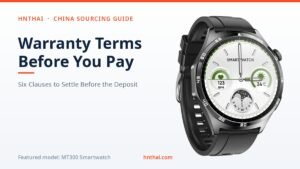
Featured model: the MT300
The MT300 smartwatch is a good model to run these questions against: a public-mould smartwatch with a spec sheet that leaves little to argue about — and a spec sheet is exactly what a warranty claim is judged against. A 1.43-inch AMOLED display at 466 × 466, a JL7013A chip, Bluetooth LE 5.0, a 440mAh battery, IP67 water resistance, 50 sports modes and 5+2 dials, running the H Band app and charged by a 2PIN magnetic cable. Every number there comes from the spec sheet; battery life in days and charging time are not stated on it, so get them in writing before you quote a warranty to your own customers. See our smartwatch sourcing guide.
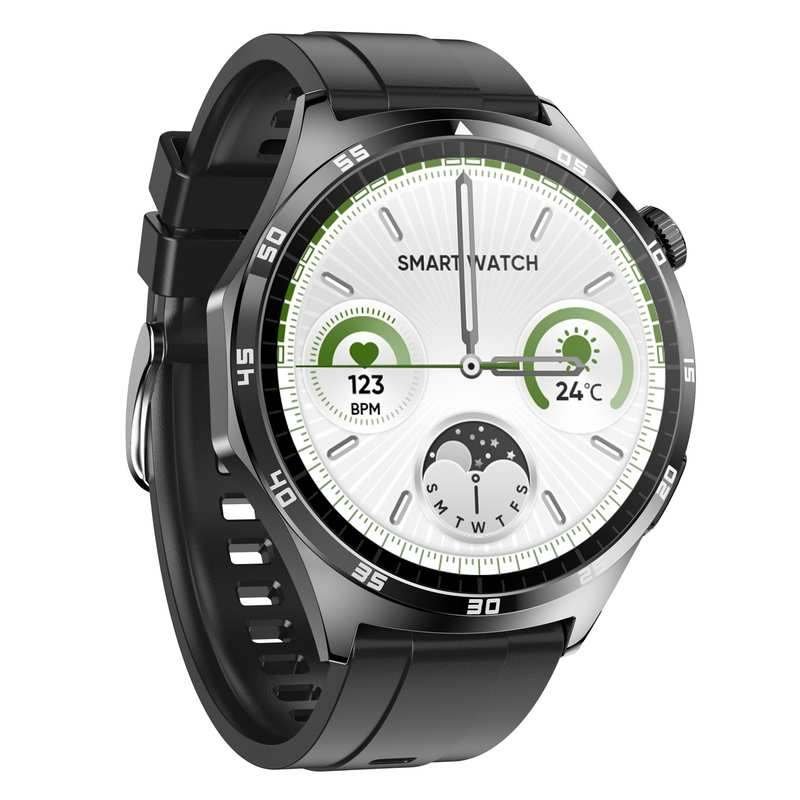
| Specification | MT300 |
|---|---|
| Display | 1.43-inch AMOLED, 466 × 466 |
| Chip | JL7013A |
| Bluetooth | 5.0 LE |
| Battery | 440mAh |
| Water resistance | IP67 |
| Sports modes | 50 |
| Watch faces | 5 + 2 dials |
| App | H Band |
| Charging | 2PIN magnetic cable |
Frequently asked questions
What warranty period should I ask for on China electronics?
Twelve months from shipment is the common factory standard, and it is the term HnThai offers. Market counters often offer only 3–6 months on stock items. The period alone is not the warranty, though — settle the start event, the scope, the DOA window, the failure rate, the remedy and who pays return freight in the same document, or the 12 months will not protect you when a claim arrives.
What is a DOA clause, and why does it matter?
DOA — dead on arrival — covers units that never worked: they do not power on, do not pair, or fail their first charge. Agree in writing how many days after delivery a unit counts as DOA and what happens to it. Without a window, every early failure becomes a negotiation; with one, a faulty unit is a routine replacement. Published guides cite replacement within 45 days of a confirmed defect as a common benchmark.
Should I ask for spare parts with my order?
Yes, on a first order especially. Sourcing guides commonly cite 1–3% of the order shipped as spare units or assemblies, so a faulty unit is replaced from your own stock instead of shipped back across an ocean at a cost that can exceed the unit's value. For products with proprietary components, also ask the supplier to commit in writing that spare parts stay available for 24 months after final shipment, at a pre-agreed price.
HnThai is a sourcing partner based in Huaqiangbei, Shenzhen, and we offer a one-year warranty on the orders we handle. If you are planning an order and want the warranty terms checked before you pay a deposit — coverage, DOA, failure rate, remedy, spares and freight — talk to us — or browse the current range in our product catalogue.