Order a test batch of 100 to 300 units when the supplier is new. Go to a bulk order of 1,000 units or more only when the product already sells and the supplier has passed a full order before. The test batch costs 15 to 40 percent more per unit — that premium buys proof before the big money moves.
What a test order actually proves
A sample proves what a factory can do once, by hand, when it knows you are watching. A first order proves what it will do at your price, at your volume, on your timeline. One sourcing guide puts it plainly: the sample is a sales tool, made by the factory’s best operator with the exact materials you specified, under no line-speed or margin pressure.
Treat the test batch as an evidence exercise, not a smaller bulk order. Get three things agreed in writing before the order goes in. First, a price ladder at several tiers — it shows whether the low MOQ is genuine or a one-time favour. Second, sample terms that carry over to the production line: which sample the run must match, and who signs it off. Third, payment tied to quality events, not calendar dates, so the balance moves only when the goods pass inspection. Agree each one before the order is placed — after that, the leverage is gone.
The real cost gap between a test batch and a bulk order
| Test batch: 100 units | Bulk order: 1,000 units | |
|---|---|---|
| Unit price | 15–40% above the bulk price | Lowest price, set by scale |
| Fixed setup and tooling | $3,000 adds $30 per unit | The same $3,000 adds $3 per unit |
| Shipping share | 20–40% of the unit cost | A small share of the unit cost |
| Inspection | About $120 per man-day for AQL 2.5 | Same day rate, spread over 10x units |
| Risk if it fails | The loss is bounded to 100 units | 800 unsold units in the warehouse |
Three readings. First, the premium is real but bounded: 15 to 40 percent more per unit on 100 units costs far less than a warehouse of unsold stock. Second, tooling is where small orders hurt most: the same $3,000 costs $30 per unit at 100 units and $3 at 1,000, so ask the supplier to spread it over later orders. Third, shipping punishes small orders twice: the freight itself, and its per-unit share. Consolidate several trial products into one shipment to share the freight and the $50 agent fee.
How to size the test batch
Three guides agree on the range: a trial batch of 100 to 300 units, after sample approval. Below that, a 50 to 100 unit pilot still works as a quality test. Size the batch from three inputs, not the supplier’s MOQ. First, how many units your channel can sell in two to four weeks — the batch should clear before the next order lands. Second, how many variants you need to test: one model in two colours is two SKUs. Third, what inspection costs: an AQL 2.5 inspection runs about $120 per man-day, and a failed batch of 100 is a cheap lesson, while a failed batch of 1,000 is not.
A test batch also buys negotiating room. The strongest card in a MOQ talk is a written plan: 100 units now to validate the market, and 1,000 units a month if it sells. That turns a one-off small buyer into a future high-value customer. Offering 100 percent upfront on a small order often unlocks a lower MOQ. One rule: never ask for a lower price and a lower MOQ in the same message.
When to skip the test batch and go straight to bulk
A test batch is the default, not a law. Skip it when three conditions all hold: the product already sells, the supplier has passed a full order for you, and the specification is unchanged.
Two other cases argue for bulk. The first is a standard stock item with no custom work — generic products on 1688 sell by the carton, MOQs of 2 to 50 pieces. The second is timing: March to May and the weeks after the October holiday are quiet for many export factories; avoid August and September, when lines fill for the fourth quarter. Even then: a golden sample signed off before production, and the balance tied to a passed inspection. Our AQL sampling guide shows what the inspection numbers mean, and our spec sheet guide shows how to write the document the factory builds from.
Featured model: the ET580
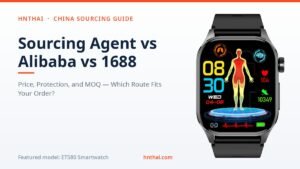
The ET580 smartwatch is the kind of model a test batch suits: a 2.04-inch AMOLED display (368×448) with Bluetooth 5.2 calling, a 380mAh battery with 3–5 days of use and 20+ days of standby, IP68 waterproofing, and magnetic charging in about 3–4 hours, running the H Band app. It ships in six colours — black, blue, and red silicone, black with a butterfly buckle, brown and black leather. Every number there comes from the spec sheet. Brightness in nits is missing — get it in writing before you quote outdoor use. See our smartwatches page and our smartwatch sourcing guide.

Frequently Asked Questions
How many units should a first test order be?
Most guides land on 100 to 300 units: enough to sell through a real channel for two to four weeks and to draw a meaningful inspection sample, small enough that a failure stays cheap. A 50 to 100 unit pilot also works when the factory will not go below its MOQ — frame it as a quality test. Size from your sell-through, not the supplier’s minimum: the batch should clear before the next order lands. Offer a written plan behind it — 100 units now, 1,000 a month if it sells — and the MOQ usually moves.
Does a test order cost more per unit than a bulk order?
Yes, and the gap is wide. Small orders typically carry a 15 to 40 percent unit-price premium, and fixed costs hit harder: $3,000 of tooling adds $30 per unit at 100 units against $3 at 1,000, and shipping can eat 20 to 40 percent of the unit cost on a small order. Treat the premium as the price of proof — it buys evidence about quality, delivery, and the real landed cost. If the numbers only work at the bulk price, the product is not ready for bulk.
Can I negotiate a lower MOQ for a test order?
Often, yes — the MOQ a supplier first quotes is an opening offer, and it moves when the factory’s costs move. Offer a higher unit price for the trial run, with a written plan to order at full MOQ pricing once the product proves itself. Offer faster or fuller payment: standard terms are 30 percent deposit and 70 percent before shipment, and full payment on a small order cuts the factory’s risk to zero. Remove a cost driver — stock colours instead of custom ones, standard packaging instead of printed boxes — and the number drops.