Most companies spend $50–$150 per client on a corporate gift. The safest choice is a compact smartwatch such as the KS02 — a 1.32-inch round display, 200mAh battery, 15 days of standby, IP68 and 46 g — because it is useful every day, neutral enough for any client, and priced to stay inside most corporate gift policies.
A client gift is not a thank-you note with a box attached. It is a message about how your company works. The client reads the quality of the gift as a sample of the quality of your work, and a cheap or thoughtless gift tells them more than any sales deck does. The good news is that the difference between a gift that strengthens a relationship and one that quietly damages it is rarely the budget. It is the choice, the timing, and the follow-through — three things a buyer can control before a single unit is ordered.
Why most client gifts end up in the bin
The numbers are blunt. According to the ASI 2019 Global Ad Impressions Study, 23% of promotional products get thrown away outright, and 55% get passed along to someone else. The worst offenders are familiar: 48% of branded calendars are thrown away, along with 28% of desk accessories and 27% of USB drives. Sendoso, writing up a real failed client-gifting programme, put it in one image: the gift lands in “a pile of seventeen other branded boxes,” gets passed to a co-worker, or goes straight in the bin.
A gift agency that has worked with more than 400 corporate clients across 18 countries names the same usual suspects — the stainless steel tumbler every recipient already owns three of, the canvas tote, the notebook and pen set, the lanyard, the polo shirt, the USB drive. None of these are bad objects. The failure is the absence of intention behind them. As that agency puts it: if your corporate gift could have been given by any other company, it probably should have been given by none.
The client gift fails in a different way from the staff gift. An employee who dislikes a gift stays quiet and puts it in a drawer. A client who receives a generic box reads it as a signal about the relationship itself: this supplier sends the same thing to everyone, and nobody here thought about us in particular. Our guide to gifts for employee appreciation covers the staff side of the same problem — the tests are similar, but the stakes with a client are higher, because the gift is doing sales work, not just saying thanks.
Four mistakes that cost you the client
Sending a generic gift with no recipient context. A branded mug or a standard gift box sent to every contact on a list signals zero effort. The recipient knows at once that they are a line item, not a relationship. Sendoso calls this the corporate-gifting equivalent of a mass email with a first-name merge field: technically personalised, functionally worthless. Before you pick a product, write one sentence about the client — what they do, what they just achieved, what they use every day. If the gift does not connect to that sentence, pick a different gift.
Sending the right gift at the wrong time. A gift that arrives three weeks after a deal closes, or the day before a holiday when the recipient’s inbox is already flooded, loses its signal value entirely. Sendoso’s rule of thumb is worth remembering: a $30 gift sent when a prospect accepts a new role will outperform a $150 gift box sent during Q4, when everyone else is sending cookies. The data backs the timing point. Reachdesk’s State of Corporate Gifting and Swag 2025 report shows April had a 77.11% redemption rate, the highest of the year, while December sat at 73.91% despite being the highest-volume month. The gifting that moves a relationship happens in February, May and August, when nobody else is sending anything. Plan your client gifts around your clients’ calendar — a contract renewal, a product launch, a new office — not around the December rush. Our guide to choosing tech gifts for year-end campaigns covers the December case specifically, for buyers who do need to send then.
Overbranding the gift so it feels like an ad. A gift covered in your logo is not a gift. It is a promotional item with a bow on it, and recipients know the difference at once. The ASI numbers above are the receipt: nearly half of branded calendars go in the bin. The test is simple — would the recipient use this item if the logo were not on it? If the answer is no, the logo is the problem. Keep the mark small and quiet: a discrete engraving on the case, a logo on the strap keeper, a gift sleeve with your name on it. The product itself should be something the client is glad to own. Our guide to gifting across markets explains why a loud logo reads as advertising in some markets and is simply impolite in others.
Ignoring the recipient’s gift policy. Many companies, schools and government offices limit what employees may accept. Some set a cap on value. Some ban gifts altogether. Public-sector and regulated industries are the strictest. In the United States, federal employees cannot accept gifts above $20 per occasion and $50 annually, and financial firms follow FINRA’s $100-per-year rule. A gift that breaks a policy does not just get returned — it puts your contact in an awkward spot with their own compliance team. When in doubt, ask the recipient’s office or check their published gift policy before you order. If you cannot confirm, keep the value modest and the item neutral.
What to avoid sending
Promogator’s short list of what to skip is a useful pre-order check, because every item on it is a gift that can break a rule, feel too personal, or make your brand look bad:
- Alcohol, unless you know the recipient well. It can conflict with workplace policy, with health or beliefs, or with local age and shipping laws — and many companies ban receiving it in the office.
- Cash and gift cards for regulated recipients. They can read as a bribe or a payment, and some policies treat them as taxable income.
- Health, grooming or fitness items. Even a kind gift in this category can read as a comment on someone’s body.
- Clothing in a specific size, perfume, lotions and strong scents. A wrong size is awkward, and allergies and taste vary.
- Religious, political or holiday-specific items. Not everyone celebrates the same holidays.
- Jokes and novelty items. Humour does not travel well across cultures and teams.
- Cheap items with a poorly printed logo. A flimsy product that breaks in a week ties that failure to your name, and a fuzzy print looks careless.
The pattern is clear: a client gift must be neutral, well made, and useful every day. A smartwatch passes all three tests. A branded desk toy passes none of them.
Picking by client tier
One product should not go to every client. Tier the gift to the relationship, and keep the tiers honest — your best accounts notice when they get the same item as everyone else.
| Client tier | Typical spend per client | What works | What to watch out for |
|---|---|---|---|
| New prospect | $25–$50 | A useful desk item or a compact smartwatch | Do not overspend before the relationship exists — a lavish first gift reads as pressure, not generosity |
| Standard client | $50–$150 | A compact smartwatch such as the KS02, or a gift set pairing a watch with earbuds | Confirm the Bluetooth version, display size and charging method in writing before you quote the model |
| Key account | $150–$250 | A premium smartwatch, or a gift set with accessories | At this level the packaging and the personal note matter as much as the product — a plain box wastes the budget |
| VIP / milestone | $250 and above | A premium model with custom packaging and a handwritten note | Check the recipient's gift policy first — a gift this size can break a compliance cap |
The spend bands above are planning numbers drawn from published benchmarks (iPromo: $50–$150 per client, $250+ for VIPs; Monsuri: $50–$150 per client, $150–$200 for milestones and executives), not a final invoice. For the full method behind setting a per-recipient budget, see our corporate tech gift budget guide. And for the cases where a set beats a single item, our gift sets guide explains how to bundle a watch with earbuds and accessories without making the lower tier look like an afterthought.
One rule holds at every tier: spend the budget on one item the client will use every day, not on three small items that fill the box. A client who wears your watch every morning thinks of you every morning. A client who received three small items thinks of you never.
Featured model: the KS02
The KS02 smartwatch fits a standard-tier client gift because it is compact, light and neutral: a round face that suits most wrists, a metal-and-TPU body that looks like a watch rather than a gadget, and a spec sheet with nothing to explain away. It passes the daily-use test — a watch is worn every day — it passes the policy test, because it sits comfortably inside the $50–$150 standard band, and it passes the fit test, because an adjustable strap covers the whole client list without a sizing survey.
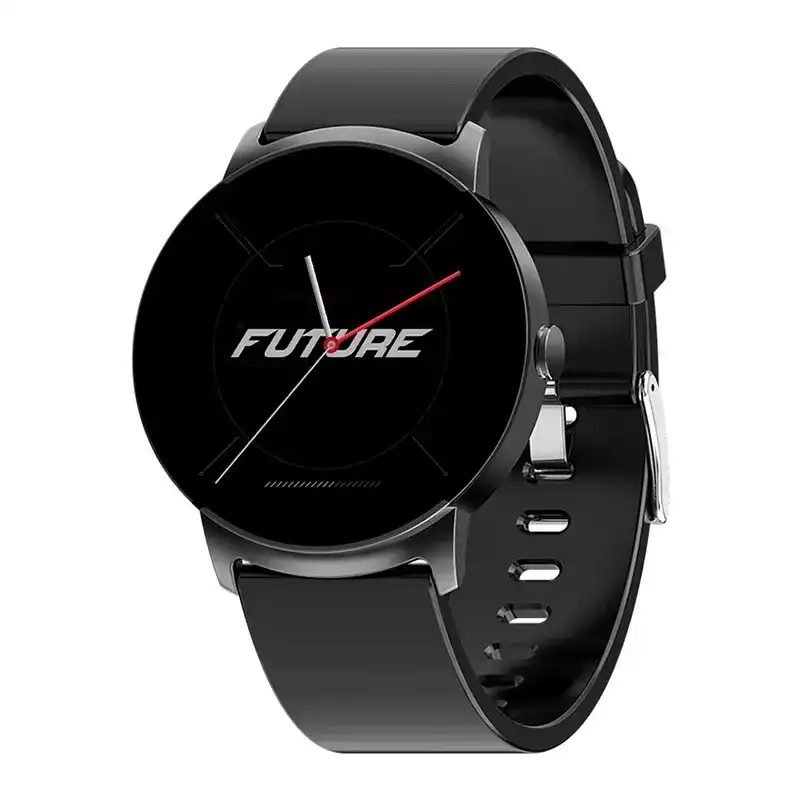
| Specification | KS02 |
|---|---|
| Display | 1.32-inch round HD color screen, 360×360 |
| Chip | GR5515 |
| Battery | 200mAh, 15 days standby |
| Bluetooth | 5.1 |
| Water resistance | IP68 |
| Weight | 46 g |
| Body | Zinc alloy and TPU, toughened glass |
| Extras | NFC, call and message reminders |
| Charging | About 2 hours |
Every number in that table comes from the product page. The 15 days is standby, not days of use — get the real-use figure in writing before you quote it to a client. For the full selection method behind the models in this guide, start with our Smartwatch Sourcing Guide. For the rest of your range, browse our products and tell us how many clients are on the list — we can put a sample together in the right colours and counts before you commit to the full order.
Ordering in time — and following up
A client gift that arrives late is not a late gift. It is a missed occasion. Chinese New Year closes factories from 5 to 13 February 2027, with production slowing from mid-January, so an order tied to a February or March occasion has to be placed in January, not February. Our guide to ordering around Chinese New Year covers the shutdown pattern in full.
| Order type | Typical lead time | What it means for a client gift |
|---|---|---|
| Stock model, logo print only | Ships in 3–7 days | Fits a gift tied to a date two weeks out |
| White-label run, your logo and packaging | 15–25 days | The sample must be signed before production starts |
| Custom OEM, your branding and packaging | 45–60 days | Start at least two months before the occasion |
| Full ODM, new tooling or hardware | 45–90 days | Tooling alone takes 30–45 days — plan a quarter ahead |
Order 5–10% spare units on top of the client list, because a gift programme with three clients missing is worse than one with three spares in the cupboard. A new contact joins the account, a box arrives damaged, an address changes — spares cover all three. And budget for a real inspection before the goods ship, not a photo from the factory floor: our gift quality inspection checklist sets out the five checks that matter on a gift order, where one faulty unit reaches a client who judges your work by it.
Then follow up. Sendoso’s last warning is the one most buyers skip: a gift without a follow-up is a sunk cost. A short message a week after the gift lands — asking whether it arrived, whether it works, whether the client needs anything — turns a box into a conversation. The gift opens the door. The follow-up walks through it. That is the whole point of sending a client gift, and the full method behind this article is in our corporate gifts sourcing guide.
FAQ
How much should we spend per client on a tech gift?
Published benchmarks put the standard band at $50–$150 per client, with $25–$50 for a new prospect and $250 and above for a VIP or a milestone. The right number depends on the relationship: a first gift to a prospect should stay modest, while a key account that renewed this year justifies the top of the band. Check the recipient’s gift policy first — US federal employees cannot accept more than $20 per occasion, and financial firms follow a $100-per-year rule.
Can I send a tech gift to a client in a regulated industry?
Yes, if you check their policy first. Healthcare, financial services and government contacts often have a value cap or a ban on certain categories, and a gift that breaks the policy puts your contact in an awkward spot. Keep the value modest, keep the item neutral — a smartwatch with a small, quiet logo — and ask the recipient’s office when in doubt. Cash, gift cards and alcohol carry the most rules and are the safest to skip.
When is the best time of year to send a client gift?
Not December, when every other supplier is sending something and redemption rates actually dip — Reachdesk’s 2025 data puts December at 73.91% against April’s 77.11%. The gifts that move a relationship arrive tied to the client’s own calendar: a contract renewal, a product launch, a new role, a new office. February, May and August are the quiet months, when a well-chosen gift stands out because nobody else is sending one.