A Chinese supplier quotation is one unit price for one specification, under one trade term, valid for a limited window. The unit price almost never includes tooling, packaging upgrades, certification testing, destination charges, or import duty — so read the Incoterm, the exclusions list, and the specification behind the price before you compare two quotes.
The line items, and what each one means
A factory quotation normally has four layers: the product cost, the terms of sale, the tax treatment, and the payment terms.
Unit price is the per-piece cost at the stated quantity, and it is almost always quantity-dependent. A factory should show price breaks at different volumes — for example 500, 1,000, and 3,000 pieces. A quote with a single unit price and no quantity breakpoints is either an oversight or a signal that the factory does not want to show how much their margin drops at volume.
Tooling fee — sometimes listed as "mold fee" or "NRE" (non-recurring engineering) — covers one-time costs for tooling specific to your product: injection molds, die-cast parts, custom stampings, or PCB stencils. It is a separate up-front charge, not amortized into the unit price by default. A typical single-cavity plastic enclosure mold runs $3,000 to $8,000; a more complex multi-cavity mold runs $10,000 to $25,000.
Sample fee is what you pay before production for a prototype or pre-production sample. It is often waived or credited against the first production order — but not always, so get the terms in writing. Packaging is usually basic export cartons; a custom printed box or retail-ready pack is an upgrade with its own line.
EXW vs FOB vs CIF vs DDP: what each price covers
The Incoterm is the single biggest source of hidden cost: it tells you where the factory's responsibility ends and yours starts.
| Cost item | EXW | FOB | CIF | DDP |
|---|---|---|---|---|
| Product and factory margin | Included | Included | Included | Included |
| Basic packaging | Included | Included | Included | Included |
| Inland transport to port | Buyer | Seller | Seller | Seller |
| China export customs clearance | Buyer | Seller | Seller | Seller |
| Origin port charges | Buyer | Seller | Seller | Seller |
| Main freight | Buyer | Buyer | Seller | Seller |
| Cargo insurance | Buyer | Buyer | Buyer | Seller |
| Destination port charges | Buyer | Buyer | Buyer | Seller |
| Import duties and taxes | Buyer | Buyer | Buyer | Seller |
| Final-mile delivery | Buyer | Buyer | Buyer | Seller |
EXW (Ex Works) is the factory's most stripped-down number: finished goods in standard export cartons, made available at the factory gate. Everything after that is your cost — trucking, export clearance, port handling, freight, insurance, destination charges, duty, and final delivery. Export clearance alone is commonly quoted at around $100 to $300 per shipment.
FOB (Free On Board, named Chinese port) is the standard basis for export orders and the one to request by default. On top of the EXW scope it adds inland transport, export clearance, documentation, and origin port handling — the factory's responsibility ends when the container is loaded on the vessel.
CIF (Cost, Insurance, Freight) adds main freight and cargo insurance to FOB. DDP (Delivered Duty Paid) has the seller handle everything to your door, including duties and taxes. DDP is convenient but carries compliance risk: sellers may under-declare values or misclassify goods, and shipments can be delayed or held.
What FOB still leaves out
FOB is the right baseline for most comparisons, but it still does not include ocean freight, marine insurance, destination terminal handling, brokerage, duty and tax, or delivery to your warehouse. The gap between a FOB quote and your true landed cost routinely runs 20% to 40% of unit cost. A published worked example makes it concrete: $8.00 FOB per piece, with freight, duty, and clearance adding $1.40, gives a landed cost near $9.40.
Ask for both EXW and FOB prices from the same supplier: the difference is their charge for trucking and clearance, and a gap far wider than local rates means padding.
The specification behind the price
The unit price assumes a specification that may not match your drawings. One supplier's "smartwatch, 1.85-inch display" can mean a different chip, a smaller battery, and a different app than another supplier's same words — and two suppliers quoting "the same" watch can differ by 15% or more once converted to landed cost.
Tax treatment is part of the same check: factories may quote tax-inclusive or tax-exclusive prices. A tax-inclusive price includes Chinese VAT and usually means the factory can issue a VAT invoice. Compare only on the same Incoterm, the same specification sheet, and the same quantity tier.
Red flags in a quotation
Six patterns should make you pause. A single unit price with no quantity breaks. No validity date on the sheet. No Incoterm named at all — a price without a trade term is not a price. Tooling bundled into a vague line instead of itemized. A "FOB" price that already includes ocean freight, which means it is really CIF or DDP mislabelled. And a specification that names only the screen size and nothing else. Any one of these is a question to ask in writing.
A real example: the V69
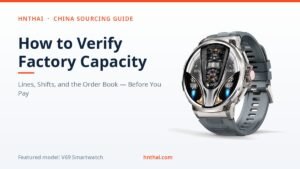
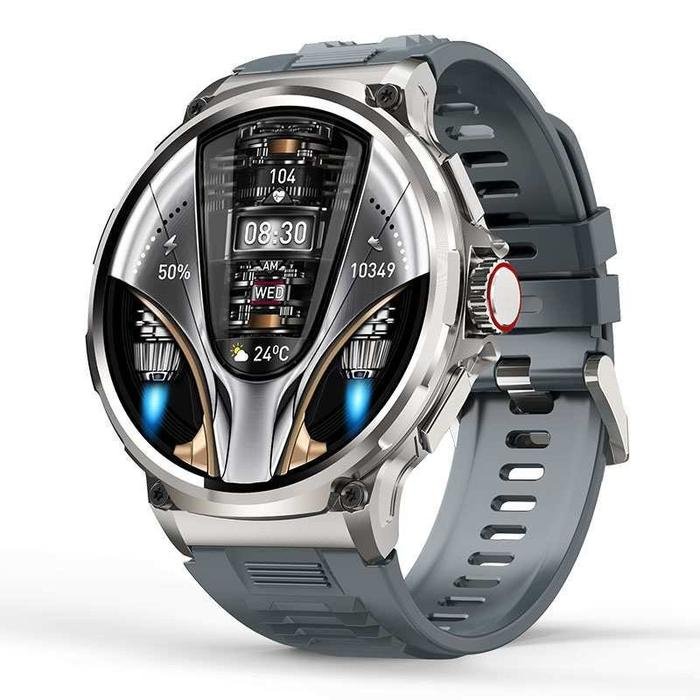
Quotations are easier to read against a real product. The V69 smartwatch runs on an 8763EWE chip with Bluetooth 5.0 BLE and a range of about 10 metres, a 1.85-inch display (360×360), a 710mAh battery on magnetic charging, IP67 water resistance, and the Da Fit app, in a 52.6mm case at 77.4g, with OTA updates and a waterproof speaker and microphone built for calling.
A quote for the V69 should name every one of those lines — chip, battery, screen, app, charging method — plus the Incoterm, the quantity tier, and the validity window. If the sheet just says "smartwatch, 1.85 inch" with a price, you cannot compare it with another 1.85-inch watch. Ask for the missing lines in writing, convert both quotes to the same Incoterm, and add freight, duty, and clearance before you decide.
See our Smartwatch Sourcing Guide, our supplier verification guide, our MOQ guide, and our pricing guide. Browse the full range on our products page and smartwatches page.
Frequently Asked Questions
Why do two suppliers quote very different prices for the same product?
Because the price assumes a specification, a trade term, and a quantity, and those three are rarely the same across two sheets. Check the chip, battery, screen, and app behind each price, convert both to the same Incoterm, and compare landed cost.
Should I ask for EXW or FOB?
Ask for FOB as the default baseline — the most common term for China export. Use EXW only if you control your own freight and clearance. Asking for both shows what the supplier charges for trucking and clearance.
How long is a Chinese factory quotation valid?
Written quotations state a validity period from issue; beyond it the factory may re-quote. Metal-heavy products often carry a raw-material adjustment clause. Confirm the window in writing and order inside it.