A buyer orders a smartwatch, wears it for a week, then buys a replacement strap online. The strap does not fit — and the buyer returns the watch to you, not the strap.
Strap problems look small next to screens and batteries, but they still produce returns and bad reviews, because the strap is the part the buyer touches every day. A watch that will not take a standard replacement strap feels broken, even when it works fine.
Lug width is the number that matters
The measurement that decides whether a strap fits is lug width: the distance between the two lugs on the watch case, in millimetres. Most non-Apple smartwatches use 20mm or 22mm, and that 2mm gap is the whole problem.
A 20mm strap on 22mm lugs slides side to side until the spring bar bends and snaps, and the watch falls. A 22mm strap forced onto 20mm lugs sits stiff, cannot rotate freely, and tears over time. Neither mistake shows in a product photo. Both show in a return.
The most common error is confusing case size with lug width. A 44mm case does not take a 44mm strap: case size is the width of the watch body, lug width is the width of the strap that fits between the lugs. A listing that only gives the case size invites the mistake — Samsung’s own support pages list both numbers separately for every model.
Quick-release pins are not all the same
Most modern straps use quick-release spring bars: a small lever on the underside lets the buyer swap a strap in seconds with a fingernail, no tools needed. But “quick-release” only describes the mechanism, not the pin.
A thread on the Garmin forums shows how this goes wrong. A Venu owner found aftermarket 20mm straps that worked fine on a Vivoactive 3 kept coming loose on the Venu, though both watches are listed as 20mm. Other owners traced the fault to the pins: the originals measured thicker than the cheap aftermarket ones, and strap-end widths varied by fractions of a millimetre between makers. The lug width was right. The pin was not.
For an importer, the lesson is plain. Two suppliers can both sell you a “20mm quick-release strap” and deliver parts that behave differently. Pin diameter, pin length, and the exact width of the strap end all matter, and none of them appear in a typical supplier quote unless you ask.
Proprietary connectors break compatibility on purpose
The big brands have moved away from standard lugs. Apple uses a slide-and-click connector that takes no millimetre strap at all. Samsung’s Galaxy Watch8 uses a new dedicated mechanism, incompatible with bands from the Watch4 to Watch7 lines, and the Galaxy Watch Ultra uses a 34mm connection that takes no earlier 20mm band. A buyer who upgrades the watch can find a drawer full of straps that no longer fit.
That is where the returns come from. A buyer who owns three straps for an older model orders your new model expecting them to fit, and they do not. The buyer calls it a defect — your listing called the strap “standard” and said nothing about the connector.
When you source a watch, ask the supplier which connector the model uses, in writing: standard spring bar or model-specific, the exact lug width, and whether the supplier’s other straps fit. If the answer is proprietary, say so in the listing and sell the matching straps alongside the watch.
Strap material decides who buys it
The strap also decides the market. Silicone and TPU suit sport buyers: they handle sweat, wash clean, and survive rough use. Leather suits office buyers but absorbs sweat and wears faster in hot climates. Steel suits buyers who want a watch that looks expensive but adds weight and cost. Nylon sits in the middle: light, breathable, cheap to replace.
Distributors who sell one watch in several strap options cover more buyers with the same stock. That is why the strap list belongs in your buying decision, next to the screen and the battery.
What to ask the supplier before you order
Get these answers in writing before the order:
- What is the lug width, in millimetres? Get the number, not “standard” or “universal”.
- What pin does it use? Quick-release or standard spring bar, and the pin diameter. Ask for a measured pin, not a catalogue claim.
- Is the connector model-specific? If straps from the supplier’s other models do not fit, you need to know now.
- What strap lengths ship in the box? S/M fits roughly 130–190mm wrists and M/L roughly 145–205mm on Samsung’s own sizing. Ask which length your order includes.
- What strap materials and colours can you order? Get the full list with the SKU count, so one model can cover several price points.
- Are spare straps available separately? A buyer who can buy a spare from you does not return the watch.
How to test straps on samples
Run this on three samples before the bulk order:
- Measure the lugs with calipers. Do not trust the catalogue. A 0.5mm error is enough to cause the sliding problem described above.
- Swap the strap twenty times. A pin that seats loosely on the tenth try will fail in a buyer’s hands within a month.
- Do a pull test. With the strap fitted, pull the watch firmly away from the strap in both directions. A strap that pops off is a return waiting to happen.
- Fit a third-party 20mm or 22mm strap. If your buyers will do this anyway, you should know first whether a common replacement strap fits.
- Wear it for a week. Check whether the strap irritates the skin, holds sweat, or lets the watch slide around the wrist.
We apply the same discipline to battery claims in our battery life guide: one fixed test, three samples, real use. Straps fail the same quiet way — not on day one, but in week three.
A watch from our range
The ET580 smartwatch shows strap variety treated as a buying decision. It ships with silicone, leather, nylon, and steel strap options across 14 SKUs, in six colours: black, blue, and red silicone, black with a butterfly buckle, brown and black leather. The watch itself has a 2.04-inch AMOLED display (368 x 448) with Bluetooth 5.2 calling, a 380mAh battery with magnetic charging, about 3–5 days of use and 20+ days of standby, IP68 waterproofing, and an alloy and stainless steel case, running on the H Band app.
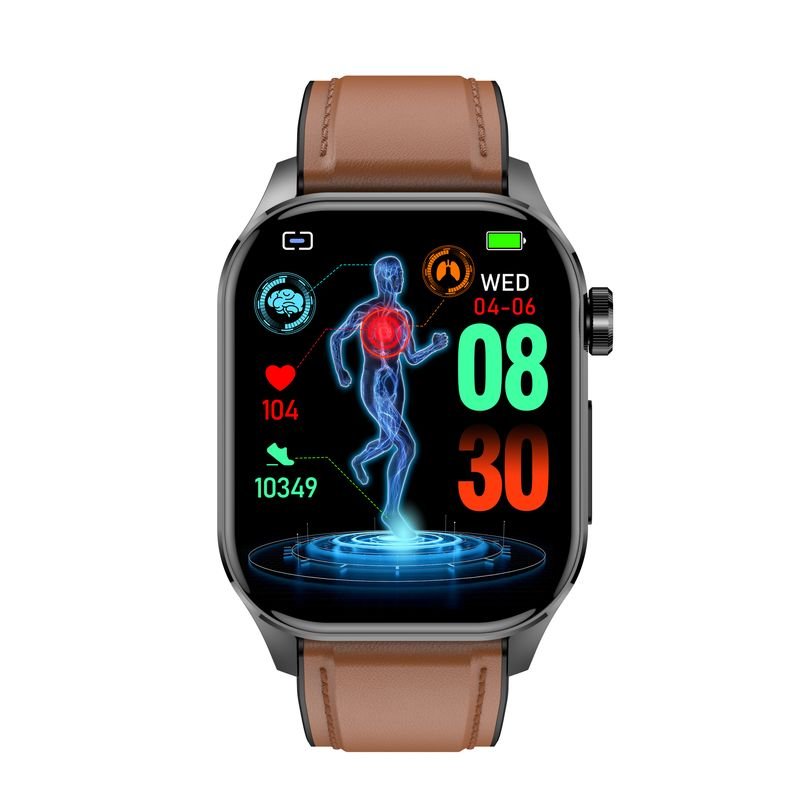
One model, four strap materials, six colours: the strap is part of the product, and a distributor who orders the strap range has something to sell to every buyer. The screen is the next thing buyers judge after the strap — see our screen glass guide.
Related reading: Smartwatch Sourcing Guide — How to Choose a Smartwatch Supplier in China
Will a 20mm strap fit a 22mm smartwatch?
No — a 2mm gap is enough to cause a failure. A 20mm strap on 22mm lugs slides side to side until the spring bar bends and snaps, and the watch falls. A 22mm strap forced onto 20mm lugs sits stiff, cannot rotate freely, and tears over time. Neither mistake shows in a photo, and both show in a return. Do not confuse case size with lug width: a 44mm case does not take a 44mm strap, since case size is the width of the watch body and lug width is the width of the strap that fits between the lugs. Measure the lugs with calipers on samples, and get the lug width in millimetres in writing before you order.
Are all quick-release smartwatch straps the same?
‘Quick-release’ only describes the mechanism — a lever on the underside that lets the buyer swap a strap in seconds with a fingernail — not the pin. Two suppliers can both sell a ’20mm quick-release strap’ and deliver parts that behave differently: pin diameter, pin length and the width of the strap end all matter. One Garmin Venu owner found aftermarket 20mm straps that worked on a Vivoactive 3 kept coming loose on the Venu, because the original pins were thicker than the aftermarket ones. Ask for a measured pin, not a claim, and swap the strap twenty times on samples: a pin that seats loosely on the tenth try will fail in a buyer’s hands within a month.
What strap details should I confirm with the supplier before ordering?
Get the lug width in millimetres — a number, not ‘standard’ or ‘universal’ — and the pin type, quick-release or standard spring bar, with the pin diameter. Ask whether the connector is model-specific, since straps from the supplier’s other models may not fit. Confirm which strap lengths ship in the box: S/M fits roughly 130–190mm wrists and M/L roughly 145–205mm on Samsung’s own sizing. Get the full list of strap materials and colours with the SKU count, so one model can cover several price points, and ask whether spare straps are available separately. A buyer who can buy a spare from you does not return the watch, so confirm spare-strap supply in writing before ordering.
If you want samples tested for strap fit and pin strength before ordering, or help comparing strap options, talk to us at HnThai. We source from Huaqiangbei daily and test every batch before it ships.