For most new electronics importers, Alibaba.com with Trade Assurance is the safest start. 1688 shows the lowest factory-gate prices, but it runs in Chinese, prices in RMB, and offers foreign buyers almost no protection. A sourcing agent charges 3–10% of the order value and earns it on custom, mixed, or large orders where one mistake costs more than the fee.
What each route actually is
Alibaba.com is the export marketplace of Alibaba Group, built for foreign companies. Listings are in English, prices are in US dollars, suppliers handle export documentation, and payment can run through Trade Assurance, which holds your money in escrow until you confirm the order. It is the default starting point for a first order, and it is also where the export markup lives: English-speaking sales staff, escrow overhead, export paperwork, and often a trading company's margin.
1688.com is the same group's domestic wholesale marketplace, built for buyers inside China. Prices are in RMB, the interface and every negotiation are in Chinese, and sellers ship within China only. Many sellers are the same factories that list on Alibaba.com at higher prices. The price you see is close to the factory-gate price — and it comes with no export service attached.
A sourcing agent is a person or company on the ground in China who does the work the platforms leave to you: finding the factory, negotiating in Chinese, checking samples, running inspection, consolidating goods from several suppliers, and arranging export and shipping. At HnThai, a sourcing partner based in Huaqiangbei, Shenzhen, that is the daily job — the agent is not a website, it is a pair of hands in the market.
The price gap is real — and smaller than it looks
Sourcing guides commonly put 1688 prices 20–40% below Alibaba.com for comparable goods, and one published comparison shows the same unit at US$4.20 FOB on Alibaba.com against US$2.50 on 1688 before the costs of getting it out of China. That gap is real, and it is also the most misunderstood number in China sourcing. The 1688 price is a domestic price. It buys you the goods sitting in a Chinese warehouse, not goods on a ship to your port.
| Cost layer | Alibaba.com | 1688 (direct) | 1688 via agent |
|---|---|---|---|
| Unit price | Export price, markup included | Factory-gate price | Factory-gate price |
| Agent fee | None | None | Typically 3–10% of order value |
| Domestic freight | Usually included or quoted | You arrange it | Agent arranges it |
| Export handling | Supplier handles it | You handle it | Agent handles it |
| Inspection | You arrange and pay | You arrange and pay | Agent arranges, you pay the fee |
| Buyer protection | Trade Assurance escrow | Almost none for foreign buyers | Depends on the written contract |
Add the agent fee, domestic freight, export handling, and inspection to the 1688 price, and the 20–40% gap shrinks fast. On a small order it can vanish entirely. The honest comparison is landed cost per unit — goods plus freight plus duty plus fees — not the unit price on a listing page. Our guide to reading a supplier quotation shows which lines buyers most often miss, and our shipping guide prices the freight leg that turns a factory price into a landed cost.
Buyer protection: where each route stands
Alibaba's Trade Assurance is the strongest protection of the three routes, and it still has limits. It holds payment until you confirm the order, and it gives you a dispute channel if the goods do not match the contract. It does not check quality for you, it does not replace a sample, and it does not cover problems you only discover after you confirm receipt. Treat it as a safety net, not a quality system.
1688 offers foreign buyers almost no protection. Payment runs through Alipay or a local bank account, disputes are handled in Chinese, and there is no export documentation unless someone arranges it. A buyer who pays a 1688 seller directly, from overseas, has very little to fall back on if the goods are wrong. That is the main reason 1688 is normally used through an agent rather than directly.
An agent's protection is only as good as the written agreement behind it. Before you pay, get the fee, the scope, and the inspection standard in writing: what the agent checks, what report you receive, and who pays if the goods fail. A good agent welcomes that conversation. One who works on a handshake and a chat message does not. The checks in our guide to verifying a Chinese electronics supplier apply to agents too — licence, references, and a live video call before money moves.
MOQ and effort: who does the work
The three routes also split the work differently. Alibaba.com listings commonly start at MOQs of 100 units or more, while 1688 sellers often accept 1–50 units — which makes 1688 attractive for testing a product, if you can handle the rest of the process. An agent can consolidate small quantities across several suppliers into one shipment, which is how small buyers get low-MOQ access without running five export processes themselves.
| Alibaba.com | 1688 | Sourcing agent | |
|---|---|---|---|
| Typical MOQ | 100–1,000+ units | 1–50 units | Any, consolidated across suppliers |
| Language | English | Chinese only | Bilingual, agent speaks for you |
| Payment | USD, Trade Assurance escrow | RMB, Alipay or local bank | Per contract, often T/T |
| Who finds the factory | You, from listings | You, from listings | Agent, from the market |
| Who checks quality | You arrange it | You arrange it | Agent arranges it |
| Who handles export | Supplier | You | Agent |
| Your time per order | Medium | High | Low |
The pattern is simple: the cheaper the unit price, the more of the work falls on you. A buyer with time, Chinese language skills, and a forwarder can run 1688 directly and keep the full gap. A buyer without those things pays for them somewhere — either in the Alibaba markup or in an agent fee. There is no route where the work is free.
Which route fits your order
First order, small budget, no experience in China: Alibaba.com with Trade Assurance. The escrow matters most when you cannot absorb a lost shipment, and the English interface keeps the process readable. Order a sample first — published guides put a typical electronics sample at $50–$200 — and pay through the platform, never off it. Read our payment terms guide before you wire anything.
Testing a product for an online store: 1688 through an agent. The low MOQ lets you test 20 or 50 units instead of committing to 500, and the agent handles the parts of the process you cannot do from overseas. Confirm the MOQ logic first — our MOQ guide explains why minimums vary and how to negotiate them.
Custom or OEM/ODM order, or a mixed order from several factories: a sourcing agent. Custom work means artwork approval, tooling, packaging, and a production schedule that a listing page cannot manage. An agent in the market can visit the factory, check the sample in person, and consolidate the shipment. The fee is 3–10% of the order value; on a custom order, one avoided mistake pays for it.
Repeat bulk restock of a product you already sell: whichever route your verified supplier sits on. Once the supplier, the specification, and the quality standard are settled, the route matters less than the relationship. Compare the new quotation against the last one line by line — our quotation comparison guide shows how to do it without comparing different things.
A real example: the ET580 smartwatch
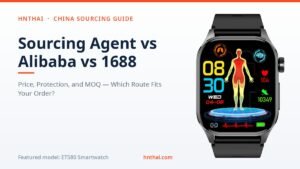
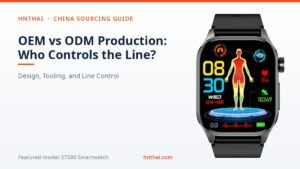
Take the ET580 smartwatch: a 2.04-inch AMOLED display at 368×448, a 380mAh battery with 3–5 days of use and 20+ days of standby, IP68 water resistance, Bluetooth 5.2 calling, magnetic charging in about 3–4 hours, and the H Band app, on a JL7013A chip. Every number there comes from the spec sheet.

The same watch can appear on all three routes at three different prices, and none of those prices is the answer by itself. On Alibaba.com you pay the export price and get escrow and English support. On 1688 you see the factory-gate price and have to add the agent, freight, and export handling yourself. Through an agent you pay the factory price plus a fee and get the whole process handled. The right question is not "which price is lowest" but "which landed cost, with which risk, for my order size." Still choosing the model? Our smartwatch sourcing guide walks through selection first. At HnThai, a sourcing partner based in Huaqiangbei, Shenzhen, we run orders through all three routes every week for wholesale buyers — and we will tell you honestly when the agent route is not worth the fee for your order. Browse our products, or contact us with your specification, quantity, and target market, and we will price the landed cost, not just the unit price.
FAQ
Can I buy on 1688 without a sourcing agent?
You can, with a forwarding service and a payment route, but most first-time buyers should not. The site is Chinese only, prices are in RMB, sellers ship within China, and there is almost no buyer protection for a foreign buyer. Without Chinese language skills and a way to handle export documentation, the savings disappear into mistakes. Use an agent for the first orders, and go direct only once you know the supplier, the product, and the export process.
Is Alibaba Trade Assurance enough protection on its own?
No. Trade Assurance holds your payment in escrow and gives you a dispute channel, but it does not inspect your goods or test your samples. A supplier can ship exactly what the contract says and still ship a product your customers return. Order a sample, run a pre-shipment inspection, and only confirm receipt after the inspection report passes. Protection and quality control are two different jobs.
How much does a sourcing agent charge?
Published guides put a typical agent fee at 3–10% of the order value, and the range is wide because the scope varies. Some agents charge a flat fee per order, some charge per service — sourcing, inspection, consolidation, shipping — and some bundle everything into one percentage. Get the fee and the full scope in writing before you pay, including what inspection report you receive and who pays if the goods fail. A fee quoted without a scope is not a price.