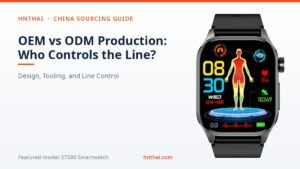
OEM means you own the design and the factory builds to your specification. ODM means the factory owns the design and you brand or adapt its existing platform. The difference is not the label on the quote — it is who controls the design files, the tooling, the production schedule, and the right to change things once the line starts.
The one question that decides it: who owns the design?
Under OEM, you supply the design: drawings, specifications, required functions, and the performance the finished product must hit. Under ODM, the factory supplies the design: a finished product or a base platform it developed, which you brand and adapt within limits the platform allows. A third route, private label, starts further along still: a finished product where you change the logo, the colour, and the packaging, and little else.
Buyers get into trouble when they use the words loosely. Asking for “OEM” when only a logo print is needed can bring an unnecessarily high MOQ and development cost. Expecting a unique design while accepting a standard product can end with competitors selling the same item. Get the route right before you compare quotations.
OEM vs ODM vs private label: the comparison
| Area | Private label | ODM | OEM |
|---|---|---|---|
| Starting point | Finished standard product | Supplier-owned design or platform | Buyer’s design or specification |
| Typical changes | Logo, label, colour, packaging | Features, appearance, accessories, software options | Structure, dimensions, materials, functions, tooling |
| Development work | Low | Medium | Medium to high |
| Tooling | Usually none | Possible for changed housings or parts | Often required for unique parts and moulds |
| Minimum order | Usually the lowest | Depends on the depth of modification | Often higher, due to development and setup costs |
| Lead time | Usually fastest | Moderate | Usually longest |
| Buyer control | Branding and minor changes only | Moderate, inside the supplier’s platform | Highest, when terms are clearly documented |
| Main risk | Low differentiation, no exclusivity | Unclear ownership, hidden platform limits | Tooling disputes, repeated samples |
The table describes typical relationships, not legal rules. The written quotation, development agreement, approved sample, and purchase documents should describe the actual work instead of relying only on the label.
Who controls what once production starts
Tooling. In an OEM order you typically own the design, the IP, and the moulds, even when they sit at the factory. In an ODM order the manufacturer usually keeps all three. An OEM buyer with written ownership can take the mould elsewhere; an ODM buyer often finds the tooling is not theirs to move.
Materials and components. An OEM buyer can name approved parts and suppliers. An ODM buyer accepts the platform’s parts list, and a component change the factory makes can change your product without a word to you. Ask for a written rule: no component change without your approval.
The production schedule. An OEM order runs on a schedule you can read and question, because the line and the dates belong to your order. Our guide to reading a factory production plan shows the eight milestones that decide whether an order ships on time. An ODM order shares the line with every other buyer on the same platform — and when a bigger customer takes the line, smaller buyers wait. Global Sources describes a car-mat buyer whose factory took a contract worth about $10 million from Kmart: every line went to that order, and smaller buyers were pushed back month after month. The only defence is a written line date. If it happens to you, our guide to what happens when production is delayed walks through the first 48 hours. See also what a production schedule is and why your order has a slot.
Quality control and changes. OEM buyers write the QC standard into the specification; ODM buyers accept the factory’s standard and should ask to see it before the first order. A pre-shipment inspection is where either route proves itself, and the balance should follow a passed report. ODM change requests also run into the platform: some are a setting, others need a new housing or a new mould.
Where buyers get hurt
The same product, another brand. This is the classic ODM trap: the platform you branded is also sold to other buyers, sometimes in your own market. If exclusivity matters, it must be written into the agreement — and expect to pay for it through a higher MOQ or a development fee.
Tooling held at the factory. A buyer pays for a mould, the factory keeps it, and the relationship ends — so the buyer either pays again at a new factory or stays. The fix is a line in the agreement stating that buyer-paid tooling belongs to the buyer, with a photo and a serial number on file.
OEM sample rounds that never end. A loose specification can run through sample after sample. A stock model with a printed logo samples in 3–7 working days; a full ODM sample takes 2–4 weeks, and each revision adds another round. Freeze the design in writing at the golden sample.
Which route fits your order?
Choose private label when speed matters most and the product is already right: a proven model, your logo and packaging, the lowest MOQ, the fastest path to a listing.
Choose ODM when you need a working product fast, with some changes — a different colour, a different strap, a feature switched on or off — and you do not need to own the design. Check the platform limits before you commit, and confirm in writing what you can and cannot change.
Choose OEM when the product itself is your advantage: a unique design, a feature no competitor has, or a specification your market demands. Budget for development, tooling, and longer lead time, and put the specification, the IP, and the tooling ownership in writing before the first sample. See our purchase order to shipment timeline for the full run.
One more test: ask what happens if the relationship ends. With private label, you walk away and buy the same product elsewhere. With ODM, you keep the brand but lose the platform. With OEM, you keep the design and the tooling — if the paperwork says so. That answer often picks the route for you.
A real example: starting from an existing platform
Most first orders from China are ODM or private label, not OEM. Take the ET580 smartwatch as an example of a platform buyers build on: a 2.04-inch AMOLED display at 368×448, Bluetooth 5.2 BLE, a 380mAh battery giving 3–5 days of use and 20+ days of standby, IP68 water resistance, magnetic charging in 3–4 hours, and 11 watch languages. A buyer starting from this platform can change the logo, strap, packaging, and watch faces, and have a branded product sampling in days rather than months.
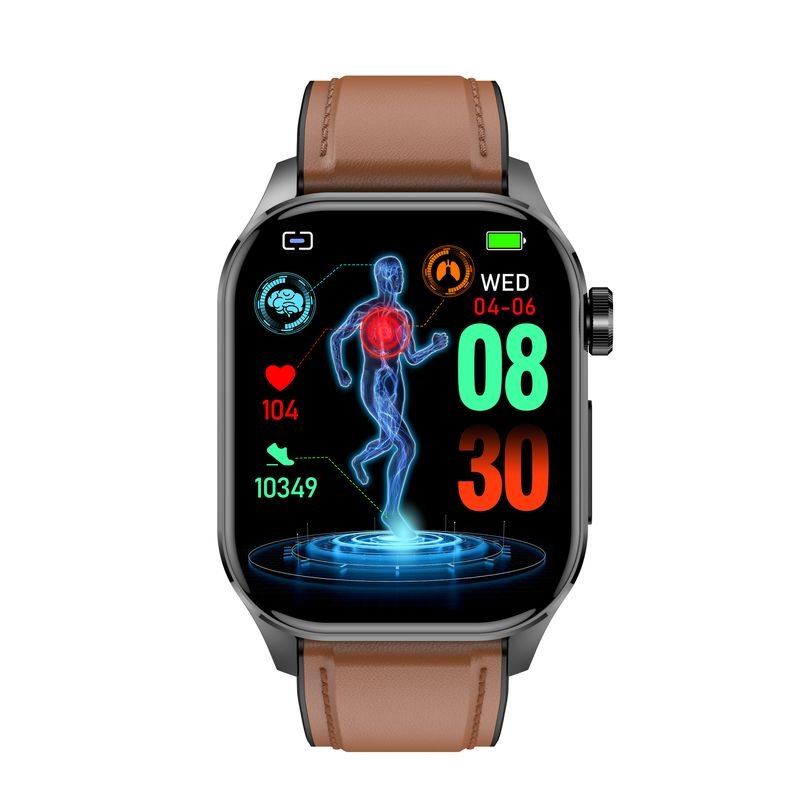
That is the ODM route working as it should: the factory’s platform, your brand, and a clear list of what can change. The same model also shows where the route ends — the display size, the chip, and the battery are the platform’s, not yours. See our custom logo guide and the smartwatch OEM/ODM guide.
At HnThai, a sourcing partner based in Huaqiangbei, Shenzhen, we work with buyers on both routes: helping you pick a proven platform and brand it, or taking your specification to a factory and managing the sample, tooling, and production schedule. Browse our products, or contact us with your specification and target market, and we will tell you honestly which route fits.
FAQ
Can I switch from ODM to OEM with the same supplier?
Yes, and it is a common path: start on the supplier’s platform, prove the market, then move to your own design once volume justifies the tooling. Treat it as a new project — new specification, new tooling agreement, new sample rounds — with separate paperwork.
Who owns the tooling if I pay for the mould?
Typically the buyer owns it when the buyer paid for it — but only if the agreement says so. Without a written clause, the factory may treat tooling it holds as its own, and moving production means paying for the mould again. Confirm ownership and get a photo and serial number on file.
Can an ODM product be exclusive to my brand?
Only if exclusivity is written into the agreement, with a defined territory, term, and product scope. Expect to pay for it through a higher MOQ or a development fee, and expect the factory to ask for a volume commitment. Without a written clause, the same platform can be sold to other buyers, including in your market.