A Chinese electronics factory runs your order through sampling, material buying, a booked production slot, assembly, quality inspection and packing — and the quoted lead time usually covers only the production slot itself. For a smartwatch, stock models ship in 3–7 days, white-label orders take 15–25 days, custom OEM takes 45–60 days and full ODM takes 45–90 days.
That gap between the quoted number and the real calendar is where most importers lose their launch date. This guide walks through how a factory actually works, step by step, so you can read a production plan, ask the right questions before you pay a deposit, and spot a delay while there is still time to do something about it.
How a factory production schedule works
A factory does not start your order the day you pay. It starts it on the day your order reaches the front of a queue — and that queue is decided by a production schedule that covers every customer on the books, not just you.
The schedule is built around lines, not orders. A typical Shenzhen electronics factory has a set number of assembly lines, each with a fixed daily output. A smartwatch line might finish 2,000 to 3,000 units a day; a line running a different product cannot simply switch over without retooling, retraining and a fresh round of first-article checks. When a sales rep says "we can start next Monday", what they usually mean is "there is a free slot on a suitable line next Monday" — and that slot disappears the moment a bigger customer books it.
Your order moves through the factory in a fixed sequence, and each step has its own owner and its own date on the plan:
- Material readiness. The factory buys chips, displays, batteries, straps and packaging. If everything is in stock, this takes days. If a chip has to be ordered, this is the step that decides your real start date.
- Pre-production sample. One or a few units are built exactly as the bulk order will be built, and you approve them in writing. Nothing after this step should change without a new approval.
- Line setup. Tooling is fitted, test jigs are loaded, workers are briefed. For a repeat order of a public-mould model this is short; for a new mould it can take days of trial runs.
- Mass production. Assembly runs line by line, with in-line checks at each station.
- Quality inspection. A sample of finished units is tested against your spec — function, appearance, packaging.
- Packing and loading. Units are boxed, cartons are labelled, and the shipment is booked onto a truck, a flight or a vessel.
The single most useful habit you can build is to ask for this sequence as dated milestones before you pay the deposit, and to get each milestone confirmed in writing as it passes. Our guide to reading a factory production plan shows what each date on that plan means and which ones buyers most often misread. Our companion piece on what a production schedule is and why your order has a slot explains the queue logic in more detail — including when a factory will move you up the queue and what it costs.
One more thing worth knowing: a factory's schedule is a promise about capacity, not a promise about your order. A line can be booked for you and still sit idle if materials have not arrived. When you ask "when will it ship?", the answer that matters is not the date on the schedule — it is whether materials are in the building, the sample is approved, and the line is actually running.
What decides your lead time
Buyers hear "30 days" more than any other number in China sourcing, and it is also the most misunderstood number. When a factory quotes a lead time, it almost always means the days of production after the order is confirmed and the deposit is received. Sampling and approval, material buying, tooling, inspection and rework, packing, inland transport, export clearance and the wait for a ship or flight all sit outside that figure. Then comes international transit and import clearance. The date that matters is not when production ends but when the goods are available to sell.
Production itself is only 30–40% of the total time from first message to goods in hand. For consumer electronics the full run is typically 45–75 days, with production itself only 20–30 days of that. The table below gives the ranges we see across smartwatch orders; the pattern holds for other small electronics too.
| Project type | Typical lead time | What fills the time |
|---|---|---|
| Public mould, stock available | 3–7 days | Picking, QC, packing |
| Public mould + logo customisation | 15–25 days | Artwork approval, printing, packaging production |
| Public mould + custom packaging | 15–25 days | Box production, manual and label printing |
| Custom OEM (private mould) | 45–60 days | Mould making, trial runs, first-article approval |
| Full ODM (new product development) | 45–90 days | Design, tooling, testing, certification, sampling loops |
Five things move that number more than anything else:
- Materials and components. A factory with materials in stock can start almost at once. If it has to buy a specific chip, the order waits for its slowest supplier — a chip shortage can add 3–4 weeks. Ask which materials are in stock before the deposit, not after.
- Customisation. Your colours, logo, packaging and manuals add steps: artwork approval, printing plates, packaging production. Each one depends on your quick answers as much as on the factory.
- New tooling. A new mould is made, tested and adjusted before mass production can start. Ask for the tooling schedule separately from the production schedule.
- The factory's queue. Your order joins a queue with other customers' orders. In the months before Christmas and before Chinese New Year, many factories are full.
- Approvals and payments. Production usually starts only when the deposit has arrived and the sample has been approved in writing. A week lost waiting for a payment or a decision is a week added to the delivery date.
If you want the full breakdown of how a smartwatch order is timed, see how long it really takes to manufacture smartwatches. For the eight factors that push a delivery date out after the order is placed, see what affects your delivery date. And for the math on why a quoted 15 days turns into 30, our earlier piece on China electronics lead times walks through the five phases and where the time goes.
ISO 9001: what it really means (and doesn't)
Ask a factory for its certificates and ISO 9001 is usually the first one they show you. It is worth knowing exactly what that piece of paper certifies — because the common reading of it is wrong in a way that costs buyers money.
ISO 9001 certifies a quality management system, not a product. It says the factory has documented processes for how it handles orders, checks incoming materials, controls production, deals with defects and keeps records — and that an accredited certification body audited those processes and found them in place. It does not say the factory's smartwatches pass any particular test, meet any particular standard, or are defect-free. A factory can hold a valid ISO 9001 certificate and still ship a bad batch, if its own controls are weak or were not followed on your order.
Three checks turn the certificate from a decoration into useful information:
- Check the scope. A certificate lists the products and processes it covers. "Manufacture of electronic products" covering a factory that also sells you a smartwatch is fine; a scope that only covers plastic moulding, when you are buying a finished watch, is not the same thing.
- Check the issuing body and the dates. The certificate should name an accredited certification body, carry an issue date and an expiry date, and show surveillance audits — usually annual — in between. A certificate with no expiry date or no audit history is a red flag, not a credential.
- Ask what the system does on your order. The useful question is not "do you have ISO 9001?" but "show me your incoming-material check for the battery on this model, and your final inspection record for the last shipment of it." A factory that runs its system will have those records ready. A factory that only holds the certificate will not.
ISO 9001 is also no substitute for your own inspection. The certificate describes the system; your pre-shipment inspection checks the actual goods in the actual cartons. Both have a place, and neither replaces the other.
Note for readers: this section gives the general picture of what ISO 9001 covers. If you need the certificate wording checked against a specific factory's documents, ask us — we will go through it line by line with you before you place the order.
QC before shipment
Quality control is the step buyers skip most often and regret most often. It is also the cheapest insurance in the whole order: a few hundred dollars of inspection against a container of goods you cannot sell.
A pre-shipment inspection happens when production is finished and at least 80% of the order is packed — late enough that the goods being checked are the goods you will receive, early enough that a failed result still leaves time to fix things. The inspector pulls a sample from the cartons using an AQL sampling plan — the industry shorthand for how many units get checked and how many defects are allowed before the shipment fails. The sample size grows with the order size; the acceptable defect count depends on the level you agreed with the supplier before production started.
What an inspector actually checks, on a smartwatch order, falls into four groups:
| Check group | What gets tested | Why it matters |
|---|---|---|
| Function | Power on, screen, touch, Bluetooth pairing, calls, charging, buttons | A watch that will not pair is a return, not a sale |
| Appearance | Case, strap, screen glass, printing, colour match against the approved sample | Cosmetic defects are the top reason for retail returns |
| Battery and charging | Charge to full, confirm the watch holds charge, check the cable and charger fit | Battery complaints arrive after the sale, when they cost the most |
| Packaging and labelling | Box contents, manual, labels, barcodes, carton count and carton marks | Wrong labels stop a shipment at customs or at the retailer's dock |
Two rules make inspection work. First, agree the defect list before production: which faults count as critical (the watch does not work), which count as major (a scratched screen), and which count as minor (a slightly off-centre logo). Without that list, the inspector and the factory will argue about every finding. Second, never accept a factory's own final inspection as your only check. The factory's QC team reports to the same manager who is under pressure to ship on time. An independent inspector reports to you.
There is also a mid-production check worth knowing about. A during-production inspection, known as DUPRO, sends an inspector to the line while your order is still being assembled — usually when 10–30% of the units are finished. It catches problems that a final inspection finds too late: the wrong strap colour on the whole batch, a printing error repeated on every box, a component fitted the wrong way round. A DUPRO costs roughly the same as a final inspection, and on a first order with a new factory it is the money best spent, because fixing a problem mid-run costs hours while fixing it after packing costs days and a reopened carton for every unit.
If the inspection fails, the usual outcome is rework: the factory fixes the defective units, the inspector re-checks the affected cartons, and the shipment goes out late rather than wrong. That delay hurts — which is why the inspection date belongs on the production plan from the start, with a rework allowance of a few days built in after it. An order with no inspection and no rework allowance is an order where the first time anyone checks the goods is when your customer opens the box.
What causes delays
Most delays have one of five causes, and each one needs a different response. Pressuring the factory helps with none of them if you pick the wrong one — a missing chip does not arrive faster because you sent three more emails.
- Big-buyer queue jumping. When a large buyer places a rush order or raises its volume, a factory will quietly pull workers and lines off a 2,000-unit batch to serve the million-dollar client. Your order is not cancelled; it is moved. The sign is a schedule that slips a few days at a time, each time with a new reason.
- Material and subcontractor bottlenecks. Most assembly factories do not make every part in-house. They outsource electroplating, PCB assembly, strap production and custom boxes to small workshops nearby. If one of those workshops is late, the line waits — and the factory may not tell you which part is missing.
- Tooling revisions. For custom hardware, mould debugging and CNC adjustments often take two or three rounds. If the first article fails your dimensional checks, re-machining the mould can add 15–25 days. This is the delay that surprises buyers most, because it happens before mass production even starts.
- Seasonal labour turnover. After Chinese New Year, a share of the workforce does not return, and new workers need training. Output drops for weeks, and the factory will rarely volunteer that its lines are short-staffed.
- The communication blackout. Sometimes the person sending you updates only knows part of the story, or is reluctant to tell you what is happening because they do not want to lose the order. The updates keep coming — "materials arrive next week", "production is nearly finished", "ten more days" — while nothing changes on the floor.
The defence against all five is the same: evidence instead of promises. Ask for the dated production plan, ask which materials are in the building, and ask for photos or a short video of your goods on the line. A factory that is genuinely running your order can show you that in a day. A factory that cannot show you anything has a problem it is not describing.
Two commercial tools help before a delay happens. The first is a late-delivery penalty clause in the purchase agreement — a common structure deducts 0.5% to 1.0% of the order value per day of delay from the final balance, capped at 15% to 20%. The second is a split shipment: the supplier funds expedited air freight for the part of the order you need first, so a delay does not empty your shelves. Neither tool works if it is raised for the first time after the delay — put them in the agreement before the deposit is paid. Our guide to what happens when production is delayed covers the step-by-step response: how to verify what is really produced, how to renegotiate a realistic date, and when to move the order.
How to plan around Chinese holidays
China's public holidays stop production, and Chinese New Year stops it for far longer than the official dates suggest. In 2027 the Spring Festival falls on Saturday 6 February, with the official holiday running 5–13 February. Factories typically reduce output two to three weeks before the holiday and may not return to normal levels until March — about six weeks of lost or reduced production from late January to mid-March.
The practical rule is simple: your goods should be inspected and loaded before the factories slow down in mid-January. That means placing the order in December at the latest for anything you need in the first quarter, and earlier if the order needs a new mould or custom packaging. An order placed in the last week of January will, in most cases, not start production until March.
The same logic applies to the other long breaks — Labour Day (1–5 May 2027) and National Day (1–7 October 2027) — but the effect is smaller, usually a week of disruption rather than six. The October break matters most for Christmas stock: goods that leave the factory in late October still make it onto a vessel in time; goods that slip into November may not.
A short planning checklist for the holiday calendar:
- Work backwards from the date you need the goods on your shelf, not from the date the factory quotes.
- Add the inspection and rework allowance (3–5 days) and the freight booking time after production ends.
- Place CNY-season orders in December; confirm the factory's last shipping date before the holiday in writing.
- Ask in advance when the factory's workers return and how long the ramp-up takes — the first week back is never full speed.
- Keep a buffer of your best-selling stock through the holiday window, so a late shipment is an annoyance rather than an empty shelf.
For the full Chinese New Year ordering calendar, including when to place orders for each product type, see how to order around Chinese New Year.
Questions to ask before you place an order
Most sourcing problems are questions that were never asked. Before you pay a deposit, get written answers to these — a factory that answers clearly is a factory you can work with; a factory that dodges them will dodge you later too.
- Which materials are in stock today, and which have to be ordered — and how long does each one take?
- What is the dated production plan: material readiness, line start, line finish, inspection, loading?
- What is the tooling schedule, separate from the production schedule, if a new mould is needed?
- What does the pre-production sample approval cover, and what happens if the bulk goods differ from it?
- What AQL level will the pre-shipment inspection use, and who pays for the inspector?
- What is the defect list — which faults are critical, major and minor?
- What happens if production runs late — is there a penalty clause, and will you split-ship by air?
- When is the factory's last shipping date before the next holiday, and when does full production resume after it?
- Who is my contact if the sales rep is on leave — and who on the factory floor owns my order?
Get the answers in the same document as the quotation, not scattered across chat messages. When the order is placed, the quotation, the spec sheet, the sample approval and the production plan should all say the same thing. If they don't, the version the factory follows will be the one that suits the factory.
For the full order timeline from purchase order to shipment, with a checkpoint at each step, see from purchase order to shipment.
What a sourcing partner does between you and the factory
Everything in this guide can be done directly with a factory — if you have someone on the ground to do it. The work that sits between a buyer and a factory is not one job; it is a chain of small jobs, and each one is a place where an order quietly goes wrong when nobody owns it.
The first job is translation, and not only of language. A buyer writes "good quality, fast delivery" and means one thing; a factory reads it and hears another. A sourcing partner turns the buyer's requirements into a spec sheet the factory can actually build to — display size and resolution, battery capacity in mAh, water rating, charging time, strap material, box contents, label wording — with numbers instead of adjectives. That spec sheet is then the document the sample is judged against, the production line works from, and the inspector checks at the end. One document, used three times, is what stops the sample and the bulk goods from drifting apart.
The second job is presence. A sample approval, a material delay, a tooling revision — each of these is a decision point where a day of waiting costs a week on the schedule. Someone in the same city can walk into the factory, look at the line, and come back with a real answer the same day: materials are in the building, the sample is ready, the mould needs one more round. Without that, the buyer is reading chat messages from a sales rep who may only know part of the story.
The third job is consolidation. A buyer ordering smartwatches from one factory, straps from another and boxes from a third ends up with three shipments, three inspection bookings and three freight bills. A partner in Huaqiangbei — where the factories, the component markets and the logistics agents sit within a few streets of each other — can bring those parts together, check them as one order, and ship them as one consignment.
None of this replaces the factory. The factory builds the product; the partner makes sure the product that gets built is the one the buyer asked for, on the schedule the buyer planned around. If you are choosing between going direct and working with a partner, the honest test is time: if you can spend a week in Shenzhen for every order, going direct works well. If you cannot, the partner is not an extra cost — it is the person doing the work you would otherwise have to do yourself, from a different time zone, through a chat window.
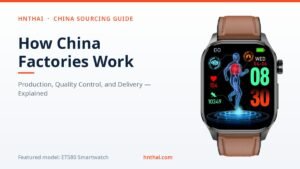
Featured model: the ET580
The ET580 smartwatch is a good example of the kind of order this guide describes: a public-mould model, ready for white-label production, with a spec sheet that leaves little to argue about. A 2.04-inch AMOLED display at 368 × 448, a JL7013A chip, Bluetooth 5.2, a 380mAh battery with 3–5 days of use and more than 20 days of standby, IP68 water resistance and magnetic charging in about 3–4 hours. Those numbers are the ones to put in the spec sheet and check at inspection — display size, battery life, water rating, charging time — because they are the ones your customers will test first.

| Specification | ET580 |
|---|---|
| Display | 2.04-inch AMOLED, 368 × 448 |
| Chip | JL7013A |
| Bluetooth | 5.2 BLE |
| Battery | 380mAh, 3–5 days use, 20+ days standby |
| Water resistance | IP68 |
| Charging | Magnetic, about 3–4 hours |
| App | H Band |
Frequently asked questions
How long does it take to manufacture a smartwatch in China?
For a stock public-mould model, 3–7 days from order to shipment. A white-label order with your logo and packaging takes 15–25 days. A custom OEM order with a private mould takes 45–60 days, and a full ODM new product takes 45–90 days. Those figures cover production only — sampling, material buying, inspection and freight sit outside them, so the full run from first message to goods in hand is typically 45–75 days.
What does ISO 9001 actually guarantee when I buy from a Chinese factory?
ISO 9001 certifies the factory's quality management system — its documented processes for handling orders, checking materials, controlling production and dealing with defects — as audited by an accredited certification body. It does not certify the product itself and does not guarantee defect-free goods. Check the certificate's scope, the issuing body and the audit dates, and always run your own pre-shipment inspection on the actual goods.
How far ahead should I order before Chinese New Year?
Place the order in December and have the goods inspected and loaded by mid-January. Chinese New Year 2027 falls on 6 February, with the official holiday running 5–13 February, and factories lose about six weeks of normal output from late January to mid-March. An order placed in the last week of January will, in most cases, not start production until March, so anything you need in the first quarter has to be ordered before the holiday window opens.
HnThai is a sourcing partner based in Huaqiangbei, Shenzhen. If you are planning an order and want a dated production plan, a spec sheet check, or a pre-shipment inspection arranged before you pay a deposit, talk to us — or browse the current range in our product catalogue. Our smartwatch sourcing guide covers model selection in detail if you are still choosing what to order.