A corporate tech gift order from China works when the buyer sets a per-recipient budget first, picks a product the recipient will actually use, locks the logo and packaging in writing, and works backward from the date the gifts must be in hand — allowing about one week for samples, 15–30 days for bulk production, and 5–45 days for freight depending on the shipping mode.
That sounds like common sense, and it is. The reason so many gift orders still go wrong is that each of those four steps is easy to skip when the deadline is close. A buyer picks a product because it looks good in a photo, agrees a logo over chat, and only then asks when the gifts can arrive. By that point the factory has already started, the logo file is wrong, and the only freight option left is the expensive one. This guide walks through the whole order the way it should run, in the order the decisions should be made.
What a corporate tech gift is actually for
Before the product, the budget, or the logo, it helps to be clear about what the gift has to do. A corporate gift is not a product sale. Nobody judges it the way they judge a purchase. The recipient did not choose it, did not pay for it, and did not ask for it — so the gift is judged on three things only: is it useful, does it feel like some thought went into it, and does it carry the giver's name without shouting it.
Tech gifts score well on the first of those three because they get used every day. A smartwatch, a pair of earbuds, or a wireless charger sits on a desk or a wrist, not in a drawer. That daily use is also why tech gifts carry the giver's brand further than a pen or a mug: the logo is seen every time the recipient checks the time or answers a call. Freebird Promo's gifting guide makes the same point from the other side — tech accessories such as power banks and wireless chargers cross cultural lines because everyone uses them, which is why they are the safest choice when the recipient list spans several markets.
The second test — did some thought go into it — is where most gift orders fail. A generic item with a logo slapped on it reads as a bulk buy, and the recipient can tell. The fix is not a bigger budget. It is a small amount of matching: a watch for a sales team that travels, earbuds for a team that works on calls all day, a 2-in-1 watch-and-earbuds model for a client list where one item has to cover everyone. The product does not need to be expensive. It needs to fit the person who opens the box.
The third test is the branding. One surface, one colour, one logo — that is the rule that holds in almost every market. A gift with the logo on the watch face, the strap, the box and the sleeve reads as advertising, and in some markets it reads as cheap. Keep the branding to one place and let the product do the rest.
Picking the product: what actually sells as a corporate gift
Not every electronic product makes a good gift. The products that work share four traits: they are useful without setup, they fit most recipients, they travel without breaking, and they can carry a logo without looking worse for it. The table below scores the common choices against those four tests.
| Product | Useful from day one | Fits most recipients | Travels well | Takes a logo cleanly |
|---|---|---|---|---|
| Smartwatch | Yes — worn daily | Yes — one size fits most wrists | Yes — small, light, no glass to crack in transit if packed right | Yes — case back or strap |
| TWS earbuds | Yes — used daily | Yes — no sizing | Yes — tiny, light | Yes — case lid |
| 2-in-1 watch + earbuds | Yes — two gifts in one box | Yes — covers both uses | Yes — single case | Yes — watch case |
| Power bank | Yes — universal | Yes — everyone charges a phone | Heavy — freight cost climbs with quantity | Yes — flat surface |
| Wireless charger | Yes — desk use | Yes — if the recipient has a phone that supports it | Yes — flat, light | Yes — top surface |
| Bluetooth speaker | Yes — home and office | Mostly — some recipients never use one | Bulky — packaging and freight rise | Yes — flat side |
| Smart glasses | Sometimes — needs the right recipient | No — fit, prescription and taste vary | Fragile — needs careful packing | Hard — little flat surface |
Two patterns stand out. First, the 2-in-1 watch with earbuds built into the case is the strongest single-item gift in the list: it solves the "which one do I pick" problem by giving the recipient both, it packs as one item, and it only needs one inspection. Second, smart glasses are the weakest gift in the list — not because the product is bad, but because fit and taste matter too much for a gift chosen for someone else. Save them for a recipient you know well, or for a retail channel where the buyer picks their own.
A practical rule for a first gift order: pick one product, not three. One product means one sample to approve, one set of artwork, one inspection, and one packing line. Buyers who order three different products for one campaign triple the number of things that can go wrong, and they usually do it to cover a worry — "what if they don't like this one?" — that a single well-chosen product already answers.
How much to spend per recipient
Budget is the first decision, and it should be made before the product is picked, not after. A budget that follows the product always drifts upward; a product picked to fit a budget stays inside it.
The short version: most corporate tech gift programs land in three bands — a standard band for a wide list of clients or staff, a mid band for valued partners, and a premium band for a small list of key accounts. The exact numbers depend on the market and the relationship, and our guide to corporate tech gift budgets sets out the tiers per recipient with the products that fit each one. Two rules from that guide are worth repeating here because they shape the whole order.
First, the gift should sit inside the tier for that recipient even when the buyer can afford more. An expensive gift creates obligation, and obligation makes people uncomfortable — in some markets it can even look like a bribe attempt, and in the United States there are strict limits on what government employees may accept. A gift that is too generous can do more damage than a modest one.
Second, the budget has to cover the whole gift, not just the product. The logo work, the gift box, the sleeve, the insert card, and the freight all come out of the same number. A watch that costs $32.50–$36.50 at the factory is not a $35 gift once the box, the printing and the shipping are added. Buyers who budget for the product alone always find the total 20–30% higher than they planned, and that gap is where the last-minute cuts happen — usually to the packaging, which is the first thing the recipient sees.
Custom branding: logo, colours and packaging
Branding is where gift orders most often stall, and the stall is almost always a file problem, not a factory problem. The factory can print a logo in a day; what takes a week is the back-and-forth over a file that is the wrong format, the wrong resolution, or the wrong colour.
Send vector artwork — AI, EPS or PDF with the fonts outlined — and name the Pantone or CMYK colour in writing. A JPG pulled from a website will not print cleanly on a watch case, and a logo in RGB will come back a different colour than the one on the buyer's screen. Our artwork guide lists the file formats that keep a proof from bouncing back, and the rule is simple: if the file is not vector, expect at least one extra round of corrections.
The logo method depends on the product. Laser engraving suits a metal watch case — it is durable, single-colour, and it reads as premium. Pad printing works on a plastic earbud case. A debossed logo on a leather sleeve or a gift box looks better than a printed one and costs little more. Ask the supplier which method they recommend for the exact model, and ask for a photo of a finished sample with the logo applied before the bulk run starts. A digital mockup is not a substitute for that photo: colours shift between screen and print, and a logo that looks centred on a mockup can sit off-centre on the real case.
Packaging deserves the same attention as the product. A gift that arrives in a plain brown carton with the product loose inside is not a gift, whatever the product cost. The minimum that works is a rigid gift box or a printed sleeve with an insert that holds the product in place, plus a short card. Our guide to private label packaging covers what to confirm before production — box size, insert fit, sleeve artwork, and the exact text on the card — and the point that matters most for gifts: confirm the packaging in the same approval as the product, not after it. Packaging added late is packaging rushed, and rushed packaging is where misprints happen.
One more branding decision to make early: how many different versions of the gift are needed. A single logo and a single box for the whole order is the cheapest path. A different sleeve per market — red and gold for China, understated for Japan and Europe — costs more in artwork and packing time, but it is the difference between a gift that lands well everywhere and a gift that offends in one market. Our guide to gifting across markets sets out the rules market by market: sets of four are avoided in China, Korea, Japan and Vietnam; white wrapping signals mourning in Singapore; alcohol and pork products are out in Muslim-majority markets. If the recipient list spans markets, the packaging plan has to be written market by market, in the purchase order, not left to the packing line to guess.
Working backward from the in-hands date
The most common reason a gift order arrives late is that the buyer started from the order date and added the steps forward, instead of starting from the date the gifts must be in hand and working backward. The forward method always finds a date that looks fine on paper and fails in practice, because it leaves no room for the one revision, the one failed sample, or the one freight delay that every real order contains.
SourcingXpro's gift-planning guide sets out the backward timeline for a typical custom gift program from China, and the numbers are a good planning base: a free logo mockup within 24 hours, sample production in about one week, sample courier to the US or the EU in 5–7 days, bulk production in 15–30 days after the pre-production sample is approved, then express freight in 5–7 days, air freight in 7–10 days, or sea freight in 35–45 days. Gift programs start at a minimum order value of USD 1,000, and the sample fee runs about USD 20–100, usually deducted from the bulk order.
| Step (work backward) | Typical time | What the buyer decides |
|---|---|---|
| In-hands date | Fixed | The day gifts must be with you or the recipients |
| Distribution buffer | A few days | Time to sort, kit locally, or ship to offices |
| Freight to you | Express 5–7 days / air 7–10 days / sea 35–45 days | Mode against budget |
| Pack, QC and ship-out buffer | A few days | Final inspection, kitting, booking the flight or truck |
| Bulk production | 15–30 days after sample approval | Quantity and customisation drive the range |
| Your sample approval time | Your call | Written approval, or a revision loop |
| Sample courier (US/EU) | 5–7 days | UPS, FedEx or DHL; your account is fine |
| Sample production | About 1 week | Gift sets sampled as a whole set |
| Mockup and logo revisions | Free mockup in 24 hours | Lock the logo before the physical sample |
| Brief and product selection | Your call | Budget, audience, set or single item |
For a December event, that timeline means the sample path should start in October for a conservative plan with express freight — earlier still if the order needs air or sea freight, a multi-item gift set, or if it runs into the Chinese New Year blackout. Our Christmas order deadline guide applies the same working-backward method to the year-end window, and our electronics sourcing calendar maps the Chinese holiday dates that shape order timing through the year. The same discipline applied to Chinese New Year is in our production planning guide for the spring festival.
Two points in that table catch first-time buyers out. The first is the sample: gift sets must be sampled as a whole set, not item by item, because the set is what the recipient opens — the box, the insert, the count and the sleeve all have to be checked together. The second is the approval: bulk production starts only after a written pre-production sample approval. A chat message saying "looks good" is not an approval, and a factory that starts on a chat message is a factory that will argue about who approved what when the colour is wrong.
Sample costs are part of the same plan. The sample fee of about USD 20–100 is usually deducted from the bulk order, and the buyer pays the sample courier. Our guide to sample costs from China explains who pays what and why — and why a supplier who refuses to send a sample at all is a supplier to walk away from.
Building a gift set that actually gets used
A single product is the safe choice for a first order. A gift set is the choice that earns a higher margin and a stronger reaction — if the set is built around how the recipient will use it, not around how many items fit in the box.
The sets that work follow one rule: every item in the box should be used with the others, or used by the same person in the same week. A watch with earbuds built into the case is a set in one product. A watch plus a charging cable plus a spare strap is a set that makes sense — the recipient uses all three. A watch plus a power bank plus a notebook is three unrelated items in one box, and the recipient will use one and shelve the rest.
The count matters too, and it matters differently by market. Six and eight are favourable numbers in China, standing for luck and prosperity, and a pair of items is considered lucky in Japan — while four is unlucky in China, Korea, Japan and Vietnam, and nine is unlucky in Japan. The practical rule: build sets of two, three, six or eight items, never four. Our guide to corporate tech gift sets shows how to build those sets so the count is a choice, not an accident, and how to price a set so the margin rises without the per-recipient cost jumping a tier.
Pricing a set is where the margin lives. A set of two items that cost $15 and $12 at the factory does not have to sell as a $27 gift — the set is worth more than the sum of its parts because the buyer did the matching work and the recipient gets a complete package. The usual way to price it is to take the combined product cost, add the shared packaging once instead of twice, and set the set price a step above the single-item tier. The packaging saving is real: one box, one sleeve, one insert, one shipment — and that saving is what funds the better box that makes the set feel like a gift rather than a bundle.
Gifting across markets: one order, several rulebooks
A gift order that goes to one market is a packaging decision. A gift order that goes to five markets is five packaging decisions, and the order has to carry them all in writing.
The rules that catch buyers out are rarely about the product. They are about the number of items in the set, the colour of the box, and the timing of the delivery. Sets of four are avoided across East and Southeast Asia. White wrapping paper signals mourning in Singapore, and white gift boxes carry the same risk across much of Asia. Red is lucky in China and a safe choice for packaging there, but red ink on a name is a bad sign in Korea. In Japan, the gift should be presented with both hands and beautifully wrapped, and it is not opened in front of the giver — while in Italy and Chile the opposite holds, and leaving the gift wrapped looks odd.
Timing is a rule too. In Japan, a gift sent too early in the relationship can read as pushy. In China, wait until the negotiation has finished, so the gift cannot be read as an inducement. In Muslim-majority markets, check the calendar around Ramadan before sending anything. Our guide to gifting etiquette across markets sets out the full market-by-market table, and it is worth reading before the order is written, not after the boxes are packed — because a colour change or a count change costs nothing before production and costs a reprint after it.
The practical way to run a multi-market order is to write the market into the purchase order line by line: destination market, set count, sleeve colour, card language, and ship date, for each batch. The supplier then packs batch by batch, and the inspection checks each batch against its own line. That is a little more work at the order stage, and it is the only way the order comes out right at the packing stage.
QC for a gift order: what to check before it ships
A gift order needs the same inspection as any electronics order, plus three checks that are specific to gifts. The standard checks — function, appearance, and packaging — are covered in our pre-shipment inspection guide, and the sampling method is the AQL system: a sample is drawn from the batch and checked against an agreed defect limit, so a few bad units do not pass a whole order and a few good ones do not hide a bad batch.
The three gift-specific checks are these.
The logo, on the real product. Check the logo on a finished unit from the bulk run, not on the sample and not on a mockup. The check is position, colour, and durability: is it centred, is the colour the Pantone that was agreed, and does it survive a rub test with a thumb. A logo that wipes off with a thumb will wipe off in the recipient's hand, and that is the last impression the gift makes.
The set count and the box contents. Open finished boxes at random and count what is inside against the packing list, market by market. A set of six that ships with five items is a gift that arrives short, and the recipient counts. Check the insert too: the product should sit in the insert without rattling, and the card should be the right language for the destination market.
The battery and the charge. Every watch and every pair of earbuds should arrive with enough charge to switch on out of the box. A gift that does not switch on when the recipient opens it is a gift that gets returned, and the recipient will not try twice. Check a sample of units from each batch for power-on, and check that the earbuds pair with a phone before the bulk run is approved. For lithium batteries, confirm the shipping documents — MSDS and battery certification — are ready before the freight is booked, because a shipment held for missing battery paperwork misses the event date entirely.
One more check that belongs on every gift order: the carton markings. The cartons should be marked by market and batch, so the warehouse ships the red-sleeve batch to China and the understated batch to Japan, not the other way round. A mixed shipment is a silent failure — nobody notices until the recipient opens the wrong box.
What goes wrong: the five mistakes that cost buyers money
Most gift-order failures fall into five patterns, and all five are avoidable at the order stage.
Ordering too late. The buyer starts in late November for a mid-December event, skips the sample, and takes the first freight quote. The gifts arrive on December 23, when the office is empty. The fix is the backward timeline above, started a month earlier than feels necessary.
Approving the logo from a mockup. The logo looks right on screen and wrong on the case — wrong colour, wrong size, off-centre. The fix is a photo of the finished sample with the logo applied, approved in writing before the bulk run.
One box for every market. The same white box and the same set of four goes to China, Japan, Singapore and Germany. The fix is a market-by-market packaging plan in the purchase order.
No sample, no inspection. The buyer skips the sample to save a week and skips the inspection to save the fee. The first time the product is seen is when the recipient opens it — and that is when the dead battery, the wrong strap colour, or the scratched case is found. The fix is a sample and an AQL inspection on every order, even a small one.
Budgeting for the product only. The logo, the box, the sleeve, the card and the freight are discovered after the order is placed, and the packaging is cut to fit the budget. The fix is a budget that covers the whole gift from the start.
None of these mistakes is a factory problem. They are all order problems, and the buyer controls every one of them.
Featured model: the GT100PRO
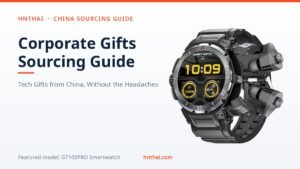
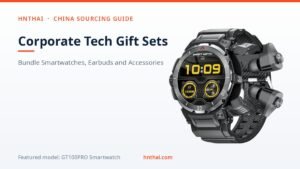
The GT100PRO smartwatch is a good model to anchor a gift order on because it is a 2-in-1: a smartwatch with TWS earbuds docked in the case, so one item does the work of two gifts. It runs on a Realtek 8763EWE chip, with a 1.46-inch full-touch display at 360×360, Bluetooth 4.0/5.2, a 360mAh watch battery with 30mAh earbuds docked in the case, IP67 waterproofing, and 128MB of flash memory, in an alloy and PC case at 75 g, at $32.50–$36.50. Every number there comes from the product page.
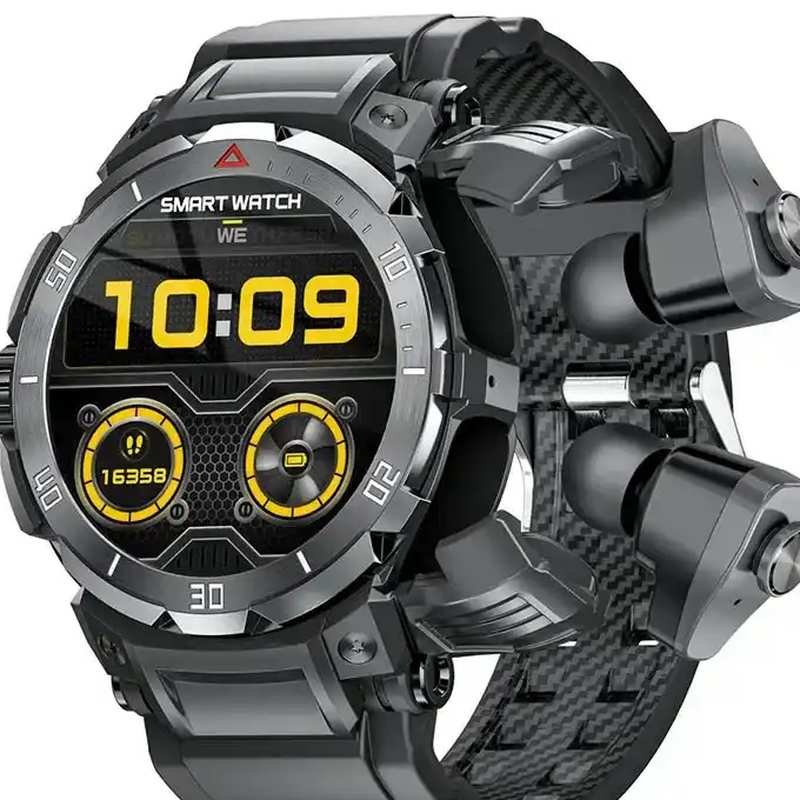
That price puts it in the standard tier for a wide client or staff list, and the 2-in-1 format is what makes it work as a gift: one item to sample, one item to inspect, one box to pack, and two things for the recipient to use. The earbuds charge from the watch battery, so there is no separate charger to forget. Earbud playtime in hours is not stated on the product page, so confirm it in writing before you quote it to a client.
For the full selection method behind the models in this guide, start with our Smartwatch Sourcing Guide. For the rest of your range, browse our products and tell us which markets you are gifting into — we can put a sample together in the right colours and counts before you commit to the full order.
FAQ
How far ahead should I order corporate tech gifts from China?
Start the sample path at least 10–12 weeks before the gifts must be in hand for a custom order: about one week for samples, 5–7 days for the sample courier, 15–30 days for bulk production after sample approval, and 5–45 days for freight depending on the mode. A December event means starting in October. Ready stock with a simple logo can move faster, but a custom gift set with custom packaging cannot be rushed without cutting the checks that keep it right.
What is the minimum order for custom corporate gifts from China?
It depends on the supplier and the level of customisation. A typical custom gift program starts at a minimum order value of USD 1,000, and a common earbud program starts at 100 pieces per model on a stock platform. A logo alone usually has a lower minimum than a custom colour or custom packaging, so ask for the minimum per customisation layer in writing before you commit to a quantity.
Should I order one product or a gift set for a corporate campaign?
One product is the safer first order: one sample, one set of artwork, one inspection, one packing line. A gift set earns a higher margin and a stronger reaction, but only when every item in the box is used with the others — a watch with earbuds built in, or a watch with a spare strap and a charging cable. If the set is three unrelated items in one box, the recipient will use one and shelve the rest, and the extra cost buys nothing.