To compare quotations from Chinese suppliers, confirm every supplier quotes against the same specification, quantity, quality requirements, packaging, and Incoterm — then compare what is included and excluded, not only the unit price. The lowest number on the first page may not produce the lowest total purchasing cost.
Why the same product comes back at five prices
Send one drawing to five suppliers in Shenzhen, Ningbo, and Yiwu and the quotes can land anywhere from $3.10 to $5.40 a unit. The instinct is to assume the cheap one is lying and the dear one is greedy — usually neither is true. A quote is a factory’s reading of an incomplete brief, priced against its own materials, machines, and position in the supply chain. A spread is not a verdict on honesty; it is a signal that the suppliers answered slightly different questions.
Most of the gap comes from spec ambiguity. If your RFQ does not pin down material, dimensions, tolerances, finish, packaging, and quantity, each factory fills the blanks with its own defaults, and the cheapest default wins. A complete RFQ built around a bill of materials removes most of the variation before it starts.
The five lines that decide the comparison
Restate every quote on the same five lines before you rank anything. The swings below are directional ranges from quotes compared on building-material orders — not a published statistic — but they show where the money hides.
| Line | What to fix | Typical swing in quotes |
|---|---|---|
| 1. Written specification | One document, priced by every supplier | 10–25% |
| 2. Unit price at a stated quantity | Same quantity, or no comparison | 5–20% |
| 3. One-time costs separated | Tooling and samples on separate lines | 2–10% |
| 4. Trade term and named point | FOB, EXW, CIF are different offers | 5–12% |
| 5. Price validity | Expiry date changes the offer | 2–8% |
Start with one controlled RFQ: send each supplier the same request, with a clear document version and a closing date. It should define the product name, model, drawing or reference, material and critical components, dimensions, tolerances, required performance, quantity and repeat demand, and the applicable standards, inspections, and tests. Separate requirements into mandatory, preferred, and optional, and ask suppliers to list every deviation instead of silently substituting a material, component, or process.
Worked example: the cheaper quote costs more
Consider this calculation example, which does not represent market prices. Two suppliers quote the same 500 units:
| Cost item | Supplier A | Supplier B |
|---|---|---|
| Unit price | $3.80 | $4.20 |
| Quantity | 500 | 500 |
| Setup fee | $120 | Included |
| Packaging per unit | $0.35 | Included |
| Subtotal | $2,195 | $2,100 |
Supplier B has a higher unit price but costs $95 less for the listed scope. Neither subtotal includes inspection, freight, or destination charges — add confirmed expenses, and keep unknown charges marked “unconfirmed”: a blank cell does not mean zero.
Material grade: the saving you cannot see
“Stainless steel” is not one thing: 304-grade costs noticeably more than 201-grade and resists corrosion far better, so a quote built on 201 undercuts a 304 quote on the identical drawing. When a price looks too good, the saving is almost always a material substitution you never specified — name the grade, the brand, and the standard in the bill of materials so nobody can swap it out quietly.
Factory, trader, or middleman
The companies quoting you may not all make the product. A real factory quotes close to its own cost; a trading company adds a margin, so its quote runs higher — or it shops your RFQ to the cheapest sub-supplier and quotes low to win the order. A trader can still be the right partner if it adds real value — quality control, consolidation, export handling — but that value should be visible in the quote, not hidden in a higher unit price.
Trade terms: EXW is not FOB
A factory quoting EXW (goods at the factory door) will always look cheaper than one quoting FOB (loaded onto the ship) or DDP (delivered to your door), because the cheaper number leaves freight, clearance, duty, and insurance for you to pay later. FOB versus EXW versus CIF can be a 5–12% swing on the same goods — ask each supplier to state the trade term, the version, and the named place or port, then get logistics estimates for the remaining stages.
Red flags in a quotation
A quote describes an offer; it does not confirm the finished goods will meet your requirements. Watch for these signs:
- No validity date. A price with no expiry can move before you order — ask how long it holds and what raw-material movement does to it.
- No packaging line. If packaging is not in the quote, it is not free — it arrives later as a separate charge.
- Vague materials. “Metal case” and “quality battery” are not specifications. Pin down the grade, the brand, and the standard.
- Tooling buried in the unit price. One factory amortises a $4,000 mould across your first order and quotes high; another already owns a near-identical mould; a third buries tooling inside the unit price. State the exact quantity, and ask for tooling, setup, and sample costs as separate lines.
- No inspection or warranty terms. Review samples against the quoted specs, and agree on inspection criteria and defect handling before production — not after the goods arrive.
A real example: the MT300
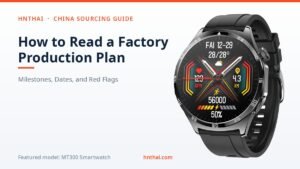
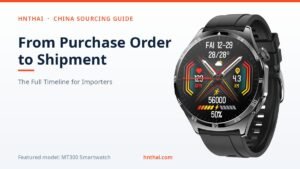
Take a real product: the MT300 smartwatch carries a 1.43-inch AMOLED display at 466×466, a JL7013A chip, Bluetooth LE 5.0, a 440mAh battery, 2-pin magnetic charging, IP67, 11 watch languages, 50 sport modes, and OTA upgrades, at 48×12 mm and 63.5g.
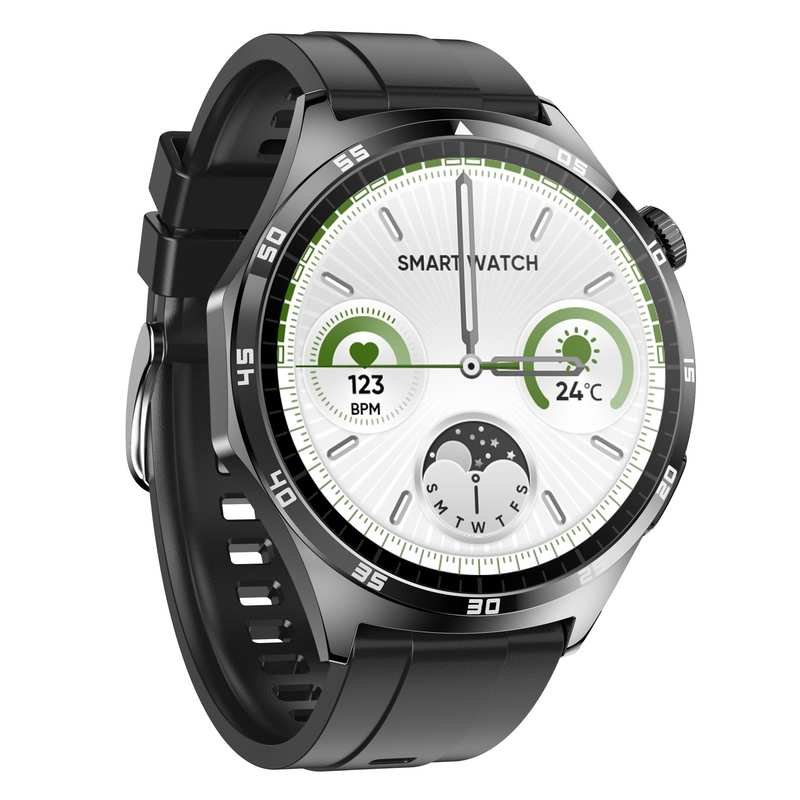
On an MT300 order, the comparison sheet writes itself: chip JL7013A, display 466×466 AMOLED, battery 440mAh, IP67, magnetic charging — each pinned in the RFQ so no supplier can substitute a smaller battery or a lower-grade display. Ask each supplier to quote the same quantity, packaging, and trade term, with tooling and samples on separate lines.
See our Smartwatch Sourcing Guide, supplier verification guide, quotation guide, MOQ guide, payment terms guide, and private label packaging guide. Browse our products page and smartwatches page.
Frequently Asked Questions
How many suppliers should I ask for quotations?
Three to five. Fewer than three and you have no comparison; more than five and the comparison sheet becomes the work. Send all of them the same RFQ — same version, same quantity, same closing date — and ask each one to list every deviation in writing.
What if the quotes differ by 30% or more?
When quotes differ by 30%, they are usually not pricing the same product — each supplier fills the spec’s gaps with its own assumptions. Restate every quote on the five lines and the gap usually shrinks to a real difference between factories.
Should I tell suppliers each other’s prices?
No. Share your specification and requirements, not another supplier’s number — telling a supplier the target price invites it to hit the number by cutting something you did not specify. Let each supplier price the same document honestly, then compare the restated quotes.