Verifying a Chinese electronics supplier means checking three things before you pay: the company is real and registered, the factory can actually make your product, and the sample matches the quote. Desk checks on China's official registry and the supplier's badges cost nothing and take about half a day. A sample order and a third-party audit are the two checks that catch what paper cannot.
What "verified" actually means
Most first-time buyers read a badge and stop there. That is the mistake that costs money: a badge answers one narrow question, and rarely the one you need answered.
Alibaba's Gold Supplier badge sits on more than 120,000 accounts. It proves the supplier paid a membership fee — from about $3,000 a year — and passed basic identity checks. It says nothing about quality, capability, or finances. A Verified Supplier badge goes a step further: a third party such as SGS, TÜV Rheinland, or Bureau Veritas checked the registration documents, the legal representative's ID, and the physical address. It still covers no on-site audit, sample testing, or supply chain.
Trade Assurance carries real weight, because it ties money to delivery: a refund if goods are not shipped, arrive defective, or do not match the verified specification. But it only applies to orders placed through Alibaba's own messaging and payment system — pay by WhatsApp, WeChat, or bank transfer and the protection is gone.
The desk checks you can run for free
Every legally registered company in China is listed on the National Enterprise Credit Information Publicity System at gsxt.gov.cn. Search by the company's Chinese name or 18-digit credit code, and read three lines: the legal representative, the business scope, and the registered address.
Stop when any of these three fails: the legal representative is not the person you are dealing with; the business scope does not mention your product category — a company registered for trading, not manufacturing, is legally a trading firm, whatever its Alibaba page claims; or the registered address sits far from the factory location in their emails. Ask for a clear scan of the business license and cross-check the code. If they hesitate, that is an answer in itself.
Search the same company name on 1688.com, China's domestic wholesale platform: if the same company sells the same products there at 20 to 40% lower prices, they are a real factory — traders rarely list on 1688 — and you have a rough floor price.
What the badges do and do not prove
| Check | What it proves | What it does not prove |
|---|---|---|
| Gold Supplier | Membership fee paid, basic identity checked | Quality, capability, finances |
| Verified Supplier | Registration, ID, and address checked by a third party | Factory audit, sample quality, supply chain |
| Trade Assurance | Refund if goods are not shipped or do not match spec | Anything if you pay outside Alibaba |
| ISO 9001 certificate | A quality system was certified, if the number checks out | That this order follows it |
| Business license on gsxt.gov.cn | The company exists and its legal scope | That the factory in the photos is theirs |
The sample test
Paper checks filter out shell companies, not a factory that cuts corners on your order. That is what the sample is for. Budget $200 to $2,000 for sample validation depending on the product.
Order the sample against the written specification, not the sales page. Check it line by line — screen size and resolution, chip model, battery capacity, charging method, waterproof rating — and run it for a week the way your buyer will use it. If the sheet states a feature, test it; if it stays silent, get it in writing before you quote it. Then sign off a golden sample as the reference for production.
Factory audits: what to ask for
An on-site audit costs $300 to $800 through a third-party agency, and it answers the question no document can: does this factory actually make this product here? Mention that you will have the factory audited and watch the reaction. A real factory welcomes it; a trading company posing as one will stall, offer a pre-recorded video, or say the floor is closed.
If you cannot send an auditor, ask for a live video walkthrough at a set time — a laptop on the shop floor. Ask to see the production line running, the material storage, and the testing bench, and ask the engineer a technical question: a factory that makes the product can describe the last three similar products it built. A factory with a real incoming-material check will show you the records. One that cannot is running on trust.
Red flags that should stop the order
Seven patterns show up again and again in bad orders. A price 40% below the market average is the first: a real manufacturer can save you 15 to 25% against a developed-country supplier and still run profitably, and it can break down its costs to explain the price.
The rest: the registration does not match the seller's story; they avoid live video calls or visits; upfront payment demands exceed what any bank would call reasonable — standard practice is 30% deposit with the rest before shipment; they raise the price after the deposit is paid; they subcontract outside the approved facility or change a component without notice. Any one is a reason to pause. Two together is a reason to walk away.
A real example: the MT300
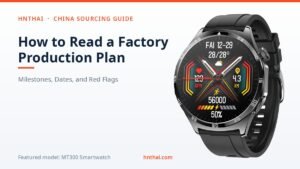
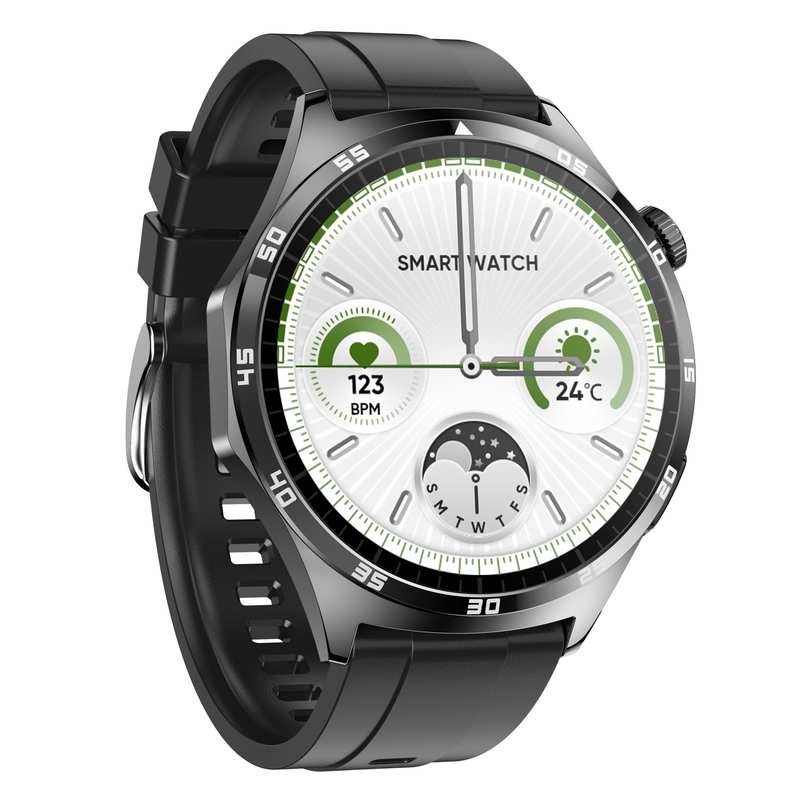
Verification is easier to picture on a real product. The MT300 smartwatch is a 1.43-inch AMOLED watch (466×466) in a metal-alloy case with a rotating crown, on a JL7013A chip with Bluetooth LE 5.0 and the H Band app. It carries a 440mAh battery with 2-pin magnetic charging, is rated IP67, and measures 48×12 mm at 63.5 g. Its sheet states over-the-air upgrades, 11 watch languages, and 50 sport modes.
The sheet states no days of use and no brightness in nits, so both go on the written-confirmation list. Order a sample, wear it for a week, and check the crown, charging pins, and app pairing. Registry first, badges second, sample third, audit when the order justifies $300 to $800.
See our Smartwatch Sourcing Guide, our sample testing guide, and our smartwatches page. Browse the full range on our products page.
Frequently Asked Questions
How long does it take to verify a Chinese supplier?
The free desk checks take about half a day. A sample takes one to two weeks including shipping and testing. An audit takes a few days to book and a day on site.
Is a Gold Supplier badge enough to trust a supplier?
No. The badge proves a fee was paid and basic identity checks passed — nothing about quality, capability, or finances. Check the registry, the business scope, and a sample before you order.
What should I do if a supplier refuses a factory audit?
Treat the refusal as information. A real factory welcomes an audit; a trader stalls or offers a pre-recorded video. Ask once for a live video walkthrough at a set time. If that is also refused, find another supplier.