Camera glasses went from a curiosity to a real product line in one year: the Ray-Ban Meta glasses showed buyers what the category could do, and now importers get asked for smart glasses with a camera every week. Supplier-demo video can look shaky and grainy in a buyer’s hands, a battery that lasts all day for music can die in twenty minutes of video, and an invisible indicator can turn into a legal problem.
Glasses are not watches: a watch sits on a wrist and does one job at a time, while glasses sit on a face and record what the wearer sees, carrying a camera into places where recording is restricted. Check the four things below on samples before you order.
The sensor sets the ceiling for video quality
Start with the camera: it is why the buyer pays more than for plain audio glasses. The market reference in 2026 is the Ray-Ban Meta Gen 2 — a 12MP ultra-wide camera recording 3K video at 30fps, clips capped at 3 minutes, default 60 seconds; cheaper models sit at 5MP to 8MP and 1080p. The gap between those tiers is visible in every frame — the first thing a buyer notices.
A small sensor in a slim frame captures less light than a phone camera: current camera glasses do well in daylight but produce grainier video in low light. The sensor and lens matter more than the megapixel number: an 8MP sensor with a decent lens and stabilisation beats a 12MP sensor with a narrow, shaky lens. Ask for the sensor model: a named sensor like the Sony IMX219 can be checked, a bare “8MP” cannot. Never judge video from a supplier render: ask for raw footage shot outdoors while walking, and check shake, grain in shade, and wind noise on a phone at full size.
Battery life for video is not battery life for music
This is where most spec sheets mislead without lying: they quote a music playback time — nine hours, ten hours — because audio sips power. Video recording is a different load: sensor, encoder and Wi-Fi run at once, and the slim frame cannot shed the heat. A 2026 category guide puts active video recording at roughly 15 to 20 minutes per session before slim frames throttle.
Read the spec sheet the way a buyer will use the glasses: the CY08 lists about 9 hours of continuous music at 80% volume and a charge time of 2 hours or less on a 290mAh battery — and gives no continuous video recording time at all. That gap is normal, and it is the number to ask for in writing: how many minutes of continuous video before the glasses stop. “About 9 hours of music” tells your buyer nothing about a 20-minute recording session. Charging matters too: ask how the glasses charge, how long a full charge takes, and whether a case charges them.
Privacy is a product feature, not a legal footnote
A camera on a face raises a question no watch ever raises: is it recording, and does everyone nearby know? The guides agree — a visible recording indicator is part of the product. Leading models use a hard-wired LED outside the frame that lights up during capture and cannot be switched off in software, with a light sensor that blocks the camera if someone tapes over it. One Alibaba buying guide puts it plainly: avoid designs without clear privacy indicators.
The law is not the same everywhere: in the United States, some states require all parties to consent to audio recording — California is the example every guide names — while others require only one party. Germany and parts of Canada restrict audio recording in public, and owning the glasses is legal almost everywhere; recording without consent is where the trouble starts. Before you order, ask whether the model has a visible recording indicator and what happens if it is covered. If the answer is vague, treat the model as a risk where recording rules are strict, and put a line about local recording laws in your own listing.
Electrochromic tint is a real selling point — if it works
Some camera glasses add a feature no phone can match: lenses that change tint electronically — the CY08’s four-level lenses shift from clear to dark on demand, so one pair covers indoor use and bright sun. Test it the way a buyer will: switch through all four levels, check each level is visibly different, check the tint changes without the app, and check the clearest state indoors — a “clear” lens that still looks grey will annoy anyone who wears the glasses all day. Ask what happens if the battery dies — a pair stuck dark indoors is a complaint.
What to ask the supplier before you order
Get these answers in writing:
- What sensor is fitted, and what video resolution and frame rate? Get the sensor model.
- How long can it record video continuously before it stops or overheats? Ask for minutes, not music time.
- Does it have a visible recording indicator that cannot be switched off?
- How does it charge, and how long does a full charge take — and is a charging case included?
- How do the lenses change tint, how many levels are there, and what tint do they fall back to with a dead battery?
How to test camera glasses on samples
Run this on three samples before the bulk order:
- Record a walk outdoors, then watch the raw file on a phone at full size: check shake, grain and wind noise — and trust your sample over the demo.
- Record continuously until the glasses stop, time it, and feel the frame — that is your real video battery life.
- Cover the recording indicator and try to record: if it still records with no visible light, the privacy design is weak.
- Switch the tint through every level, indoors and in sunlight, checking each level is distinct and the clearest looks clear indoors.
- Test the AI translation on a real conversation on the network your buyers will use.
We covered the other half of wearable buying in our charging guide: a device that cannot charge reliably is a return.
Glasses from our range
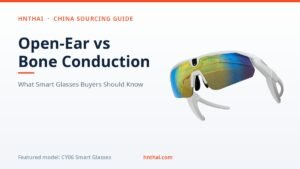
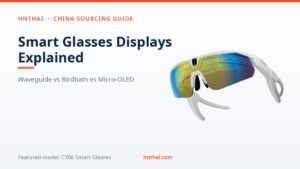
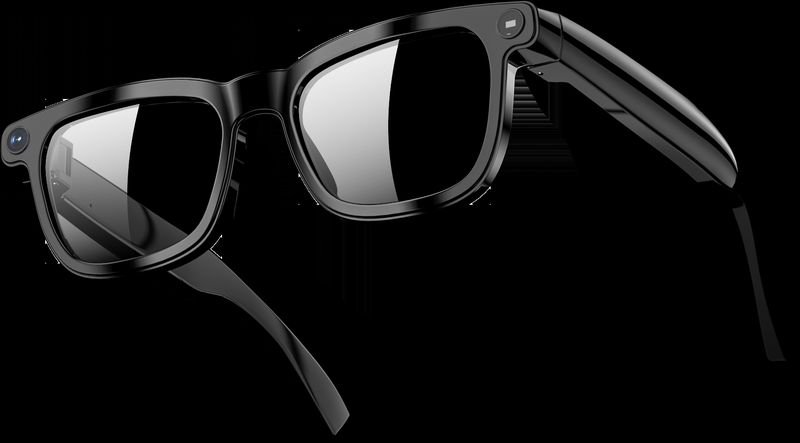
The CY08 electrochromic AI smart glasses show what the category offers when the pieces fit: an 8MP Sony IMX219 camera for photos, video and audio recording, four-level electrochromic lenses that shift from clear to dark, and a JL7018 main chip with stereo speakers and dual-microphone noise cancellation. Files move off the glasses over 2.4G Wi-Fi; the battery is 290mAh, charges in 2 hours or less (5V/0.22A input), and plays music for about 9 hours at 80% volume. The frame is PC+ABS, Bluetooth reaches 10 metres or more, the app speaks 19 languages, and the AI side covers voice commands, real-time translation, call translation and photo translation.
The camera sells the glasses; the battery, the privacy design and the tint decide whether the buyer keeps them.
Related reading: Smartwatch Sourcing Guide — How to Choose a Smartwatch Supplier in China
How long can smart glasses with a camera record video continuously?
Much less than the music time on the spec sheet suggests. Spec sheets quote music playback — nine hours, ten hours — because audio sips power, but video recording runs the sensor, encoder and Wi-Fi at once, and the slim frame cannot shed the heat. A 2026 category guide puts active video recording at roughly 15 to 20 minutes per session before slim frames throttle. The CY08 in our range lists about 9 hours of continuous music at 80% volume on a 290mAh battery and gives no continuous video recording time at all. Ask for the video figure in writing — how many minutes of continuous video before the glasses stop — and time it yourself on samples.
What camera specs matter most in smart glasses?
The sensor and lens matter more than the megapixel number: an 8MP sensor with a lens and stabilisation beats a 12MP sensor with a narrow, shaky lens. The market reference is the Ray-Ban Meta Gen 2 — a 12MP camera recording 3K video at 30fps, with clips capped at 3 minutes and a default of 60 seconds — while cheaper models sit at 5MP to 8MP and 1080p. Ask for the sensor model in writing: a named sensor like the Sony IMX219 can be checked, while a ‘8MP’ cannot. Never judge video from a supplier render — ask for footage shot outdoors while walking, and check shake, grain in shade and wind noise on a phone at full size.
Do camera glasses need a visible recording indicator?
Yes — a visible recording indicator is part of the product, not a legal footnote. Leading models use a hard-wired LED outside the frame that lights up during capture and cannot be switched off in software, with a light sensor that blocks the camera if someone tapes over it. The law is not the same everywhere: in the United States some states require all parties to consent to audio recording, with California the example every guide names, while Germany and parts of Canada restrict audio recording in public. Before you order, ask whether the model has a visible indicator and what happens if it is covered — and put a line about local recording laws in your own listing.
If you want samples tested for video quality and recording time, or help comparing camera glasses, talk to us at HnThai.