Smart rings are no longer a niche gadget. After years of smartwatch dominance, distributors and e-commerce sellers are adding rings to their catalogues — they are small, light, easy to ship, and they appeal to buyers who don’t want another screen on their wrist. If you are thinking about importing them, here is what actually matters before you place an order.
1. Start with the sensor set, not the price
Every supplier will quote you a low price. What separates a ring your customers keep from one they return is the sensor configuration and how honestly it is described.
Ask for the exact list in writing: heart-rate sensor, SpO2 sensor, temperature sensor, accelerometer. Then ask which of these are actually enabled in the shipped firmware — not just listed on the spec sheet. A ring that advertises a sensor the app never reads is a complaint waiting to happen.
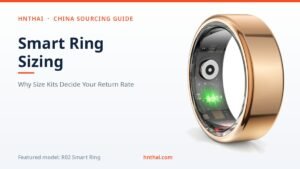
Unlike watches, rings cannot be adjusted. Most factories offer sizes 7–13 (US sizing), and a wrong size mix is the most common reason for high return rates on first orders.
Practical approach for a first order:
- Order a full sizing kit first and test it yourself.
- Ask the factory for their size-distribution recommendation based on your market — size curves differ between Southeast Asia, Europe and North America.
- Confirm whether the factory accepts size exchanges on unsold stock. Many won’t, and that should be in your costing.
3. Test the app before you test the ring
The ring is hardware; the experience is the app. Before committing to volume:
- Install the app yourself and pair a sample. Check that it is available in your market’s app stores.
- Check language support. An app that is only in Chinese and English may not work for your customers.
- Ask who owns the app — the factory, or a third-party platform? If the platform shuts down, your rings become paperweights. Prefer suppliers whose app has been live for at least a year.
4. Battery, charging and waterproofing — verify, don’t trust
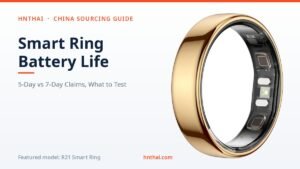
Typical smart rings quote 5–7 days of battery life and IP68 waterproofing. Both claims are easy to print and hard for a buyer to verify from a spec sheet alone.
- Run a sample through a full charge cycle and count the days yourself.
- Ask for the IP test report, not just the IP68 label.
- Confirm the charging method (magnetic case vs. cable) and whether the charging case is included in the quoted price — it often isn’t.
5. Certifications your market actually requires
CE and RoHS cover most of Europe. FCC matters for the US. Some markets in Southeast Asia have their own telecom or import registration. Ask the supplier which certificates they already hold for the exact model you are buying — a certificate for a different model does not count, and re-testing takes weeks.
6. MOQ, customisation and packaging
Smart rings are small, so mixed-model orders are realistic: many Huaqiangbei suppliers accept 100–500 piece orders across sizes and colours. Confirm in advance:
- Can you mix sizes and colours in one order?
- Is logo printing or custom packaging available, and what is the extra lead time?
- What does the standard retail box include — ring, charging case, manual, sizing guide?
7. Always order samples first — and inspect them properly
A sample approval is not the same as production readiness. Test samples for a full week: wear them, charge them, sync them, check the data against a known device. We wrote a separate guide on inspecting a new smartwatch step by step — the same discipline applies to rings.
A ring from our range

The R11C is a smart ring with a built-in display — one of the ring models we currently supply to importers.
Get the sample stage right, and the volume stage takes care of itself.
What is the minimum order quantity for smart rings from China?
Many Huaqiangbei suppliers accept mixed-model smart ring orders of 100–500 pieces across sizes and colours, which keeps a first order affordable for a distributor testing a new line. Before you commit, confirm in writing whether you can mix sizes and colours in one order, whether logo printing or custom packaging is available and how much lead time it adds, and what the standard retail box holds — ring, charging case, manual and sizing guide. Ask whether the factory accepts size exchanges on unsold stock, since many do not. HnThai, a sourcing partner based in Huaqiangbei, Shenzhen, can arrange mixed-model orders and check these terms for you.
How do I choose the right size mix for my first smart ring order?
Most factories offer smart ring sizes 7–13 in US sizing, and a wrong size mix is the most common reason for high return rates on first orders, because rings cannot be adjusted like watch straps. Order a full sizing kit first and test it yourself before you place volume. Ask the factory for their size-distribution recommendation for your market, since size curves differ between Southeast Asia, Europe and North America. Confirm whether the factory accepts size exchanges on unsold stock and put that answer in your costing. Get the size range confirmed in writing before ordering, so the sizes you receive match the sizes your customers actually wear.
What should I check before ordering smart rings in bulk?
Check four things before you place a bulk smart ring order. First, get the sensor list — heart-rate, SpO2, temperature sensor and accelerometer — and ask which sensors are enabled in the shipped firmware, not printed on the spec sheet. Second, install the companion app yourself, pair a sample, and check it is available in your market’s app stores with the languages your customers need. Third, run a sample through a full charge cycle and ask for the IP test report behind any IP68 claim. Fourth, confirm which certificates the exact model holds for your market, such as CE and RoHS for Europe or FCC for the US, since a certificate for a different model does not count.
If you want help finding a reliable smart ring supplier, checking samples, or arranging mixed-model orders from Huaqiangbei, talk to us — we have been sourcing consumer electronics from Shenzhen since 2015.