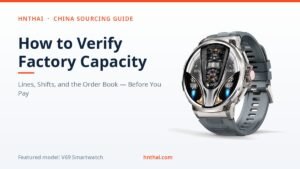
A factory's stated capacity is a claim, not a fact. Verify it by asking for a dated production slot for your exact order, checking the lines, shifts, and order book behind that slot, and confirming it against shipping records or a trial order. A factory that cannot name a slot cannot commit to a delivery date.
What "capacity" actually means
Capacity is not one number — split it into four ideas:
- Design capacity: the theoretical maximum under ideal conditions.
- Demonstrated output: what the factory has actually produced for a comparable product.
- Available capacity: demonstrated output minus the confirmed work already in the schedule.
- Usable capacity for your order: what is left after changeovers, maintenance, yield loss, and your quality checks.
The headline figure in a sales pitch is almost always design capacity. Your delivery plan needs the last number, not the first. A line rated at 10,000 units a day, running one shift with changeovers and a 3% reject rate, delivers far less — and that assumes the line is yours.
Why capacity fails when everything else looks fine
The most common capacity failure is overbooking — more accepted orders than production slots — and it shows up in three patterns.
Overbooking. The factory says yes to every buyer and sorts out the queue later. Your order is real, the slot is not. The sign is a delivery date given in a chat message with no schedule behind it. Ask for the slot in writing, with dates, and check it against the factory's own production schedule.
Seasonal peaks. The factory runs at full load in the months before a trade show or a retail season. A slot that existed in June may not exist in September. Every capacity figure has a date attached — ask about the load in your window, not in general. Our guide to what affects your delivery date lists the eight factors that move it.
Equipment bottlenecks. One machine or one process — a printing line, a welding station, a testing bench — limits the whole output. A factory can have ten assembly lines and still ship late if a single test station handles every unit. Ask which process is the bottleneck for your product and what its daily output is.
Five checks before you pay a deposit
| Check | What to ask | What a good answer looks like |
|---|---|---|
| Production slot | What is the earliest confirmed slot for my quantity and date? | Named start and completion dates, tied to a schedule you can read |
| Lines and shifts | How many lines run my product type, and how many shifts? | Line count, shift pattern, and current utilisation |
| Bottleneck process | Which step limits output for my product? | A named process with a daily output figure |
| Order book | What confirmed orders sit ahead of mine? | A schedule, even redacted, showing your place in the queue |
| Staffing | How many skilled workers per shift on my process? | Headcount and shifts; a skeleton crew on a full order book is a warning |
The last question matters most. A factory that names a slot but has no schedule to back it is guessing — learn to read a factory production plan before you accept one.
Documents that prove it
Before you pay for a visit, ask for papers that show capacity instead of describing it: a production schedule for the period, even redacted, showing the lines, dates, and orders ahead of yours; recent shipping records, showing actual output rather than claimed output; an equipment list; and staff count and shift structure.
Check the company too: run its licence number through China's official registry (NECIPS) to confirm the legal name and scope, and confirm it exports — a registered manufacturer with no export record is either new to exporting or not what it claims. Confirm any ISO 9001 certificate separately: scope, site, issuer, validity.
Three checks you can run without leaving your desk
A live video tour. Documents prove a company exists; a video call proves it operates. Ask for a live call — not a recorded tour — and have them walk from the front gate to the production floor without cutting the video. A real factory has connected spaces; a borrowed facility shows up in the gaps. On the floor, ask to see machines running, and ask about the monthly electricity bill and the shift count — a factory owner answers at once, a middleman stalls.
A sample order as a test. A sample tests more than product quality: communication, packaging accuracy, and deadline reliability. Did the factory hit the sample delivery date? A supplier who misses a sample deadline by two weeks will miss production by two months. Did the invoice come from the same company you verified? A payment request from a different entity is a serious mismatch.
A paid audit, when the order justifies it. For orders above about $20,000, or a supplier you plan to keep long-term, a third-party factory audit is the most reliable read you can buy. It checks machine condition, who signs off each stage, and whether the written procedures are the ones the floor follows. For smaller first orders, the document checks, the video tour, and the sample are usually enough.
Red flags that mean walk away
| Red flag | What it usually means |
|---|---|
| No capacity evidence at all | Nothing you can verify |
| A catalogue covering everything | A trader, or heavy subcontracting you were not told about |
| Slow on a small sample | Low capacity, or your order is not a priority |
| Price far below market | Cut materials or skipped steps are coming |
| Cannot explain the process | The capability is probably absent |
| Cannot name a production slot | No schedule, no commitment |
| Subcontracting not disclosed | Your goods may be made somewhere you never checked |
The fastest test: ask the technical contact to walk you through how your product gets made, machine by machine. A factory with real capability answers in detail. Put in writing which site makes your goods, and that no subcontracting happens without your approval — capacity verified at one site means nothing if the order moves.
A real example: the V69 smartwatch
Take the V69 smartwatch: a 1.85-inch display at 360×360, Bluetooth 5.0 calling with a range of about 10 metres, a 710mAh battery, magnetic charging, IP67 water resistance, and the Da Fit app, running on the 8763EWE chip. Every number there comes from the spec sheet.
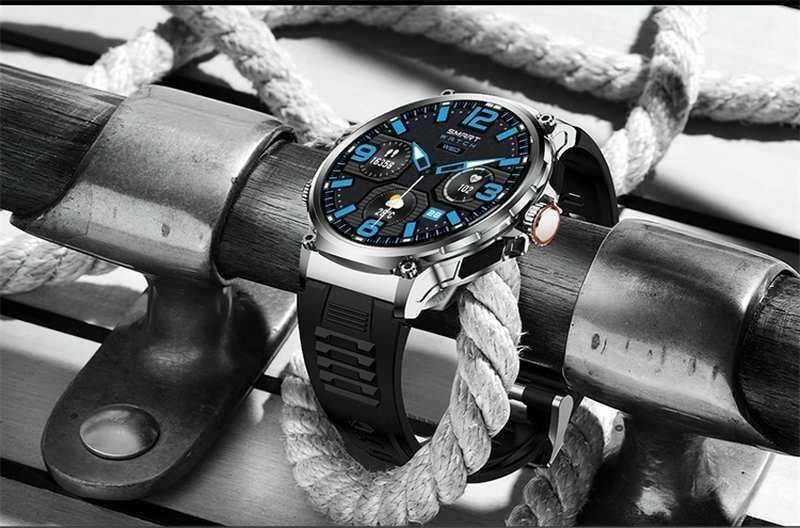
That is the kind of defined order a capacity check needs: one SKU, one configuration, one quantity, one date. Ask for a production slot for that model at your quantity, then check it against the lines, the shifts, and the order book. If it can show you a schedule with your order in it, you have something to plan around. If it can only say "no problem," you have nothing — and a pre-shipment inspection is the last place that gap shows up before the goods are yours.
Still choosing the model? Our smartwatch sourcing guide walks through selection first. At HnThai, a sourcing partner based in Huaqiangbei, Shenzhen, we run these checks with factories every week for wholesale buyers: reading the schedule, asking for the slot in writing, testing with a sample first. If a date slips anyway, our guide to what happens when production is delayed covers the first 48 hours. Browse our products, or contact us with your specification, quantity, and target date, and we will tell you honestly whether the slot is real.
FAQ
What is the difference between capacity and capability?
Capacity asks how much a factory can make; capability asks whether it can make yours. A factory with lines for 50,000 units a month can still fail your order if it has never made your product type. Capacity fails as late goods; capability fails as defective goods. Prove capacity with a floor visit, output records, and the order book; prove capability with an audit and a sample.
How much capacity evidence should I ask for on a small first order?
For a first order under a few thousand dollars, three checks are usually enough: the licence checked on the official registry, a live video tour from gate to floor, and a sample order with the delivery date tracked. Ask for a dated production slot in writing too — a factory that will not give one is telling you something. Save the paid audit for larger orders, roughly above $20,000, or a supplier you plan to keep for years.
The factory says it can add a second shift for my order — should I believe it?
Treat it as a claim to verify, not a promise. Ask what the second shift needs — workers, materials in stock, overtime approvals — and which line it runs on, and what happens to the orders already on that line. Get the slot and completion date in writing in the purchase order. A second shift that pushes another buyer's order back is a delay waiting for a new owner — and it may be you.