Shipping electronics from China comes down to three choices: sea is cheapest, air is fastest, courier fits samples. A 20-foot container from Shenzhen to the US West Coast ran $2,000 to $2,800 in 2026 spot rates, 25 to 35 days in transit; air ran about $7 per kilogram in 5 to 10 days; express ran $8 to $15 per kilogram in 3 to 7 days.
The four modes, side by side
| Mode | Cost (2026 spot) | Transit time | Best for |
|---|---|---|---|
| Sea freight, full container (FCL) | $2,000–2,800 per 20GP, Shenzhen to US West Coast | 25–35 days | Large restock orders, 1,000+ units |
| Sea freight, shared container (LCL) | Per cubic metre, cheaper per unit than air | 30–40 days | 100–1,000 units, no rush |
| Air freight | About $7/kg | 5–10 days | Mid-size orders, seasonal deadlines |
| Express courier (DHL, UPS, FedEx) | $8–15/kg | 3–7 days | Samples, urgent small orders |
Sea freight wins on cost the moment volume justifies it: a full container is cheapest per unit once filled, and a shared container (LCL) charges only for the cubic metres you use. The trade is time — 25 to 35 days to the US West Coast, 28 to 32 days to Rotterdam, 30 to 35 days to Hamburg, before clearance adds its own days.
Air freight sits in the middle: about $7 per kilogram, 5 to 10 days in transit — enough to save a selling season sea freight would miss. Express courier is fastest door-to-door at 3 to 7 days and most expensive per kilogram; reserve it for samples and urgent top-ups. One rule: express rates roughly double past 50 kg.
Shipping runs 5% to 30% of total product cost. Price freight before you confirm the order: landed cost is FOB plus freight plus insurance plus duty.
The battery question decides the channel
Every electronics shipment starts with one question: does your product contain a battery? The answer decides whether you are shipping general cargo or Class 9 dangerous goods — about 65% of air cargo incidents involving electronics trace back to improperly declared or packaged batteries.
Lithium batteries carry UN numbers: UN3480 for standalone lithium-ion batteries such as power banks and loose cells; UN3481 for batteries contained in or packed with equipment — smartphones, laptops, earbuds, smartwatches; UN3090 and UN3091 are the lithium-metal equivalents.
UN3480 always needs a full Dangerous Goods Declaration, UN-certified packaging, and a cargo-only aircraft. UN3481 may qualify for the simplified Section II pathway if the cell is at or below 20Wh, the battery at or below 100Wh, and the net quantity at or below 5 kg per package. Most smartwatches clear those limits easily: a 710mAh cell holds about 2.6Wh, far below the 100Wh ceiling.
Every lithium battery shipment, by any mode, needs a UN38.3 test report — eight safety tests, one-vote veto — from a third-party laboratory with CNAS or ILAC accreditation, not the factory’s own lab. Ask for the UN38.3 test summary and the MSDS before you book freight; a forwarder who specialises in electronics handles the declaration without delays.
The 2026 changes that changed the math
Two regulatory changes made the maths harder. First, the $800 de minimis exemption ended for China-origin goods on May 2, 2025: every parcel now pays full duty, and the small-parcel shortcut is gone — which is why DDP has become the default for first orders.
Second, from January 2026, IATA requires all lithium-ion batteries shipped by air at 30% state of charge or below. The rule applies to UN3481 devices with batteries above 2.7Wh, and exceeding it causes cargo rejection, not a warning. Tell the factory the limit before production ends.
Misclassification is the expensive mistake: battery misclassification alone triggers fines above $15,000 per violation under IATA rules. Confirm the classification — UN number, watt-hour rating, whether the battery ships inside the device — in writing with the factory and the forwarder before the goods move.
DDP or FOB: who handles customs
The Incoterm decides who clears customs and who pays the duty. Under FOB, the factory delivers the goods to the named port and loads them onto the vessel; you arrange freight, insurance, clearance, and duty from there. Cheaper per unit, but the customs risk sits with you.
Under DDP, the factory or its forwarder handles freight, insurance, clearance, and duty to your door. The premium runs 8% to 15% above FOB plus freight, and for a first-time importer it buys a single party responsible for the whole journey. Collect the four clearance documents before the goods sail — missing documents are the number one cause of customs holds.
A real example: shipping 1,000 V69 watches
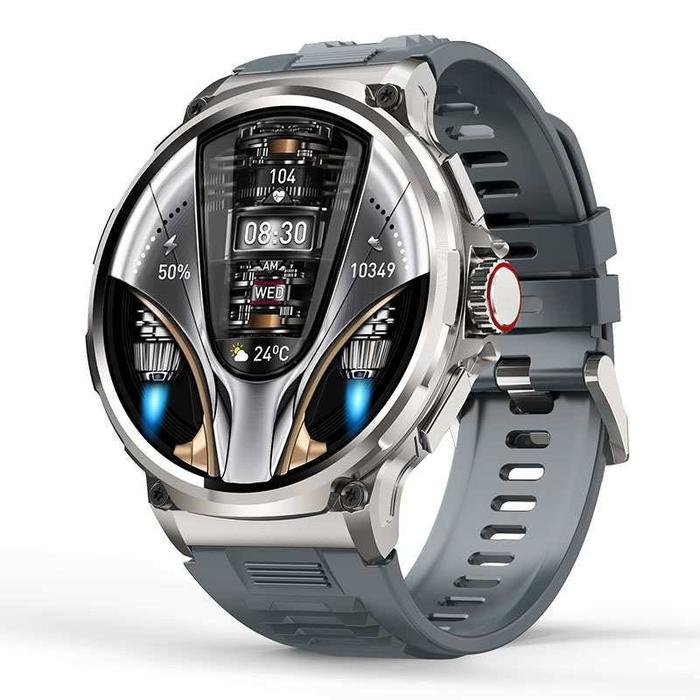
Take a real product. The V69 smartwatch carries a 1.85-inch display at 360×360, an 8763EWE chip, Bluetooth 5.0 BLE with about 10 m range, a 710mAh battery, IP67 water resistance, magnetic charging, and the Da Fit app, in a 52.6 mm case at 77.4 g.
One thousand V69 watches weigh about 77 kg before packaging — call it 90 kg packed. By air at about $7 per kilogram, freight runs roughly $630, landing in 5 to 10 days. By express at $8 to $15 per kilogram, roughly $720 to $1,350, landing in 3 to 7 days. By sea, the same 1,000 units share a container and the freight per unit drops to a fraction of the air cost — but the goods take 25 to 35 days, plus clearance.
The battery maths is simple too: a 710mAh cell holds about 2.6Wh, so the V69 ships as UN3481 under the simplified Section II pathway, with the UN38.3 test summary and MSDS attached, at or below 30% charge. Packaging gets a drop test through the forwarder — $200 to $500, trivial next to one damaged shipment.
See our Smartwatch Sourcing Guide, supplier verification guide, pre-shipment inspection guide, payment terms guide, and quotation guide. Browse our products page and smartwatches page.
Frequently Asked Questions
Can I ship smartwatches by air?
Yes, in nearly all cases. A smartwatch battery sits far below the 100Wh air limit — a 710mAh cell holds about 2.6Wh — so the watch ships as UN3481 under the simplified Section II pathway. You still need the UN38.3 test summary, the MSDS, the lithium battery mark on the carton, and a charge level at or below 30% for air shipment from 2026.
Usually yes. The 8% to 15% premium above FOB plus freight buys a single party responsible for freight, insurance, clearance, and duty to your door. On a first order you do not yet know your forwarder, your broker, or the destination port’s habits — the premium removes three failure points at once. After three successful shipments, FOB with your own forwarder is usually cheaper per unit.
What documents does customs need for electronics?
Four documents cover most clearances: commercial invoice, packing list, bill of lading or air waybill, and product documents — CE or FCC marks and the UN38.3 test summary for the battery. Missing documents are the number one cause of customs holds. Collect all four before the goods leave the factory.