A minimum order quantity is the factory's break-even point — not a sales tactic. Before a single board is made, SMT setup — stencil fabrication, feeder loading, first-article inspection — typically costs the factory $300 to $800. A 1,000-unit minimum on a finished electronic product is the quantity at which those fixed costs are recovered. Once you see it that way, stop arguing about the number and start removing the costs behind it.
What MOQ actually is
MOQ is a floor set by the factory's break-even math. Every run carries fixed costs that do not depend on quantity: line setup, printing plates, firmware configuration, component minimum buys, and the time a short run takes from a longer line.
The same product can carry a different MOQ at two factories. A factory that already runs your colour, packaging, and firmware has almost nothing to set up. One that has to buy a new stencil, print new plates, and load a new component reel has to recover all of that from your order alone.
MOQ is usually per model, per colour, or per SKU — not per order: 300 units in three colours is three 100-unit runs. Second, a trading company's MOQ is not a factory's MOQ. Traders can offer lower numbers because they aggregate orders across buyers — but you pay a margin for that.
Why minimums vary so much
The cost driver decides the floor. A simple cable needs only labour setup, so factories quote 100 to 500 pieces. An injection-moulded enclosure needs the mould paid down over the run: 500 to 2,000. A single-sided PCBA with few components sits at 200 to 500; a complex multi-layer board with 50 or more BOM lines runs 500 to 1,500. A finished consumer electronic product — enclosure plus PCBA — typically quotes 1,000 to 3,000, and a custom antenna or RF module runs 2,000 to 5,000, because regulatory testing is spread across the run.
| Product type | Typical factory MOQ | Primary cost driver |
|---|---|---|
| Simple cable / harness | 100–500 | Labour setup only |
| Injection-moulded enclosure | 500–2,000 | Mould depreciation + cycle time |
| Single-sided PCBA, few components | 200–500 | SMT setup + PCB fabrication |
| Complex multi-layer PCBA, 50+ BOM lines | 500–1,500 | BOM procurement + setup + test fixtures |
| Consumer electronics, enclosure + PCBA | 1,000–3,000 | All of the above combined |
| Custom antenna / RF module | 2,000–5,000 | Regulatory testing spread |
Component minimums sit underneath. If the chip in your design only sells in reels of 1,000 and you want 200 units, the factory has to buy more than it will use — swapping it is worth discussing with your engineer before production. Customisation pushes the number up the same way: a new colour means a changeover, custom firmware a new build, and new tooling a mould to pay down — fully custom tooling typically needs 2,000 to 3,000 pieces.
Five levers that actually move the number
Give up a customisation. The single most effective lever. Accept the standard housing colour, the existing packaging, or the default firmware, and the setup steps behind the MOQ disappear with it. With stock housings, a consumer electronics MOQ of 500 to 1,000 can fall to 200 to 300 pieces.
Accept a higher unit price. Offer 10 to 30% above the quoted price on a trial order, with a written plan to order at full MOQ pricing once the product proves itself. The factory recovers setup through margin rather than volume. This is often cheaper than carrying inventory you cannot sell.
Ask for the price at two quantities. Ask: "What is your price at 300 units and at 1,000 units?" The gap tells you what the setup is worth. A $2 to $3 per-unit jump means the setup cost is low and the MOQ is partly a soft preference; a $15 or more jump means the setup cost is real.
Consolidate colours or SKUs. If two variants share most of the bill of materials, ask for 500 of each to count toward one combined MOQ. A factory that sees $15,000 across five products will accept 300 units of each where it would refuse 300 of one.
Pay the setup cost separately, or commit to a repeat. Offer to cover printing plates or configuration as a one-off charge, or put a written indication of the next order on the table so the factory can spread setup across two runs. State annual volume honestly.
Ask for a paid pilot run of 50 to 100 units after sample approval — factories that refuse a 200-unit order often agree to a pilot framed as a quality test. For generic products, 1688 stock sellers sell by the carton at MOQs of 2 to 50 pieces.
What does not work
Asking for a lower MOQ with nothing in return is the most common failure: it asks the factory to absorb a cost for free. Claiming future volume you cannot evidence fails the same way, and comparing your order to a competitor's price fails when you do not know their specification. Never ask for a lower price and a lower MOQ in the same message — pick one.
March to May and the weeks after the October holiday are quiet for many export factories, and idle machines make small orders attractive.
A real example: the D22
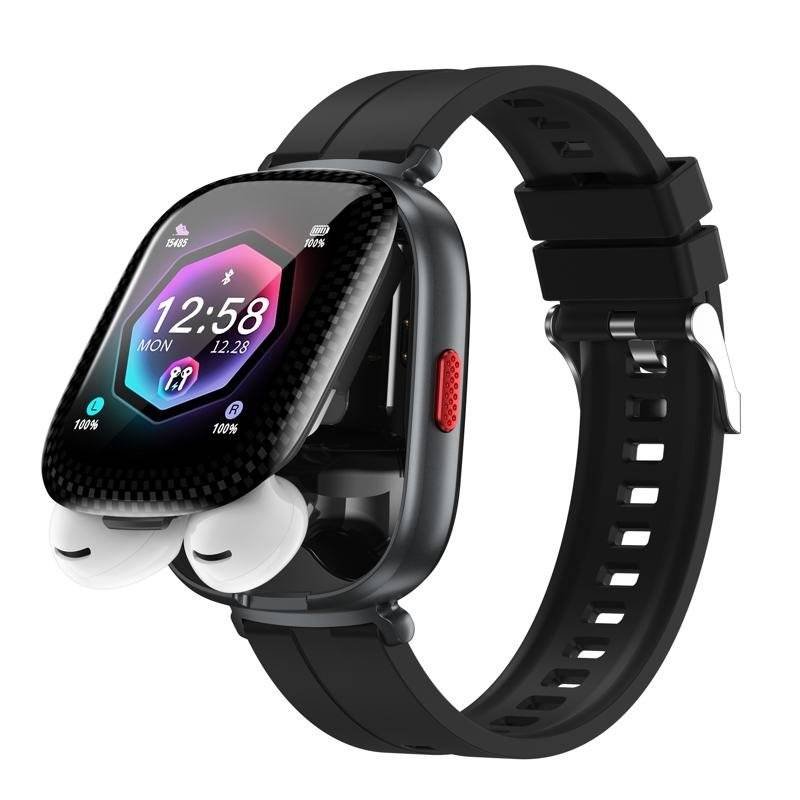
The D22 smartwatch shows how MOQ and customisation connect on a real product. It is a 2-in-1 watch with built-in TWS earbuds, a 1.88-inch TFT display, Bluetooth 6.0. The watch UI runs in 10 languages, the app in 16, and two-way translation covers 27. It pairs with iOS 13 and above, Android 8.0 and above, and HarmonyOS 3.0.
A buyer who wants the D22 in the standard colours, firmware, and packaging is asking for a run the factory already knows — the MOQ follows the standard floor. A buyer who wants a custom housing colour, a private-label box, and a locked-down firmware build is asking for changeovers and plates — the MOQ rises with them. Weigh that trade before you write the email.
See our Smartwatch Sourcing Guide, our supplier verification guide, and our smartwatches page. Browse the full range on our products page.
Frequently Asked Questions
Can I order fewer than the MOQ if I pay more per unit?
Yes. Offering 10 to 30% above the quoted price on a trial order is the most reliable way to get below the minimum, because the factory recovers setup through margin instead of volume.
Is the MOQ per model or per order?
Usually per model, per colour, or per SKU — not per order. Confirm which unit the MOQ counts in writing, and ask whether colours or SKUs that share a mould and a box can combine toward one total.
What is a realistic MOQ for a first order of consumer electronics?
For a finished product with enclosure and PCBA, factories typically quote 1,000 to 3,000 pieces. With stock housings, a negotiated floor of 200 to 300 pieces is realistic. For a first market test, a paid pilot of 50 to 100 units, or 1688 stock at 2 to 50 pieces per carton, is often better.