
A mini projector needs at least 200 ANSI lumens for a dark room up to 80–100 inches. The HY320 Mini meets that mark at 200 ANSI lumens, with a native 1280×720 panel and automatic keystone correction. Ignore any brightness figure that does not say ANSI: a “9,500 lumen” label often hides a real output of 200–400 ANSI lumens.
The complaint that starts every brightness dispute
A buyer on eatsip365 tells the story every importer should read before ordering. He bought a mini projector advertised at “9500 Lumens” for a backyard movie night, set it up after sunset, and got a dim, washed-out ghost of a picture. The number on the box measured light at the bulb, not light on the screen.
That story repeats across Amazon and marketplace reviews because “lumens” is not a protected word in projector marketing. Only “ANSI lumens” follows a certified, independently verifiable test method. Every other brightness term on a box is measured however the brand that printed it decided to measure it.
Three lumen numbers, one real standard
Three brightness terms show up on budget projector listings. Only one can be compared across brands.
| Lumen type | How it is measured | How far it runs from ANSI |
|---|---|---|
| ANSI lumens | White image split into a 3×3 grid, nine readings averaged, times screen area | The standard itself |
| LED lumens | Perceived brightness from the LED source, using the Helmholtz-Kohlrausch effect | Divide by 2.4 to reach ANSI |
| Light-source lumens | Light measured straight off the bulb, before lens and optics | Divide by roughly 16 to 17 to reach ANSI |
ANSI lumens is the only brightness measure with a standard, scientific method certified by an international body, per BenQ’s own knowledge center. The method is plain: project a white image, split it into nine rectangles, and average the nine readings. A 500 ANSI lumen projector from one brand gives the same brightness as a 500 ANSI lumen projector from another brand, on the same screen, in the same room.
The other two numbers run high by design. Divide “LED lumens” by 2.4 to reach the ANSI figure: a projector claiming 1,000 LED lumens is roughly 417 ANSI lumens in reality. Divide “light source lumens” by roughly 16 to 17: a projector claiming 1,000 light source lumens is only about 60 ANSI lumens once the light actually hits the wall. A “9,500 lumen” projector often measures only 200–400 ANSI lumens. The gap is not a rounding error; it is the whole trick.
The industry knows it. Epson has sued sellers over false brightness ratings, and tech outlet BGR wrote in September 2026 that most non-ANSI lumen ratings are “nearly meaningless” as a way to compare products. When a listing hides the word ANSI, that is your warning sign.
What the numbers mean in a real room
Brightness only matters in the room where the picture will be watched. For a pitch-black room with blackout curtains, 200–500 ANSI lumens gives a good picture up to 80–100 inches. That is the range a wholesale buyer should quote from, not the number on the box.
Our three mini projectors sit on one ladder. The HY300 states 120 ANSI lumens, for a dark bedroom or small meeting room at 40–130 inches. The HY300 Pro states 160 ANSI lumens, with a short-focus 0.9 throw ratio that fills the same 40–130 inches from closer in. The HY320 Mini states 200 ANSI lumens, with automatic keystone correction and a 2000:1 contrast ratio — the most headroom of the three in the same dark room. None of the three is a daylight projector, and none should be sold as one.
Screen size moves the reading too: the same 200 ANSI lumens looks bright at 60 inches and thin at 150 inches, because the same light spreads over a bigger area. Ask which screen size the figure was tested at.
How to check brightness on a sample
Do not trust the listing. Test the sample in the room your buyer will use, at the size they will watch, and check three things.
First, read the spec sheet and look for the word ANSI next to the lumen figure. If the sheet says only “lumens,” ask for the ANSI figure in writing before you place the order. A supplier who cannot give it is telling you something.
Second, test with the lights off and with one lamp on: a projector that looks fine in a black room can wash out under a single lamp. Check text as well as video: soft, grey text is the first sign of a weak picture.
Third, compare the unit in your hand with the figure on the order. Side by side, on the same screen, in the same picture mode, two samples of the same model should look the same. If one is dimmer, stop the order and ask why.
Featured model: the HY320 Mini
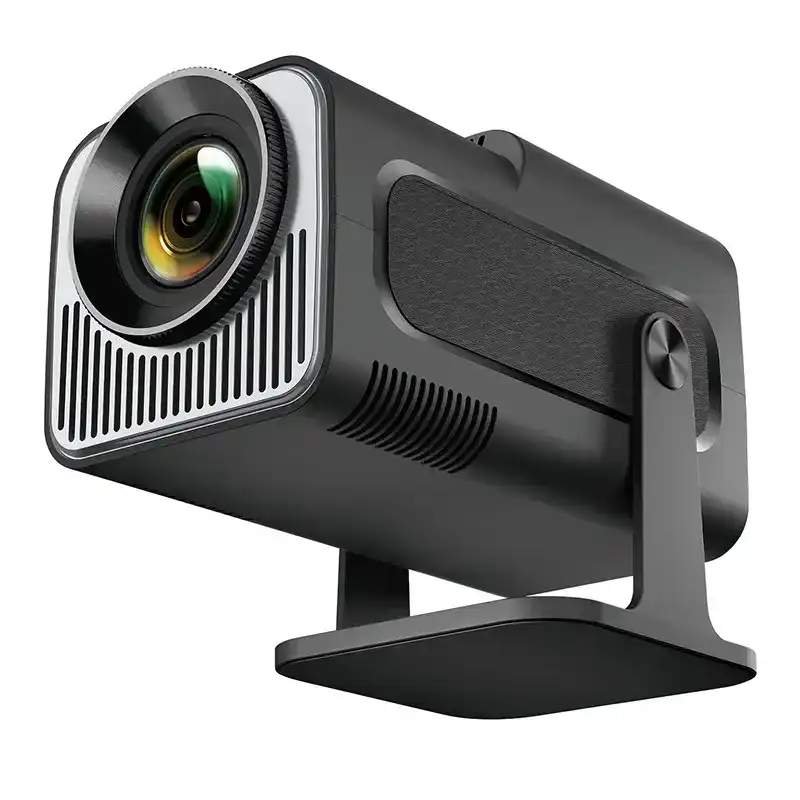
The HY320 Mini portable smart projector states 200 ANSI lumens on a native 1280×720 panel, with a 2000:1 contrast ratio, automatic keystone correction, and a 50,000-hour bulb life on the sheet. It runs Android with dual-band Wi-Fi 6 and Bluetooth 5.0, carries a single 3W speaker, and draws 40W from a standard outlet. Its body measures 90×98×175.5 mm. No battery is listed on the sheet, so confirm power options in writing if your buyer needs off-grid use. See our projectors page for the full HnThai projector range.
Frequently Asked Questions
How many ANSI lumens does a mini projector need?
For a pitch-black room, 200–500 ANSI lumens gives a good picture up to 80–100 inches. The HY320 Mini, at 200 ANSI lumens, sits at the bottom of that range and suits a dark bedroom or small meeting room. The HY300, at 120 ANSI lumens, suits a smaller, darker room at 40–130 inches. Neither is a daylight projector. Always convert both figures to ANSI lumens before you compare two models, and ask which screen size the figure was tested at.
What is the difference between ANSI lumens and LED lumens?
ANSI lumens is a standardized test: a white image is split into a 3×3 grid, nine readings are averaged, and the result is multiplied by the screen area. LED lumens measures perceived brightness from the LED source and runs about 2.4 times higher than the ANSI figure for the same projector. Light-source lumens is measured straight off the bulb before the optics, and runs roughly 16 to 17 times higher. Only the ANSI figure can be compared across brands, so ask for it in writing on every order.
Why does my projector look dim even though the box says 9,500 lumens?
Because the box number is almost never ANSI lumens. A ‘9,500 lumen’ projector often measures only 200–400 ANSI lumens once the light passes through the lens and reaches the screen. The listing measured light at the bulb, not light on the wall. Check the spec sheet for the word ANSI next to the figure, test the sample in the room your buyer will use, and compare the unit in your hand against the figure on the order before you pay for the bulk run.