A corporate tech gift set bundles two or three items — a smartwatch, earbuds, and a strap or charger — into one branded box. Buyers pay more for a set than for the same items sold apart, because the set reads as a finished gift. The extra margin comes from the box and the pairing, not from cutting item prices.
That is the whole trick, and it is also where most first-time set orders go wrong. A set is not three single gifts in one carton. It is one product with three parts that all have to arrive together, look like they belong together, and work when the recipient opens the box. If one part fails, the whole gift fails — and the complaint lands on the set, not on the one faulty piece.
Why a set sells better than a single gift
A single smartwatch at a company event is a nice gift. A smartwatch with earbuds docked in the case and a spare strap in the same box is a gift the recipient shows to a colleague. That difference is what corporate buyers pay for.
Three things make sets work for the buyer who orders them. First, one box means one decision: the buyer picks a tier and a quantity, and the gift is done — no matching items across three suppliers. Second, a set hides the unit cost of each part. Nobody at the event knows what the earbuds cost on their own; they judge the box. Third, a set gives the buyer a clear price ladder: a starter set for all staff, a standard set for clients, a premium set for executives. Our guide to corporate tech gift budgets shows how to set those tiers per recipient before you pick any products.
For the seller, the set also fixes a problem single gifts have: a lone item competes on price with every identical item online. A set competes on the pairing. Two suppliers can sell the same watch, but only one of them ships it with matching earbuds, a printed sleeve, and a box that opens the right way.
Three mistakes that eat the margin
Mistake one: items that do not belong together. A heavy steel watch with feather-light plastic earbuds feels wrong in the hand, even if both work fine. Match the finish and the weight class. If the watch case is alloy, the earbuds case should not look like a toy. Ask the supplier for a photo of the items together in the box before you approve anything — a photo of each item alone tells you nothing about the set.
Mistake two: packaging treated as an afterthought. The box is the first thing the recipient touches, and it is also the part most likely to arrive dented. A rigid gift box costs more than a printed carton, and it is worth it for anything above the starter tier. Check the box size against the items: a box that is too big makes the gift look empty, and loose items rattle and scratch each other in transit. Ask for one full sample set — box included — not a sample of each item in separate bags.
Mistake three: MOQs that do not line up. The watch factory wants 100 pieces, the earbuds factory wants 500, and the strap factory wants 300. You order 100 sets and end up holding 400 spare earbuds. Before you commit, get the MOQ for every part in writing and work out the leftover stock at your order size. If the numbers do not line up, change the pairing — pick an earbud model whose MOQ matches the watch, or buy the strap from the same factory as the watch. Our guide to custom logo MOQs and lead times covers how to read those numbers before you pay.
Three bundle recipes that work
These are starting points, not fixed menus. The rule for every tier is the same: one hero item the recipient notices first, one useful second item, and one small extra that fills the box.
| Tier | What goes in the box | Who it is for | What to watch |
|---|---|---|---|
| Starter | Smart bracelet or basic smartwatch, charging cable, printed sleeve | All staff, event giveaways | Keep the box simple — a printed carton is fine at this tier; check the cable fits the watch port |
| Standard | 2-in-1 smartwatch with earbuds docked in the case, spare strap, rigid gift box | Clients, partners, mid-level staff | The watch and earbuds must charge from the same cable; test the docked earbuds before you approve the sample |
| Premium | Large-screen smartwatch, TWS earbuds in their own case, spare strap, rigid box with foil logo | Executives, key accounts, year-end VIP gifts | Two separate batteries means two charge tests; logo work on two surfaces needs one proof, not two |
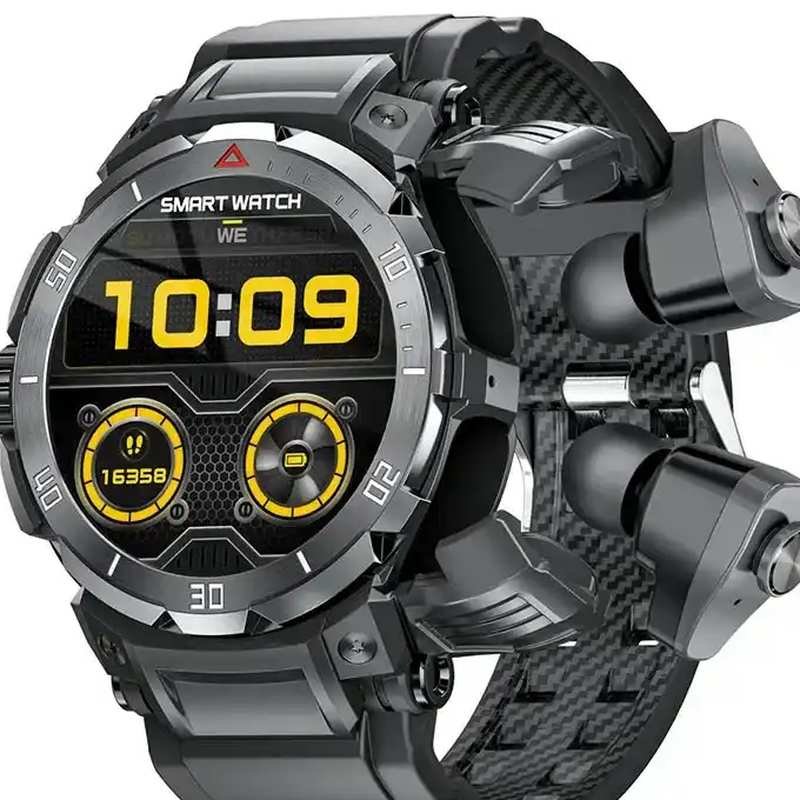
The standard tier is where most of the volume sits, because it solves the pairing problem in one product. A 2-in-1 watch with earbuds built into the case is a set that cannot come apart in the warehouse: the earbuds live in the watch, so there is no second box to lose and no second MOQ to match. That is why it works as the anchor of a standard set — the buyer gets two gifts for one packing step.
How to price a set without giving the margin away
Price the set from the perceived value, not from the sum of the parts. Add up the landed cost of every part plus the box, the logo work, and the freight, then compare the total with what a single gift at the same tier sells for. The set should sit clearly above the single gift — if it does not, the pairing adds no value and you are paying for a box nobody wanted.
Three rules keep the price honest. First, keep one hero item and let it carry the price: the buyer anchors on the watch, and the earbuds and strap are the reason the set feels generous. Second, never discount the set below the hero item’s normal price — a set that costs less than the watch alone tells the buyer the watch was overpriced to begin with. Third, quote the set as one SKU with one price. Itemised pricing invites the buyer to delete the strap and haggle over the earbuds; one price keeps the conversation on the gift.
Packaging and logo: one surface, one colour
A set has more surfaces to brand than a single gift, and that is a trap. Logo work on the watch case, the earbud case, the strap, and the box sleeve is four separate production steps, and each one can slip a day. Keep the custom work to one surface and one colour: a single-colour print on the box sleeve, or on the watch case if the box stays plain. A full-colour wrap plus a debossed strap plus a printed sleeve is three jobs, not one, and the proof round alone can eat a week in late November — our Christmas order deadline guide shows how fast those days disappear.
Get the artwork right the first time. Our artwork guide lists the file formats that keep a proof from bouncing back for a redraw; a low-resolution logo that needs redrawing is a classic way to lose three days. And confirm the logo position on the actual sample set, not on a render — a logo that looks centred on screen can sit crooked on a curved watch case.
Quality control: test the set, not the parts
A set needs a different inspection from a single product. Checking 100 watches and 100 earbud pairs separately does not tell you whether the set works, because the failures live in the combination: earbuds that do not sit in the dock, a strap that does not fit the lugs, a box insert that holds the watch but lets the earbuds slide.
Ask the inspector to open finished sets, not parts. The check list is short: every item present, earbuds docked and charging, strap fitted, box closes flat, logo in the right place, and one set in ten powered on and paired. If the supplier ships the parts from two factories to one packing line, the packing line is where the mistakes happen — ask who packs the set and where, and put the answer in the purchase order.
Timing matters too. A set order has more steps than a single-item order, so it needs a longer runway. Work backward from the delivery date with our electronics sourcing calendar and add a week to whatever the supplier quotes — the box and the logo work are the steps that slip most often.
Featured model: the GT100PRO
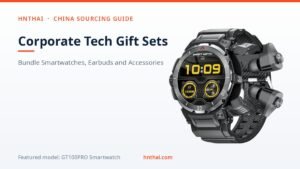
The GT100PRO smartwatch is a good anchor for a standard-tier gift set: a Realtek 8763EWE chip, a 1.46-inch full-touch display at 360×360, Bluetooth 4.0/5.2, a 360mAh watch battery with 30mAh earbuds docked in the case, IP67 waterproofing, and 128MB of flash memory, in an alloy and PC case at 75 g, at $32.50–$36.50. Every number there comes from the product page. The earbuds charge from the watch battery, so the set is one item to pack, one item to inspect, and one item to charge — which is exactly what makes a standard set easy to run at volume. Earbud playtime in hours is not stated on the product page, so confirm it in writing before you quote it to a client.
If you want the full selection method behind the models in this guide, start with our Smartwatch Sourcing Guide. For the rest of your range, browse our products and tell us which tier you are building — we can put a sample set together before you commit to the full order.
FAQ
How many items should a corporate tech gift set have?
Two or three. One item is not a set, and four or more turns into a lucky bag — the box gets bigger, the packing gets slower, and the recipient remembers none of it. A hero item, one useful second item, and one small extra is the format that holds its price at every tier.
Should the watch and the earbuds come from the same supplier?
Yes, when you can. One supplier means one MOQ, one shipment, and one party to call when something is wrong. A 2-in-1 watch with earbuds docked in the case removes the question entirely. If the earbuds must come from a second factory, confirm in writing who packs the set and who pays if the packing run is short.
What is the most common reason a gift set order goes wrong?
The box. Either it arrives dented because the carton was too thin, or the insert does not hold the items and they scratch each other in transit. Order one finished sample set with the box included, and open it the way a recipient would — if anything rattles, the insert needs a redesign before production starts.