
Most companies spend $25–$75 per employee and $50–$150 per client on a corporate tech gift. The $50–$75 standard tier covers a compact smartwatch such as the KS02 — a 1.32-inch round display, 200mAh battery, 15 days of standby, IP68 and 46 g — with logo printing and gift packaging in the landed cost.
What companies actually spend
Published benchmarks do not agree on one number, and that is the first useful fact. They agree on the shape: employees cost less than clients, routine gifts cost less than milestone gifts, and a small number of VIP relationships cost far more than the rest. Monsuri puts the working range at $25–$75 per employee and $50–$150 per client, with milestone and executive gifts at $150–$200. iPromo and Revased widen the employee band to $25–$100 for routine occasions and $75–$250 for major milestones. Xoxoday frames it as three tiers: around $20 for token gifts, around $75 for standard gifts, and around $150 for premium ones.
Platform data tells the same story from the other side. Gifts employers sent through Tremendous, a gift-card and payouts platform, averaged $62 per employee holiday gift in 2025, with a $25 median — the median is the more useful number, because it describes what a typical gift actually cost rather than what anyone hoped to spend. Older trade surveys land lower: the Advertising Specialty Institute found a $24 median per customer gift in 2017 and a $48 average in 2018 across 552 companies, while a business.com poll of 1,547 professionals in 2022 found a $30 median — and the same poll found clients said they expected a $100 gift. That gap between $30 spent and $100 expected is the tension every gift budget has to resolve.
| Recipient | Typical per-gift spend | When it applies |
|---|---|---|
| Employee, routine (holiday, appreciation, onboarding) | $25–$75 | Team-wide, everyone gets the same tier |
| Employee, milestone (work anniversary, promotion, retirement) | $75–$200 | Individual recognition |
| Employee, full year across all occasions | $100–$350 | The annual budget per head |
| Client, standard thank-you | $50–$150 | Most accounts |
| Key client, executive partner, VIP | $150–$200+ | The relationships that carry your revenue |
Use the ranges as planning bands, not as prices. A median and an average are different measures, the surveys come from different years and different samples, and your own list — how many people, how many occasions, how far they ship — moves the number more than any benchmark does.
The mistake that wastes the budget
Most gift budgets fail in the same place: they are built on the unit price and forget the landed cost. The gift, its packaging, the logo printing, the freight to each recipient’s door, duties where they apply, and the platform or handling fee are all part of what one gift costs. iPromo’s formula states it plainly: total budget equals the sum of recipients times occasions times landed cost per gift, plus a reserve. A $30 gift that costs $18 to ship to one address is a $48 gift, and a buyer who planned for $30 has already overspent by 60% before the gift is even opened.
The second failure is timing. Custom logo printing and gift packaging add production days, and a year-end order placed in December pays for rush production or air freight — or arrives in January. The third failure is fit: one design for everyone means the gift suits nobody in particular. For wearables the fit is literal, a strap that does not adjust small enough or a case that overwhelms a small wrist, and the gift ends up in a drawer. Our guide to choosing tech gifts for year-end campaigns walks through the timing, and our custom logo guide covers what to confirm on printing and packaging before production starts.
Three tiers that work
A tiered budget beats a single number, because not every recipient is the same. Three tiers cover almost every corporate gifting program, and each tier maps to a class of tech gift.
| Tier | Per recipient | Best for | What it buys in tech |
|---|---|---|---|
| Token | Around $20 | Large lists, event giveaways, broad thank-yous | Cables, small accessories, branded items |
| Standard | $50–$75 | Most employees and clients, anniversaries, onboarding | A compact smartwatch, earbuds, a power bank with your logo |
| Premium | $150 and up | Top performers, VIP clients, major milestones | A full-feature smartwatch, a gift set, a premium bundle |
The standard tier is where most of the money goes, and it is also where a tech gift earns its keep: a smartwatch or a set of earbuds is used every day, which means your logo is seen every day, while a $20 accessory is forgotten by February. The premium tier should stay small — the top 10 or 20 names on your list — because that is where the cost concentrates and where a generic gift does the most damage. A $150 gift that misses the mark reads as careless; a $50 gift that fits reads as thoughtful.
How to set your number
Start from the people, not from a total. List each group, count the recipients, count the occasions per year, and multiply by the landed cost per gift. Revased gives a worked example: a 100-person company expecting 250 gifts across the year at a $65 average has a base product budget of $16,250 — before shipping, customisation, and contingency. That is the shape of the arithmetic: the product cost is the largest line, but it is never the whole budget.
For clients, a second method works better than a flat number. Monsuri and iPromo both suggest 1–3% of an account’s annual value: a $10,000 account gets a gift worth around $100, and a $100,000 account gets one worth far more. A flat $75 for every client either insults your largest account or wastes money on your smallest one. The percentage method scales the gift to the relationship, and it gives finance a rule they can check instead of a number they have to take on trust.
Hold back a reserve on top of the arithmetic — 10% of the product budget is a workable starting point — for reprints, replacements, and names added late. Every gifting program adds names after the order is placed, and a program with no reserve either leaves those people out or blows the budget. Get the fee and the full scope in writing from your supplier before you pay, including the logo artwork approval step our artwork guide explains, so a reprint does not come as a surprise charge.
What to check before you order
Three checks belong on every order, and none of them is about the product. First, the recipient’s own gift policy: some companies cap the value employees may accept, and a gift over the cap gets returned or reported. Ask before you send, not after. Second, the tax treatment where you operate. In the United States, IRS Publication 463 caps the business-gift deduction at $25 per recipient per tax year, and gift cards given to employees count as taxable wages. In the United Kingdom, trivial benefits must stay at or under £50. These are planning notes, not tax advice — confirm the current rules with your accountant before you set the budget.
Third, the fit and the schedule. For a wearable gift, check the strap range and the case size against the people who will wear it: the KS02, at 46 g with a 1.32-inch round face, suits small wrists, and our women’s smartwatch guide shows what to measure. For the schedule, confirm the production and shipping dates in writing before you commit to a delivery date, and build in a week of slack for artwork approval. A gift that arrives after the occasion is not a late gift, it is a missed one.
A real example: the KS02 smartwatch
Take the KS02 smartwatch: a 1.32-inch round HD color screen at 360×360 on a GR5515 chip, Bluetooth 5.1, a 200mAh battery with 15 days of standby, IP68 waterproofing, NFC, and call and message reminders, in a zinc alloy and TPU body with toughened glass at 46 g. It charges in about 2 hours. Every number there comes from the product page.
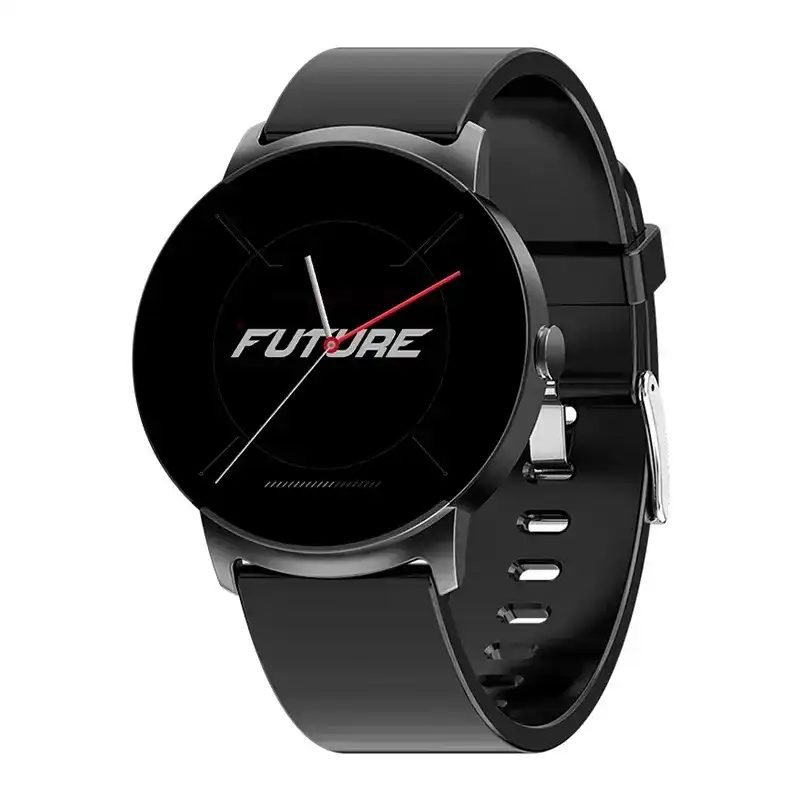
The KS02 is the shape a standard-tier gift takes: compact enough to suit most wrists, light enough to wear all day, and water-resistant enough to survive daily use. The sheet states 15 days of standby, not days of use — get that figure in writing before you quote it to your team. Still choosing the model? Our smartwatch sourcing guide walks through selection first. At HnThai, a sourcing partner based in Huaqiangbei, Shenzhen, we run corporate gift orders with logo printing and gift packaging for wholesale buyers — and we will tell you honestly when a premium tier is not worth the money for your list. Browse our products, or contact us with your recipient count, occasions, and target budget, and we will price the landed cost, not just the unit price.
FAQ
How much should a small business spend per employee gift?
Most small businesses land at $25–$75 per employee for a routine gift such as a holiday or appreciation gift, and $75–$200 for a milestone such as a work anniversary or promotion. Across a full year, $100–$350 per employee covers all occasions. Platform data backs the low end: employers’ 2025 holiday gifts sent through Tremendous averaged $62 with a $25 median. Set the number by recipient group and occasion, budget the landed cost rather than the unit price, and hold back a reserve for names added late.
Is there a tax limit on corporate gifts?
It depends where you operate. In the United States, IRS Publication 463 caps the business-gift deduction at $25 per recipient per tax year, and gift cards given to employees count as taxable wages rather than gifts. In the United Kingdom, trivial benefits must stay at or under £50 to keep their tax treatment. Other countries have their own caps, and many companies add their own gift policy on top. Check the current rules with your accountant and the recipient’s policy before you set the budget.
When should we order corporate tech gifts for the year-end holidays?
Order early, and confirm the schedule in writing. Custom logo printing and gift packaging add production days to the order, and a year-end order placed in December pays for rush production or air freight, or arrives in January. Send your artwork for approval first, get the production and shipping dates confirmed before you pay, and build in a week of slack for reprints. If your supplier cannot confirm a date in writing, treat the order as unconfirmed and keep a backup gift ready. Our guide to choosing tech gifts for year-end campaigns walks through the timing in detail.