A pre-shipment inspection checks a random sample of finished, packed goods against your specification before you release the balance. A good report covers nine areas — quantity, packaging, construction, labelling, accessories, measurements, function, your own extra requirements, and workmanship — and judges the lot pass or fail against AQL limits you agreed in advance.
The nine things a report should cover
Most buyers read only the pass/fail line — which means nothing without the nine sections behind it.
Quantity comes first: units produced versus ordered, cartons packed versus available, and how many cartons the inspector opened. A lot that is 90% packed is not a finished lot.
Packaging covers the retail box, the shipping carton, the shipping marks, and the barcode — artwork matching the approved version, contents matching the packing list, carton strong enough for its weight.
Style and construction compare the product against the approved sample and the technical pack: same materials, same finish, same build. Logo and labelling check that the logo prints correctly, the barcode scans, and the compliance labels are present. Accessories check that every box holds the full kit — charger, cable, manual in the right language, warranty card. Measurement data records key dimensions against the specification, measured across the sample.
Function and performance put each sampled unit through its core jobs: it powers on, the buttons and ports work, the screen behaves, the connection pairs, the battery charges. Your own extra requirements sit in their own section, and workmanship logs the visual defects, graded critical, major, or minor, with a photo for each one.
AQL: how many units get checked
AQL stands for Acceptance Quality Limit. The inspector draws a random sample sized by the lot and accepts or rejects the whole lot on the defects found. The tables come from ISO 2859-1; the standard setting for consumer electronics is General Inspection Level II — 0 for critical defects, 2.5 for major, 4.0 for minor.
| Lot size (units) | Sample size | Major defects (AQL 2.5) | Minor defects (AQL 4.0) |
|---|---|---|---|
| 281–500 | 50 | Accept 3 / Reject 4 | Accept 5 / Reject 6 |
| 501–1,200 | 80 | Accept 5 / Reject 6 | Accept 7 / Reject 8 |
| 1,201–3,200 | 125 | Accept 7 / Reject 8 | Accept 10 / Reject 11 |
| 3,201–10,000 | 200 | Accept 10 / Reject 11 | Accept 14 / Reject 15 |
Read the table this way: on a 1,000-unit order, the inspector pulls 80 units at random. Find 6 major defects in those 80 and the lot fails; find 5 and it passes — barely. Critical defects are different: the accept number is zero. One swollen battery, one exposed live part, or one missing safety mark in the sample fails the lot whatever the sample size.
Both choices belong in your purchase order before production starts: the inspection level sets the sample size — Level I smaller and cheaper, Level III larger and more sensitive. The AQL per defect class sets the tolerance; a product worn on the skin all day, like a smartwatch, is a fair case for tightening the major limit from 2.5 to 1.5. Agree the defect list too: write down what counts as critical, major, and minor for your product, so the factory cannot argue about a scratch after the report lands.
Function testing is where electronics inspections earn their fee
A visual check catches scratches and wrong colours. It does not catch the defects that drive returns on electronics, because the worst of them stay invisible until the customer switches the product on. That is why every sampled unit should go through function testing — not just a handful.
The procedure powers each sampled unit on and runs its core functions against a test sheet: all buttons and ports respond, the screen and indicators behave, Bluetooth pairs and holds a connection, the battery charges, and there is no abnormal noise, smell, or heat. For safety-critical products, function testing often runs on 100% of units.
Safety checks sit beside the function tests: plug type and voltage matching the destination market — a US plug on a Europe-bound order is an instant fail — cables and strain relief intact, and the required safety markings present and matching the certified model. One limit: the inspection verifies that marks such as CE, UKCA, or FCC are present and look right. It does not re-certify the product.
What an inspection cannot do
An inspection is a sample check at one point in time. It does not test every unit, so a defect that hits 1% of production can slip through an 80-unit sample. It does not catch firmware problems that appear after a week of use, or a battery that fades after three months. It does not verify the lab certificates behind the safety marks.
And it cannot fix a missing specification. If your purchase order says "good quality" and nothing else, the inspector has no standard to judge against. Write the spec sheet first — chip, battery, screen, app, packaging, marks — and attach it to the order.
A real example: the MT300
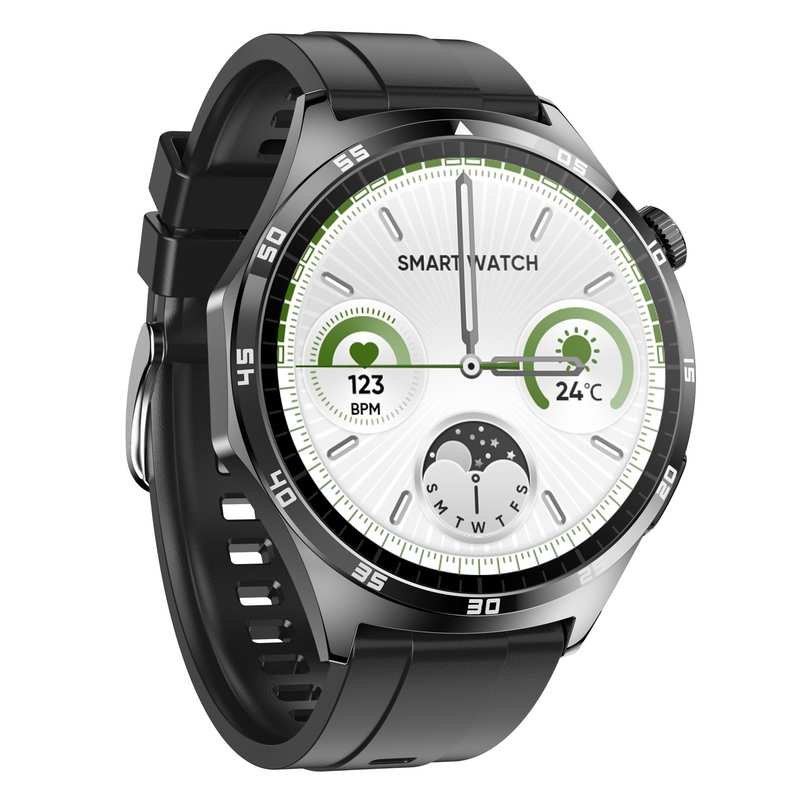
Inspection is easier to picture on a real product. The MT300 smartwatch carries a 1.43-inch AMOLED display at 466×466, a JL7013A chip, Bluetooth LE 5.0, a 440mAh battery, 2-pin magnetic charging, IP67 water resistance, and the H Band app, in a 48×12 mm case at 63.5 g.
On a 1,000-unit MT300 order, the inspector would pull 80 units at random. Each one gets powered on, paired over Bluetooth, charged on the magnetic cable, and checked for screen defects at full brightness. The IP67 rating is checked as a printed mark plus a look at the seals; the lab certificate is requested separately. Any single critical defect — a battery that swells during charging, a live contact exposed at the charging pins — fails the lot.
See our Smartwatch Sourcing Guide, supplier verification guide, MOQ guide, and shipping guide. Browse our products page and smartwatches page.
Frequently Asked Questions
How much does a pre-shipment inspection cost?
A one-day inspection of a single product at one factory typically runs $200 to $400. The report usually arrives within 24 hours with 50 to 150 photos. Against a $10,000 order, that is 2% to 4% of the order value — cheap next to a container of unsellable goods.
Who should I hire — the factory's inspector or a third party?
A third party, always. An inspector paid by the factory reports to the factory. Hire an independent firm — SGS, TÜV, Bureau Veritas, or a smaller specialist — and hand them your spec sheet and defect list. Tell the factory the inspection is booked and the balance depends on the result.
What happens if the lot fails?
The report states the failure and lists every defect with photos. The factory reworks or replaces the failed units, and you book a re-inspection of the fixed lot — agree in the purchase order who pays for it and how many days the factory has. Do not accept a promise to fix the goods after shipment: once the balance is wired and the container is on the water, your leverage is gone.