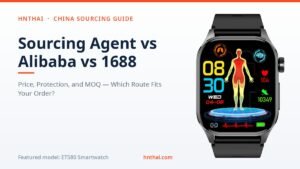
There is no single best smartwatch screen size: a 1.43-inch screen suits small wrists, while a 2.04-inch screen suits buyers who read messages and maps on the wrist. The ET580 pairs a 2.04-inch AMOLED display (368×448) with a 380mAh battery, 3–5 days of use and IP68 — the large-screen end of the range.
How screen size is measured, and what the number hides
Screen size is the diagonal of the display in inches, like phone and monitor screens. The number alone hides two things. The first is case size: compare the diagonal against the case measurement and the width of the forearm — a screen that looks compact on a broad wrist can feel large on a narrow one. The second is resolution: a 1.43-inch screen at 466×466 packs about 461 pixels per inch, while a 2.04-inch screen at 368×448 packs about 284 — the smaller screen is sharper on paper. When a supplier quotes a screen size, ask for the diagonal, the resolution, and the case size together. For wholesale buyers sourcing from China, those three numbers are the whole screen question.
The three sizes, compared on real models
| Model | Screen | Resolution | Battery | Waterproof | Best for |
|---|---|---|---|---|---|
| MT300 | 1.43-inch AMOLED | 466×466 | 440mAh | IP67 | Small wrists, all-day wear |
| D8 | 2.01-inch TFT | 240×296 | 240mAh bin, 28mAh earbuds | No rating stated | Budget bundles, 2-in-1 buyers |
| ET580 | 2.04-inch AMOLED | 368×448 | 380mAh, 3–5 days use | IP68 | Reading, maps, big text |
Three readings. First, the MT300 is the sharpest at about 461 pixels per inch, with the biggest battery at 440mAh — small does not mean weak. Second, the D8 is the only TFT screen here, far lower at 240×296 than either AMOLED panel — and it is a 2-in-1 watch with earbuds, so its 240mAh cell is a charging bin for the buds too. Third, the ET580 trades sharpness for space: at about 284 pixels per inch it is the least dense screen, but its 2.04-inch panel shows far more text per glance, and still runs 3–5 days on 380mAh. Size classes from the WikiSmartwatch guide: under 1.4 inches is compact, 1.4 to 1.8 standard, 1.8 and above large. Neither spec sheet states nits, so confirm brightness in writing before you quote outdoor use.
Matching the size to the wrist and the use
Start with the wrist, not the screen. Smaller wrists — under 6 inches around — often feel overwhelmed above the standard range, and a screen above 1.8 inches on a narrow wrist can overhang the case and catch on sleeves. A screen under 1.4 inches on a broad wrist can look small and need more precise taps. For casual checking — time, calls, step counts — a standard 1.4-to-1.8-inch screen balances readability and comfort. For small wrists or a minimal look, a compact screen under 1.4 inches stays light and discreet. For navigation, maps, and heavy text reading, a large screen of 1.8 inches or more earns its bulk: messages read at a glance instead of a squint. The MT300 weighs 63.5g in a 48×12mm body; ask the weight and case size of every model you compare.
Size, battery, and brightness: the trade-offs
A bigger screen lights more glass, so it uses more power — but the battery behind it decides. The ET580 runs 3–5 days of use on 380mAh despite its 2.04-inch panel, with 20+ days of standby, recharging in about 3–4 hours. The MT300 carries a larger 440mAh cell behind its smaller screen, but its spec sheet does not state days of use — get that figure in writing, because brightness moves the number more than the cell does. A large screen at full brightness outdoors drains far faster than indoors, and a dim always-on face costs far less than a bright one. Screen size and burn-in belong in the same conversation — a big, bright, fixed face ages faster than a small, dim, shifting one (see our AMOLED burn-in guide). Compare models on battery in mAh, rated days of use, and brightness together.
What to order for each channel
E-commerce sellers should stock the range: a compact 1.43-inch model for small-wrist and gift buyers, and a large 2.04-inch model for buyers who read on the wrist. Phone accessory shops sell on the counter, where a large screen wins: the customer reads the time and a message at arm’s length before buying, so put the ET580 class on display. Corporate gift buyers want the safe middle — the 1.43-inch size fits the most wrists. Outdoor channels should pair the large screen with the tougher rating: the ET580 is rated IP68, the MT300 IP67 — but confirm the rating per model. Wear a sample of each size for a day before you commit. Our smartwatch sourcing guide has the full sample checklist.
Featured model: the ET580
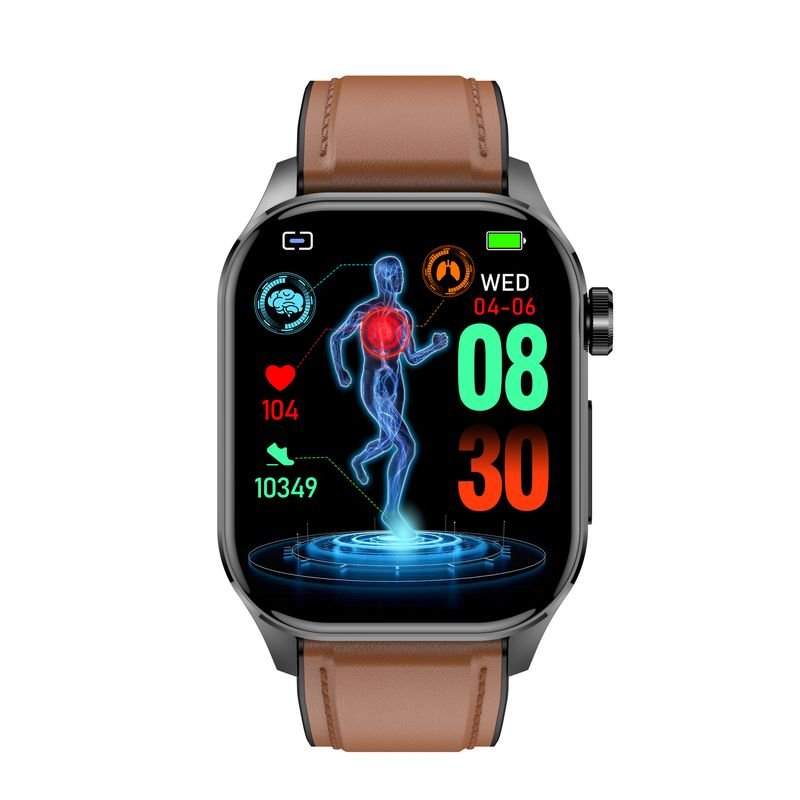
The ET580 smartwatch shows the large-screen end of the range: a 2.04-inch AMOLED display (368×448), Bluetooth 5.2 calling, a 380mAh battery with magnetic charging in about 3–4 hours, 3–5 days of use and 20+ days of standby, and IP68 waterproofing, in an alloy and stainless steel case running the H Band app. It ships in six colours — black, blue, and red silicone, black with a butterfly buckle, brown and black leather. Every number there comes from the spec sheet. Brightness in nits is missing — get it in writing before you quote outdoor use. See our smartwatches page.
Frequently Asked Questions
What smartwatch screen size is best for small wrists?
A compact screen under 1.4 inches is the usual pick for small wrists — the 1.43-inch MT300 is the smallest screen in our comparison, in a 48×12mm body at 63.5g. Measure the wrist first: wrists under 6 inches around often feel overwhelmed above the standard range, and a screen above 1.8 inches can overhang the case and catch on sleeves. A compact screen also stays light during sleep — but check resolution too: a small, low-resolution screen is harder to read than a dense one.
Does a bigger smartwatch screen drain the battery faster?
It can, but the battery matters more than the diagonal. A bigger screen lights more glass, so at the same brightness it uses more power — yet the ET580 runs 3–5 days on 380mAh behind a 2.04-inch screen, with 20+ days of standby. Brightness moves the number more than size does: a large screen at full brightness outdoors drains far faster than indoors. Ask for battery in mAh, rated days of use, and brightness together, and test the sample at the brightness your customers use.
Is a 2-inch smartwatch screen too big for everyday wear?
It depends on the wrist and the use. A 2.04-inch screen suits buyers who read messages, maps, and workout summaries on the wrist, and it is the size class — 1.8 inches and above — that guidebooks call large. On a broad wrist it reads as a normal watch; on a narrow wrist it can feel bulky, catch on sleeves, and disturb sleep. The honest test is a full day of wear: order a sample of each size, wear each for a day, and stock the size your own wrist forgets.