A smart ring rated 5ATM can go swimming. A ring rated 1ATM cannot. An IP68 ring can survive a dip, but the test behind the code says nothing about soap, salt water, or a hot shower. Read the rating as a lab result, not a promise.
What 1ATM, 5ATM, and IP68 actually test
Two rating systems cover nearly every smart ring, and they measure different things. Mixing them up is how a buyer ends up with a dead ring.
ATM comes from the watch standard ISO 22810 and measures static pressure. One ATM equals the pressure about 10 metres under still water, so 5ATM means the ring passed a test at the pressure of 50 metres of still water. The test holds the ring under steady pressure in a lab tank. It says nothing about a freestyle stroke, a shower jet, or a hot tub — all push water harder than still water.
IP comes from the electronics standard IEC 60529. The first digit grades dust: 6 means fully dust-tight. The second grades water: 7 means 30 minutes under 1 metre, and 8 means continuous immersion deeper than 1 metre, under conditions the maker states. One maker’s IP68 may be tested at 1.5 metres and another’s at 100 metres. Ask for the depth and the time.
What each rating covers in daily use
| Rating | Lab test | Safe for | Keep out of |
|---|---|---|---|
| 1ATM | Splash and brief immersion | Hand washing, rain, sweat | Swimming, showering |
| 5ATM | Static pressure equal to 50 metres of still water | Swimming, showering | Diving, high-pressure jets, hot tubs |
| IP68 | Immersion beyond 1 metre (maker states depth) | Hand washing, rain, shallow swimming | Diving, hot tubs, high-pressure water |
Write your listing around what the buyer can do, not the code. "Swim and shower safe, not for diving" is clearer than "5ATM" on its own. Water resistance is not damage cover, and most warranties do not cover water damage at all.
Four things that wear the seal down
1. Soap and shampoo. Plain water beads on a seal; soapy water does not. Surfactants in body wash and shampoo lower the surface tension of water, letting it slip past seals that would hold against plain water. A ring worn in every shower meets soap daily. Tell buyers to rinse in fresh water after showering and dry it before charging.
2. Heat. Hot tubs, steam rooms, and very hot showers work against seals two ways: heat softens the seal, and steam finds gaps that liquid water cannot. Most 5ATM and IP68 ratings are tested in cool fresh water, not a 40-degree hot tub. Keep the ring out of hot tubs and saunas.
3. Salt and chlorine. Sea and pool water leave salt and chemicals on the ring, and both attack the seals over time. Rinse in fresh tap water after every pool or sea swim — it takes five seconds and adds years to the seal.
4. Knocks and age. A ring lives on a hand, and hands hit things. A hard knock can shift a seal just enough to let water in on the next swim, and age alone wears seals down. Ceramic adds its own limit: it shrugs off scratches but chips on a hard drop — see our smart ring materials guide.
The charging dock is not waterproof. Never place a wet ring on it. Dry the ring and the contacts first, or the next charge is the one that fails — and the buyer will blame the battery, not the water. Test the charger and the app in the same sample week — see our smart ring app and data sync guide.
Ratings across our ring line
| Model | Rating | Battery | Sizes | Best for |
|---|---|---|---|---|
| R20 | IP68 | 15mAh, 3–5 days use, 7–10 days standby | 8–14 | Gift and fashion buyers |
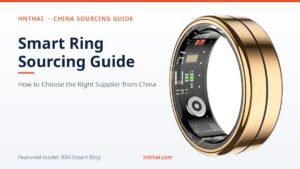
| R04 | 5ATM | 15mAh (18mAh size 9+), 5–7 days | 7–13 | Everyday sellers, the default for swimmers |
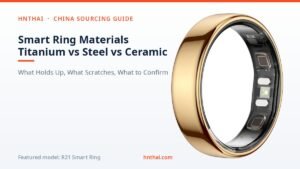
| R21 | 5ATM | 16mAh, 5–7 days | 6–13 | Everyday sellers, lightest steel ring |
| R22 | 5ATM | 16mAh / 13mAh, 5–7 days | 6–13 | Buyers who want a slim ring |
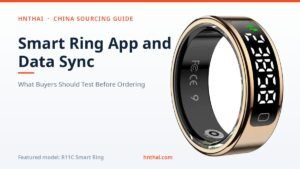
| R11C | 1ATM | 15mAh (18mAh size 11+), 5–7 days | 7–13 | Buyers who want the display and never swim |
One model at 1ATM for the buyer who wants the touch display and takes it off, three at 5ATM for the buyer who swims, and one IP68 ceramic ring for the buyer who wants the look and the water cover together. Pick the rating for the buyer’s water — and if a buyer asks for diving, sell them a different product.
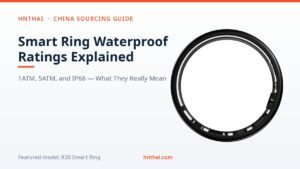
Featured model: the R20
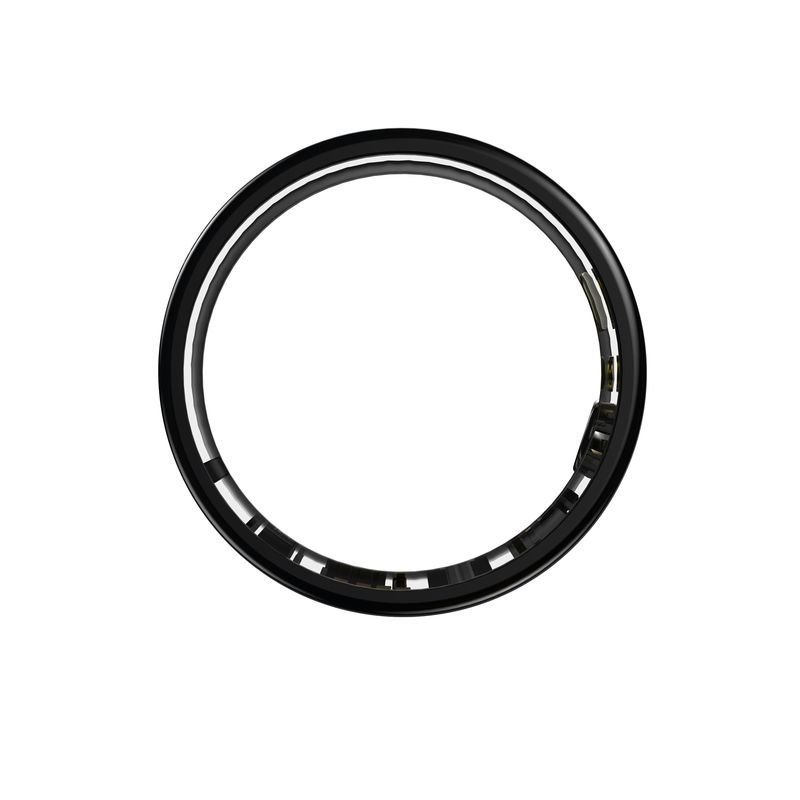
The R20 is the IP68 ring in our line — the one to quote when a buyer asks for a ceramic ring that handles water. It is a black ceramic ring weighing 3.6 to 4.5 g across sizes 8 to 14, rated IP68, running 3 to 5 days of use with 7 to 10 days of standby. Inside is an AC6323 chip with a Goodix GH3018 heart-rate sensor, paired through the Smart Health app.
Print the limits with the rating. Ceramic chips on a hard drop onto tile, and a chipped ring cannot be resized, so a wrong size is a return — order a size kit with your samples. The IP68 code alone does not state the test depth, so ask us for the test conditions in writing. See the full listing on our R20 ceramic smart ring page. See the full range on our smart ring page or start from our Smart Ring Sourcing Guide.
Frequently Asked Questions
Can I shower with a 5ATM smart ring?
Yes — a 5ATM ring passed a static pressure test equal to 50 metres of still water, and a shower is well inside that. The risk is not the water but the soap: shampoo and body wash lower water surface tension and let water past seals that would hold against plain water. Rinse in fresh water after showering, dry it before charging, and keep it out of hot tubs and saunas. A 1ATM ring should not be showered with at all — hand washing and rain only.
What is the difference between 5ATM and IP68?
Two different tests. 5ATM comes from the watch standard ISO 22810 and means the ring passed a static pressure test equal to 50 metres of still water. IP68 comes from IEC 60529: 6 means fully dust-tight, and 8 means continuous immersion deeper than 1 metre, under conditions the maker states. A ring can carry one rating without the other — the R20 is rated IP68, while the R04, R21, and R22 are rated 5ATM. Neither rating covers diving, high-pressure jets, or hot tubs.
Does an IP68 rating mean my ring is safe in the sea?
For a swim, yes — with one habit attached. Salt water and chlorine wear seals faster than plain water, so rinse in fresh tap water after every sea or pool swim and dry it before charging. The charging dock is not waterproof, so never place a wet ring on it. Check the maker’s stated test depth first: IP68 only means immersion beyond 1 metre. If your buyer dives, sell them a different product — no smart ring rating covers diving.